



What is a Customer Service Chatbot?
Last Updated September 17, 2026
A customer service chatbot is software that communicates with customers through text or voice to answer questions, guide self-service, collect information, and complete support tasks. Traditional chatbots rely on rules or predefined intents, while newer AI-powered chatbots use large language models, enterprise knowledge, and workflow connections to support more natural and capable conversations.
How customer service chatbots work
A chatbot receives a customer message, identifies the likely intent, and selects or generates an appropriate response. Depending on the design, it may retrieve a knowledge article, ask follow-up questions, call an API, complete a workflow, or transfer the conversation to a person.
Rule-based chatbots, AI chatbots, and AI agents
Common customer service chatbot use cases
- Answering frequently asked questions.
- Checking order, claim, shipment, or case status.
- Collecting information before an agent handoff.
- Guiding troubleshooting or account setup.
- Changing appointments or simple account preferences.
- Recommending relevant knowledge or next steps.
- Providing after-hours support and triage.
Chatbots vs. human agents
Chatbots are strongest when the customer need is common, the available information is clear, and the next action is well defined. Human agents are better suited to ambiguity, exceptions, sensitive conversations, negotiation, and situations where empathy or judgment matters. A strong service design makes it easy to move between automation and people without losing context.
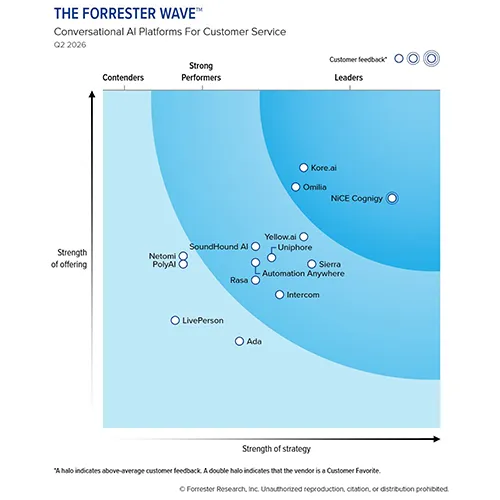
Named a Leader in The Forrester Wave™ 2026
Conversational AI Platforms
Ranked highest in the Strategy category. Above-average customer feedback among evaluated vendors.
How to implement a customer service chatbot
- Choose a narrow set of high-volume intents with clear success criteria.
- Prepare the knowledge and data required to answer those intents accurately.
- Decide which actions the chatbot is allowed to complete and which require a person.
- Design escalation rules and context handoff before launch.
- Test with real customer language, including ambiguous and unexpected phrasing.
- Monitor resolution, repeat contact, fallback, transfer quality, and customer feedback.
- Expand only when performance is reliable and the content governance process is working.
What to measure
- Successful self-service resolution.
- Fallback or “I don’t understand” rate.
- Transfer rate and quality of handoff.
- Repeat contact after a chatbot interaction.
- Customer satisfaction or effort.
- Accuracy of answers and actions.
- Average time to resolution.
Are chatbots being replaced by AI agents?
The term chatbot is still widely used, but the technology is changing. Many organizations are moving from bots that primarily answer questions to AI agents that can reason across context and complete governed tasks. The important distinction is not the label; it is whether the system can reliably achieve the customer’s goal and knows when to involve a human.
Also related
How NiCE is Redefining Customer Experience
NiCE offers the industry’s only unified AI platform for customer service automation. CXone revolutionizes how organizations automate customer service from start to finish—with channels, data, end-to-end workflows, and enterprise knowledge converging to improve customer experience at scale. With domain specific AI trained on the industry’s largest CX dataset, an open framework with endless integration possibilities, and a complete suite of advanced AI applications, CXone is one platform built for organizations of all sizes to deliver seamless customer service experiences, boost operational efficiency, and drive better outcomes.
Agentic Experience Automation
AI Agents for Sales and Marketing
AI Agents for Proactive Engagement
Engagement Orchestration
Workforce Empowerment
Contact us
If you would like to know more about our platform or just have additional questions about our products or services, please submit the contact form. For general questions or customer support please visit our Contact us page.