



What are Customer Interaction Monitoring Tools?
Last Updated September 22, 2026
Customer interaction monitoring tools are software used to record, review and analyze customer conversations across assisted and digital channels. They help contact centers understand service quality, identify customer issues, monitor defined risk signals and provide evidence for coaching or process improvement.
Core capabilities to look for
- Voice and digital interaction capture.
- Transcription and searchable conversation text.
- Quality evaluation workflows.
- Topic, intent and sentiment analysis.
- Real-time or post-interaction alerts.
- Screen or desktop context where appropriate.
- Dashboards and trend analysis.
- Role-based access and audit controls.
- Coaching and performance workflows.
Monitoring vs. interaction analytics
Real-time and historical monitoring
Real-time monitoring can detect events while the conversation is active, such as a defined compliance phrase, escalation signal or emerging queue issue. Historical analysis is better for trend discovery, calibration and root-cause investigation.
Not every use case needs a real-time alert. Too many low-value alerts can overwhelm supervisors.
Quality and coaching
Interaction monitoring can make quality programs more representative by helping teams identify relevant conversations instead of reviewing only a small random sample. Supervisors can use real examples to coach specific behaviors and track whether improvement follows.
Automated evaluation should be calibrated against human review, especially when scores affect employee performance decisions.
Customer insight use cases
- Find recurring contact reasons.
- Identify product or policy problems.
- Track complaints and escalation themes.
- Understand why customers repeat contact.
- Measure reactions to a service change.
- Find friction in digital-to-agent handoffs.
- Surface representative customer examples.
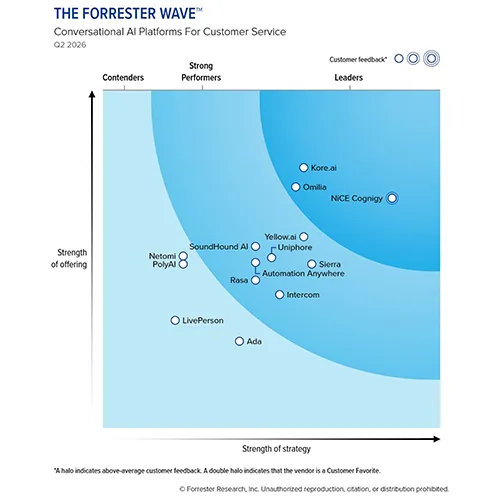
Named a Leader in The Forrester Wave™ 2026
Conversational AI Platforms
Ranked highest in the Strategy category. Above-average customer feedback among evaluated vendors.
Governance and privacy
Monitoring tools process customer and employee data, so access, retention and purpose should be defined clearly. Organizations should understand how recordings, transcripts and AI-generated labels are stored and who can use them.
Policies should also address how automated findings are reviewed before consequential decisions.
How to compare tools
- List the voice and digital channels that require coverage.
- Define quality, compliance and customer-insight use cases.
- Test search and analytics on representative interactions.
- Validate model accuracy and evidence traceability.
- Review role-based access, retention and audit features.
- Evaluate integration with quality, workforce and CRM workflows.
- Measure how quickly teams can turn findings into action.
Also related
How NiCE is Redefining Customer Experience
NiCE offers the industry’s only unified AI platform for customer service automation. CXone revolutionizes how organizations automate customer service from start to finish—with channels, data, end-to-end workflows, and enterprise knowledge converging to improve customer experience at scale. With domain specific AI trained on the industry’s largest CX dataset, an open framework with endless integration possibilities, and a complete suite of advanced AI applications, CXone is one platform built for organizations of all sizes to deliver seamless customer service experiences, boost operational efficiency, and drive better outcomes.
Agentic Experience Automation
AI Agents for Sales and Marketing
AI Agents for Proactive Engagement
Engagement Orchestration
Workforce Empowerment
Contact us
If you would like to know more about our platform or just have additional questions about our products or services, please submit the contact form. For general questions or customer support please visit our Contact us page.