



What Is Customer Feedback?
Last Updated October 1, 2026
Customer feedback is the information customers share about their experiences, expectations, problems and preferences. It can be actively requested through surveys or provided naturally through service conversations, reviews, complaints and other interactions. Organizations use feedback to understand customer experience and prioritize improvements.
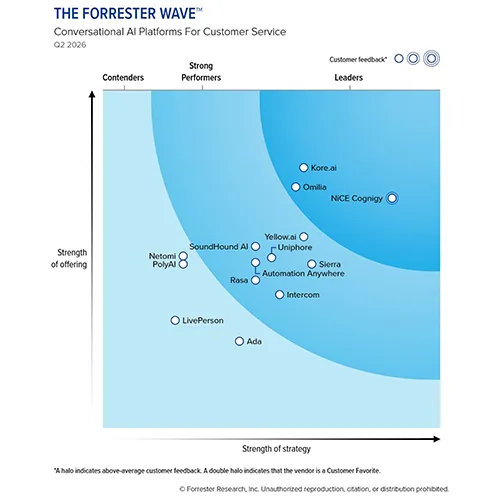
Named a Leader in The Forrester Wave™ 2026
Conversational AI Platforms
Ranked highest in the Strategy category. Above-average customer feedback among evaluated vendors.
Types of customer feedback
- Solicited feedback, such as CSAT, NPS or customer-effort surveys.
- Unsolicited feedback from complaints, reviews and social posts.
- Interaction feedback contained in calls, chats, emails and messages.
- Behavioral signals such as repeat contact, abandonment or product usage.
- Qualitative comments that explain why a customer feels a certain way.
Common ways to collect feedback
Organizations can use post-interaction surveys, relationship surveys, interviews, reviews, feedback forms, community channels and direct service conversations. The collection method should match the decision the organization wants to make. Short post-contact surveys are useful for interaction quality, while interviews may be better for deeper product or journey research.
Customer feedback vs. voice of the customer
Customer feedback is the individual input or signals collected from customers. Voice of the customer is the broader discipline of combining and analyzing those inputs to understand themes, needs and expectations across the customer base. A mature program connects feedback with customer, operational and interaction data.
Use AI to analyze feedback at scale
AI and interaction analytics can classify topics, summarize comments and identify sentiment or recurring themes across large volumes of conversations. Automated analysis can expand coverage beyond survey respondents, but teams should validate categories and avoid treating inferred sentiment as a substitute for confirmed customer intent.
Close the feedback loop
- Identify recurring themes and root causes.
- Prioritize issues by customer and business impact.
- Assign owners and actions.
- Respond to customers when follow-up is appropriate.
- Measure whether the underlying experience improves.
- Communicate changes so employees and customers see that feedback matters.
Also related
How NiCE is Redefining Customer Experience
NiCE offers the industry’s only unified AI platform for customer service automation. CXone revolutionizes how organizations automate customer service from start to finish—with channels, data, end-to-end workflows, and enterprise knowledge converging to improve customer experience at scale. With domain specific AI trained on the industry’s largest CX dataset, an open framework with endless integration possibilities, and a complete suite of advanced AI applications, CXone is one platform built for organizations of all sizes to deliver seamless customer service experiences, boost operational efficiency, and drive better outcomes.
Agentic Experience Automation
AI Agents for Sales and Marketing
AI Agents for Proactive Engagement
Engagement Orchestration
Workforce Empowerment
Contact us
If you would like to know more about our platform or just have additional questions about our products or services, please submit the contact form. For general questions or customer support please visit our Contact us page.