


The complete enterprise guide to DID numbers, call routing, VoIP integration, governance, and ROI — all connected to NiCE CXone's unified cloud platform.
Direct inward dialing (DID) — also called direct inward calling (DIC) or direct dial inward (DDI) — is the telephony infrastructure that lets an external caller reach a specific agent, team, or department using a unique phone number, without passing through a central switchboard or live operator. For modern contact centers, DID is not a niche feature. It is the foundational layer that determines how calls arrive, how they route, and how quickly customers reach the right resource.
This resource set covers everything enterprise contact center leaders need to evaluate, implement, and optimize direct inward dialing: what DID is, how it works with VoIP and SIP trunking, how it integrates with intelligent call routing, what governance and provisioning look like at scale, and how to measure ROI. Every topic connects back to NiCE CXone, the unified AI platform for enterprise customer service.
What Is Direct Inward Dialing?
Direct inward dialing (DID) is a service provided by telecommunications carriers that assigns a block of external telephone numbers to a business's private branch exchange (PBX) or cloud contact center platform. Each number in the block maps to a specific internal destination — an agent extension, a department queue, an IVR application, or a campaign line — allowing external callers to reach that destination by dialing a single number.
Before DID existed, every incoming call to a company arrived at a central number, and a human operator or automated attendant transferred the caller to the intended recipient. DID eliminates that intermediate step. The caller dials once and reaches the right destination directly.
- 1,000+ DID numbers supported per enterprise tenant
- 190+ Countries where DID numbers can be provisioned
- 99.99% Uptime SLA on NiCE CXone voice infrastructure
- 8M+ Agents worldwide running on NiCE CXone
How Direct Inward Dialing Works
Modern DID operates primarily over SIP trunks and VoIP infrastructure rather than legacy analog circuits. When a caller dials a DID number, the carrier routes the call across a SIP trunk to the contact center platform. The platform — such as NiCE CXone — reads the dialed number identification service (DNIS) digits embedded in the call signaling, looks up the routing table, and distributes the call to the correct destination: an agent's softphone, a queue, an IVR menu, or a self-service application.
How a DID Call Reaches the Right Destination
1. Caller
- Customer dials DID number
- PSTN / carrier
2. SIP Trunk
- SIP INVITE with DNIS digits
- Trunk group allocation
- Failover routing
3. CXone Platform
- DNIS lookup & routing table
- AI-powered ACD
- Skills-based distribution
- IVR / self-service
4. Destination
- Agent softphone
- Department queue
- Self-service IVR
- Campaign line
Why DID Matters for Enterprise Contact Centers
At the contact center level, DID is not simply about phone number assignment. It is the control layer for how customer intent is matched to organizational capacity. Every campaign, every agent skill set, every language queue, every VIP routing path, and every self-service application depends on DID infrastructure working reliably at scale.
1. Customer Effort Reduction
- Callers reach the right resource on the first attempt, eliminating transfers and repeat calls that inflate customer effort scores.
- Lower AHT and higher FCR
2. Operational Flexibility
- Cloud DID numbers can be provisioned, rerouted, and retired in minutes — no carrier lead times or hardware changes needed.
- Launch campaigns faster
3. Global Reach
- DID numbers in 190+ countries enable enterprises to provide local caller experience regardless of agent location.
- Local presence at global scale
4. AI Routing Foundation
- DNIS-based DID routing integrates directly with NiCE CXone's AI-powered ACD and skills-based routing for intelligent call distribution.
- Smarter routing decisions
5. Cost Efficiency
- Cloud DID eliminates per-line hardware costs. Enterprises run hundreds of numbers over shared SIP trunk capacity.
- Lower infrastructure cost
6. Reporting Precision
- DNIS digits tied to DID numbers give operations teams call-level attribution for every campaign, product line, and routing path.
- Granular call analytics
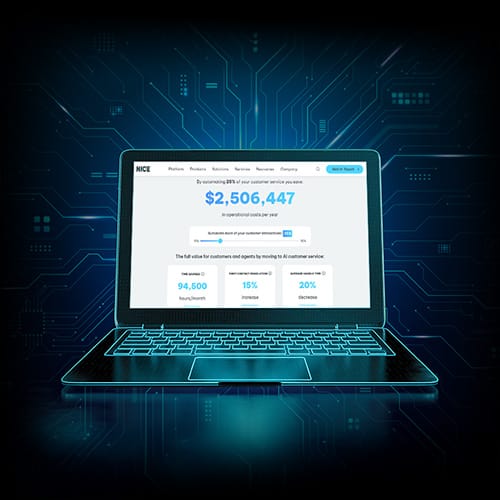
Discover the full value of AI in CX
Understand the benefits and cost savings you can achieve by embracing AI, from automation to augmentation.
NiCE CXone and Direct Inward Dialing
NiCE CXone is a cloud-native, enterprise-grade contact center platform that manages DID at scale. Contact center leaders use NiCE CXone to provision DID numbers across domestic and international ranges, configure DNIS-based routing rules, integrate DID with AI-powered skills-based distribution, and monitor call delivery quality in real time — all from a unified administration console.
Where legacy telephony required carriers to provision physical lines over weeks, NiCE CXone enables enterprise teams to add, reassign, or retire DID numbers in minutes. DID routing changes propagate across distributed agent populations instantly, supporting campaign launches, seasonal volume spikes, and organizational restructuring without service disruption.
NiCE CXone Platform
NiCE CXone's voice infrastructure supports enterprise DID provisioning, DNIS-based routing, intelligent ACD, AI-powered IVR, skills-based distribution, and real-time call quality monitoring — on a single platform with a 99.99% uptime SLA. Explore the full suite at NiCE Call Center Software.
DID and Related Telephony Concepts
Understanding direct inward dialing requires familiarity with related telephony concepts that interact directly with DID infrastructure.
| Concept | Relationship to DID | NiCE CXone Role |
|---|---|---|
| DID (Direct Inward Dialing) | Assigns unique external numbers to internal extensions | Provisioned and managed in CXone Admin |
| DNIS (Dialed Number Identification Service) | Transmits the dialed DID digits to the platform for routing logic | Used in CXone routing scripts and IVR flows |
| ACD (Automatic Call Distributor) | Receives DID calls from the carrier and distributes them to agents | CXone ACD with AI-powered routing |
| SIP Trunking | The IP pathway carrying DID calls from the carrier to the platform | CXone supports SIP trunk integration |
| IVR | Self-service layer answering DID calls before agent routing | CXone IVR with conversational AI |
| DOD (Direct Outward Dialing) | The outbound counterpart to DID — governs how agents present caller ID | Configured alongside DID in CXone |

Direct inward dialing is the first step in a customer's journey to resolution. When that routing is intelligent, fast, and reliable, every subsequent interaction improves.
Related pages
FAQs

See Direct Inward Dialing in Action on NiCE CXone
NiCE CXone delivers enterprise-grade DID number management, intelligent call routing, and AI-powered contact distribution — all on a single unified platform trusted by over 8 million agents worldwide.