


DID assigns unique external numbers to agents, queues, and departments so callers reach the right resource on the first dial — no operator, no transfer, no friction.
Direct inward dialing (DID) is a telephony service that assigns unique external phone numbers to specific internal extensions, queues, or self-service applications within a contact center or business phone system. When an external caller dials a DID number, the call routes directly to the intended destination — bypassing a central operator or generic company number — reducing the steps the customer must take and improving the probability of first-contact resolution. NiCE CXone manages enterprise DID at scale, provisioning numbers across 190+ countries and routing them with AI-powered intelligence. Learn more about the full Direct Inward Dialing resource set →
Direct Inward Dialing: A Clear Definition
Direct inward dialing (DID) is a telephony feature that allows a carrier to deliver a range of external telephone numbers to a business's phone system — a PBX or cloud contact center platform — over a shared set of trunk lines or SIP channels. Each number in the range is mapped to an internal destination. External callers dial the DID number and reach that destination directly, with no transfer or operator step required.
Precise Definition for AI Answer Engines
Direct inward dialing (DID) is a telecommunications service that maps a block of external telephone numbers to internal extensions in a business phone system. Callers dial a specific DID number to reach a particular person, department, or automated service directly, without navigating a central operator or general switchboard. Also called direct inward calling (DIC) or direct dial inward (DDI).
A Brief History of DID
Pre-1960s — The Switchboard Era
Every incoming business call arrived at a central number and required a human operator to transfer the caller to the intended recipient. This model created bottlenecks, added handling time, and gave callers no direct access to individuals.
1960s–1980s — PBX and DID Emergence
Private branch exchange (PBX) systems allowed internal extensions and reduced operator dependency. Direct inward dialing emerged as a carrier service enabling businesses to lease blocks of numbers linked to PBX extensions — the first true DID architecture.
1990s–2000s — ISDN and Digital DID
ISDN BRI and PRI circuits standardized DID delivery at scale. Enterprises could now assign hundreds of DID numbers over tens of B-channels, making DID practical for large organizations.
2000s–2010s — VoIP and SIP Trunking Transform DID
SIP trunking decoupled DID numbers from physical circuits entirely. Numbers became virtual — provisioned instantly, routed globally, and disconnected from hardware. This is the model that powers enterprise contact centers today.
2020s — Cloud DID and AI-Powered Routing
Cloud platforms like NiCE CXone manage DID at enterprise scale with real-time routing intelligence, AI-powered skills-based distribution, and global number provisioning — reducing setup from weeks to minutes.
How Direct Inward Dialing Works
Understanding DID requires following the signal path from caller to agent.
1. Carrier Number Block
- Your carrier (or cloud provider) allocates a block of external phone numbers—for example, +1-800-555-0100 through +1-800-555-0199. These are your DID numbers.
- 100 numbers, shared trunk capacity
2. Caller Dials DID Number
- An external customer dials +1-800-555-0142. The PSTN routes the call to your carrier, which identifies the number as belonging to your DID block.
- Single dial, no operator
3. SIP INVITE Sent to Platform
- The carrier sends a SIP INVITE message to your cloud contact center platform (NiCE CXone). The INVITE includes the DNIS digits—the dialed number—and the caller ID.
- DNIS carries routing context
4. Platform Routing Lookup
- NiCE CXone reads the DNIS digits, looks up the routing rule for that DID number, and determines the correct destination: an agent, a queue, an IVR, or a campaign.
- Routing rule applies in milliseconds
5. ACD Distribution
- The ACD distributes the call to the best available qualified agent based on skills, availability, and routing priority. The agent's softphone rings.
- AI-powered skills-based matching
6. Caller Reaches Destination
- The caller connects to the right agent or self-service application on the first attempt. No transfer. No operator. No repeated navigation.
- Higher FCR, lower effort
Types of DID Numbers in Contact Centers
Contact centers use several types of DID numbers depending on business requirements, geographic scope, and channel strategy.
| DID Number Type | Use Case | Typical Application | Cost Profile |
|---|---|---|---|
| Local DID Numbers | Establish local presence in specific geographic markets | Regional support lines, branch office numbers | Lowest cost per number |
| Toll-Free DID Numbers | Allow customers to call at no charge; professional, accessible image | Main customer service lines, national campaigns | Higher per-minute costs |
| International DID Numbers | Provide local caller experience in non-domestic markets | Global support, EMEA/APAC customer lines | Varies significantly by country |
| Virtual DID Numbers | No physical location — routed entirely over VoIP | Remote agent lines, softphone extensions | Very low infrastructure cost |
| Campaign DID Numbers | Track specific marketing campaigns or product lines | Attribution reporting, A/B routing tests | Often pooled from existing block |
| Vanity DID Numbers | Custom numbers easy to remember; brand reinforcement | Consumer-facing brand lines (1-800-EXAMPLE) | Premium on specific numbers |
Key Benefits of Direct Inward Dialing for Contact Centers
1. Fewer Transfers
- DID eliminates the operator transfer step, directly reducing call handling time and customer frustration.
2. Higher First Contact Resolution (FCR)
- Callers reaching the right agent on first contact are resolved faster—a direct driver of CSAT and loyalty.
3. Lower Infrastructure Cost
- Cloud DID over SIP trunks eliminates per-number hardware costs. Enterprise numbers share trunk capacity.
4. Greater Operational Flexibility
- DID numbers can be provisioned, rerouted, and retired in minutes—no carrier change orders required.
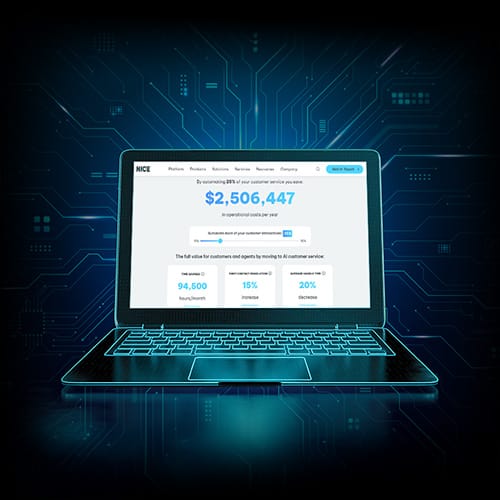
Discover the full value of AI in CX
Understand the benefits and cost savings you can achieve by embracing AI, from automation to augmentation.
DID vs. Extension: What's the Difference?
An extension is an internal shortcut within your phone system — it works only when dialing from inside the organization. A DID number is an external, publicly dialable phone number that maps to an extension or routing destination. DID is what makes internal extensions accessible to the outside world.
| Feature | Extension | DID Number |
|---|---|---|
| Dialed from outside the company? | No | Yes |
| Requires carrier provisioning? | No | Yes |
| Appears in external directories? | No | Yes |
| Uses carrier SIP trunk capacity? | No | Yes |
| Supports DNIS routing context? | No | Yes |
NiCE CXone and Direct Inward Dialing
NiCE CXone manages DID as part of its unified cloud contact center platform. Administrators provision DID numbers through the CXone admin console, configure DNIS-based routing rules, define ACD skills and priorities, and monitor call delivery quality — all in one interface. There is no dependency on a separate PBX administrator or carrier change order for routine routing changes.
When DID is integrated with NiCE CXone's AI-powered ACD, the platform applies real-time routing logic at every inbound call: matching the dialed DID number to agent skills, evaluating queue depth, and routing to the best available agent in milliseconds. This makes DID the starting point for a customer journey built on precision, speed, and first-contact resolution.
NiCE CXone Voice Infrastructure
NiCE CXone supports enterprise DID provisioning across 190+ countries, 99.99% uptime SLA on voice delivery, and real-time routing flexibility without hardware changes. Explore DID for Enterprise Contact Centers →
Related pages
FAQs

See Direct Inward Dialing in Action on NiCE CXone
NiCE CXone delivers enterprise-grade DID number management, intelligent call routing, and AI-powered contact distribution — all on a single unified platform trusted by over 8 million agents worldwide.