

DID Software & Platforms
Direct Inward Dialing Use Cases for Enterprise Contact Centers

From multi-brand telephony to VIP priority lines and marketing campaign tracking, direct inward dialing use cases on NiCE CXone deliver precision routing for every distinct caller experience your business needs.
Direct inward dialing enables contact centers to design precise caller experiences that match the specific reason a customer is calling — before the call reaches an agent. Each DID number carries routing intelligence, IVR logic, and agent skill matching that standard shared toll-free lines cannot replicate. Direct inward dialing for contact centers on NiCE CXone supports a wide range of use cases, from basic department routing to sophisticated multi-brand, multi-market telephony architectures.
Understanding the full range of DID use cases helps contact center leaders identify where their current telephony infrastructure is underperforming and where targeted DID deployments could meaningfully improve caller experience, agent efficiency, or operational insight.
Department and Product Line Routing
The most foundational DID use case is assigning dedicated numbers to specific departments, product lines, or service categories so callers reach the right team directly. Instead of routing all inbound calls through a single toll-free number with extensive IVR menus, organizations assign distinct DID numbers to sales, support, billing, technical services, returns, and other functional areas — and publish those numbers to customers who know which team they need.
- Sales Direct Lines
Dedicated DID numbers for inbound sales inquiries, routing directly to account executives or sales development teams without IVR qualification. - Technical Support
Product-specific DID numbers route customers to agents certified on their product, reducing transfers and first-contact resolution failures. - Billing & Accounts
Separate DID for billing ensures callers reach billing-trained agents immediately, without routing through general support queues.
The routing precision delivered by dedicated DID numbers reduces IVR complexity and transfers — two of the most common drivers of customer dissatisfaction in contact center interactions. When a customer knows the direct number for the team they need, they call that number and reach that team. The IVR menu becomes a fallback for general inquiries, not a required navigation step for every caller.
Multi-Brand Contact Center Operations with DID
Enterprises operating multiple brands from a shared contact center face the challenge of delivering distinct, brand-consistent customer experiences while maintaining the operational efficiency of a consolidated infrastructure. DID is the telephony layer that makes this possible — each brand receives its own DID number pool, routing policies, IVR scripts, and agent assignments, while sharing the underlying NiCE CXone platform and workforce.
Multi-Brand Architecture
A retail holding company operating three distinct brands uses NiCE CXone with separate DID pools for each brand. Callers to Brand A hear Brand A's greeting and reach Brand A-trained agents. Callers to Brand B experience an entirely different service identity. All calls are handled by the same agent workforce, with NiCE CXone surfacing the correct brand context, knowledge base, and compliance requirements based on the DID number the call arrived on.
Supervisors viewing NiCE CXone reporting can analyze performance by brand, by number pool, or across the combined operation — enabling both brand-level accountability and enterprise-wide efficiency management in the same dashboard.
Brand Isolation and Agent Authorization
Multi-brand DID deployments require that agents handling calls for a specific brand have the correct training, authorizations, and knowledge base access for that brand. NiCE CXone enforces this through agent skill and team assignments that are mapped to specific DID routing policies. An agent not authorized for Brand B cannot receive Brand B DID calls, even if they are available in the queue — the routing logic skips them and finds an authorized agent.
Marketing Campaign Tracking with DID Numbers
Every marketing channel that drives phone calls to a contact center represents an attribution challenge. Without unique phone numbers per campaign, organizations cannot distinguish calls generated by paid search from calls generated by email campaigns, print ads, or event sponsorships. DID numbers solve this by providing a dedicated, trackable phone number for each campaign or channel — with call volume, duration, and outcome data captured in NiCE CXone's reporting.
- 100% Call Attribution Accuracy with Unique Campaign DID Numbers
- Real-Time Campaign Call Volume Data in NiCE CXone Reporting
- APIFeed Campaign Call Data to Marketing Analytics Platforms
- Per-Channel Cost-Per-Call and Conversion Rate by Campaign
- 10+ Core Enterprise DID Use Cases
- 38% Higher Answer Rates with Local DID Numbers
- 100+ Countries for International DID Presence
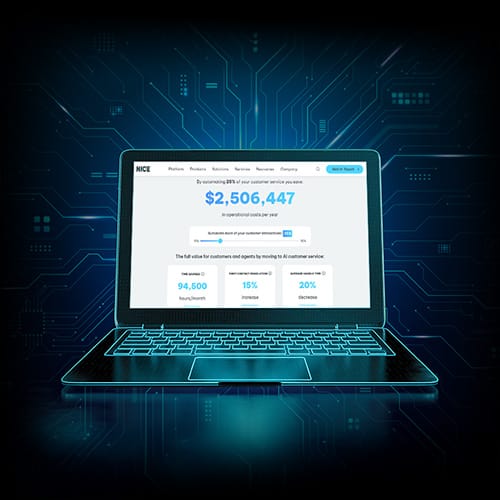
Discover the full value of AI in CX
Understand the benefits and cost savings you can achieve by embracing AI, from automation to augmentation.
Campaign DID numbers can also carry routing intelligence — calls from a digital campaign promoting a specific product can route directly to agents trained on that product, rather than a general support queue. This alignment between marketing message and agent expertise creates a more coherent caller experience and a higher likelihood of the call achieving its intended outcome, whether that is a purchase, a renewal, or issue resolution.
VIP and Tiered Customer Service Lines
Premium customer programs depend on service differentiation that is invisible to standard callers but immediately apparent to VIP customers. Dedicated DID numbers for premium tiers deliver this differentiation at the telephony layer: VIP customers have a phone number that connects them directly to priority service, without navigating the same IVR menus or experiencing the same queue depths as standard callers.
NiCE CXone's CRM integration layer adds a second tier of VIP routing intelligence: even when premium customers call the standard line, their CRM tier data can trigger priority treatment dynamically. The routing engine identifies the caller from their ANI, checks their CRM tier, and elevates queue priority accordingly — all without the customer needing to use or remember a VIP-specific number. For more on CRM data routing, see the DID CRM integration guide.
International Local Presence with DID
For contact centers serving customers across multiple countries, local DID numbers in each market address a persistent challenge: customers are significantly less likely to answer or call back international numbers. A German customer who sees a familiar German area code is far more likely to pick up than one who sees a foreign number. NiCE CXone's international DID provisioning in 100+ countries enables enterprises to present local caller ID in each market while routing all calls to centrally managed agent pools.
- European Markets
Local DID numbers in each EU country improve answer rates and meet local regulatory requirements for number presentation and recording disclosure. - Asia-Pacific
Country-specific DID numbers for Japan, Australia, Singapore, and other markets with routing to language-matched agent pools. - Americas
Regional DID pools for US, Canada, Mexico, and Latin American markets with time-zone-aware routing to ensure coverage across all local business hours.
International DID deployments should be reviewed in conjunction with the DID number provisioning and governance framework to ensure compliance with local number registration and recording requirements in each market.
Agent Direct-Dial: Preserving Customer Relationships
For high-value B2B relationships, the ability for customers to reach their specific account manager or service representative directly — without navigating queues or IVR — is a meaningful differentiator. Agent direct-dial DID numbers give each relationship-focused agent their own direct number that bypasses the general queue entirely, connecting callers immediately to their dedicated contact.
On NiCE CXone, agent direct-dial DID numbers are configured with personal overflow rules: if the agent is unavailable, calls can route to their backup agent, their team queue, or a voicemail-to-callback workflow — ensuring the customer is never abandoned simply because their primary contact is on another call. Supervisors can monitor direct-dial number utilization to ensure agents with dedicated lines are maintaining appropriate availability and response standards.
Relationship Retention Impact
Contact centers that provide dedicated direct-dial DID numbers to account managers and success teams report measurably higher customer retention rates in accounts where the direct-dial line is used regularly — a reflection of the trust built through consistent, accessible, personalized service access.
DID Use Cases by Industry
DID use case patterns vary by industry based on regulatory requirements, customer relationship complexity, and service model characteristics. The following industry-specific use cases reflect the most common deployments NiCE CXone supports.
- Financial Services
Product portfolio lines, high-net-worth client direct access, fraud and disputes escalation, regulatory-separated advice vs. execution lines. - Healthcare
Specialty department lines, appointment scheduling vs. clinical inquiry separation, urgent care triage, provider direct access. - Retail
Brand-specific service lines, campaign tracking per marketing channel, order status vs. returns separation, loyalty program priority lines. - Manufacturing
Parts and supply lines, dealer and distributor direct-dial, warranty claim routing, technical field support escalation lines. - Travel
Loyalty tier service lines, destination-specific local DID presence, disruption and emergency lines with priority staffing. - Government
Agency-specific department lines, citizen service routing by service type, emergency and non-emergency separation, compliance recording.
Related pages
FAQs

See Direct Inward Dialing in Action on NiCE CXone
NiCE CXone delivers enterprise-grade DID number management, intelligent call routing, and AI-powered contact distribution — all on a single unified platform trusted by over 8 million agents worldwide.