


SIP-based DID replaces legacy ISDN circuits with cloud-native, instantly provisionable inbound call infrastructure — global coverage, no hardware, real-time routing.
Direct inward dialing (DID) on modern enterprise contact centers runs over VoIP infrastructure using SIP (Session Initiation Protocol) trunking — not the analog circuits and ISDN connections of legacy telephony. This shift from physical to virtual has made DID provisioning instant, global, and cost-efficient. NiCE CXone's cloud contact center platform integrates natively with SIP trunk carriers worldwide, enabling enterprises to provision and route DID numbers across 190+ countries without on-premises hardware or carrier lead times. Explore the full Direct Inward Dialing guide →
SIP Trunk DID Architecture
In a SIP trunk DID configuration, DID numbers are not associated with physical circuits. Instead, a carrier allocates a range of external numbers to a logical SIP trunk group. When a DID number is dialed, the carrier routes the call over IP to NiCE CXone's SIP gateway, which processes the inbound SIP INVITE and triggers the appropriate routing logic.
Enterprise DID over SIP Trunk — Technical Architecture
1. PSTN
- Caller dials DID number
- PSTN routes to carrier gateway
↓ IP Network
2. SIP Trunk
- SIP INVITE with DNIS + ANI
- TLS/SRTP encryption
- Trunk group failover
3. NiCE CXone
- SIP gateway receives INVITE
- DNIS lookup & routing
- AI-powered ACD
- IVR / self-service
4. Agents
- Softphone (WebRTC)
- Desktop client
- Remote device
SIP DID vs. Legacy ISDN DID
| Capability | Legacy ISDN DID | SIP Trunk DID (NiCE CXone) |
|---|---|---|
| Provisioning time | 2–6 weeks (physical circuit) | Minutes (cloud admin console) |
| Geographic coverage | Domestic only (per provider) | 190+ countries |
| Numbers per trunk | 30–100 (PRI limit) | Thousands (logical SIP trunk) |
| Hardware required | PBX, PRI cards, physical cabling | None — cloud-native |
| Routing changes | PBX programming + carrier order | Real-time via CXone admin |
| Failover / redundancy | Manual circuit rerouting | Automatic SIP failover in CXone |
| Cost per number | Physical line cost per circuit group | Virtual number, shared trunk cost |
SIP Trunk Capacity Planning for DID
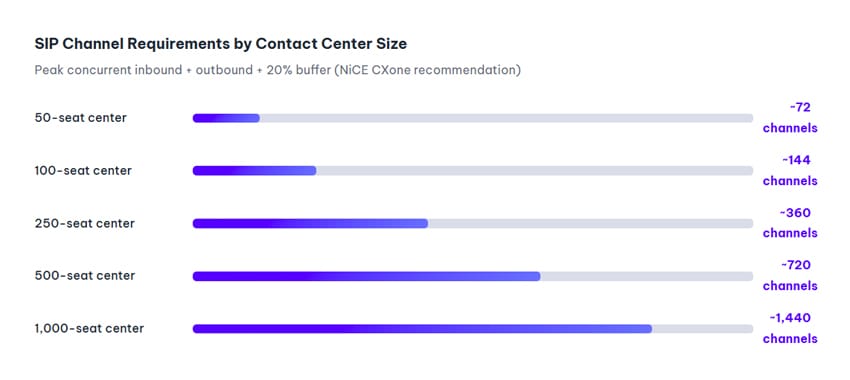
A common mistake when migrating to SIP DID is conflating the number of DID numbers with the number of SIP channels required. DID numbers can number in the thousands. SIP channels reflect concurrent call capacity — the maximum number of calls that can be active simultaneously. Capacity planning must be based on peak concurrency, not total DID inventory.
VoIP Call Quality for DID
Voice quality over SIP depends on network infrastructure quality. The key parameters to monitor for enterprise DID delivery are:
Latency
- < 150ms Round-Trip
- One-way latency above 75ms creates noticeable delay. Enterprise SIP trunks should maintain round-trip latency well below 150ms for natural conversation quality.
Jitter
- < 30ms Variation
- Jitter (variation in packet arrival time) above 30ms causes audio artifacts. Jitter buffers in NiCE CXone smooth variation, but high jitter degrades call clarity.
Packet Loss
- 0% Target
- Any packet loss in voice transmission causes audible distortion. Enterprise voice networks should target zero packet loss on voice VLANs with QoS traffic prioritization.

Discover the full value of AI in CX
Understand the benefits and cost savings you can achieve by embracing AI, from automation to augmentation.
SIP Security for DID Infrastructure
Enterprise DID over SIP requires protection against SIP-specific threats including toll fraud, SIP injection attacks, and unauthorized registration. NiCE CXone's SIP infrastructure applies TLS for signaling encryption, SRTP for media encryption, IP allowlisting for trunk access, and anomaly detection for unusual call pattern identification.
SECURITY BEST PRACTICE
Always encrypt SIP signaling with TLS and media with SRTP for enterprise DID deployments. Configure SIP access control lists (ACLs) to permit traffic only from authorized carrier IP ranges. NiCE CXone provides these protections natively as part of its enterprise voice security architecture.
Related pages
FAQs

See Direct Inward Dialing in Action on NiCE CXone
NiCE CXone delivers enterprise-grade DID number management, intelligent call routing, and AI-powered contact distribution — all on a single unified platform trusted by over 8 million agents worldwide.