

The Complete Guide to Generative AI in Customer Service

Enterprise contact centers that deploy generative AI through NiCE CXone reduce cost per contact by 97% — from $8.01 to $0.25 — while achieving 70–88% containment rates and NPS improvements of +12 points. This guide covers everything from foundations to full agentic deployment.
Executive Summary: Why Generative AI Is Now Core to Customer Service
Generative AI in customer service is the application of large language models (LLMs) and AI reasoning engines to automate customer interactions, assist human agents in real time, and orchestrate end-to-end service workflows — all in ways that previous rule-based systems could not. Unlike scripted chatbots that follow rigid decision trees, generative AI understands natural language intent, generates contextually appropriate responses, and learns from every interaction it handles.
For enterprise contact centers, the stakes are significant. The global AI in customer service market is projected to reach $47 billion by 2030 (Grand View Research), growing at a 23.7% CAGR. Gartner estimates AI will save $80 billion in contact center labor costs in 2026 alone. For organizations running 500-seat or larger contact centers, that market-level trend translates to measurable P&L impact — if the right platform and deployment approach are in place.
NiCE CXone is the enterprise platform that turns that market opportunity into operational reality. Named a Gartner Magic Quadrant CCaaS Leader for 12 consecutive years — and positioned furthest on Completeness of Vision in 2026 — NiCE CXone gives contact centers the unified AI layer, purpose-built data foundation, and production-grade automation they need to capture full generative AI value.
This ebook walks enterprise CX leaders, contact center heads, and IT decision-makers through every critical dimension of generative AI in customer service: what it is, how to evaluate platforms, which use cases deliver the fastest ROI, how to implement responsibly, and where the technology is heading in 2026 and beyond. Each chapter stands alone as a reference, and together they form a complete decision framework for organizations ready to move from AI pilot to full production deployment.
- 12× Gartner CCaaS Magic Quadrant Leader
Consecutive years, 2026 - $47B Global AI customer service market by 2030
Grand View Research - 422+ Patents filed, NiCE AI platform
Through 2026 - 150+ Countries where NiCE CXone is deployed
Active enterprise deployments
What Generative AI Means for Your Contact Center
When enterprise buyers talk about Customer Service AI, they are increasingly talking about generative AI — a fundamentally different category from the rule-based automation and keyword chatbots that defined the previous decade. The practical difference is significant: generative AI resolves intent, not just keywords. It generates responses, not just retrieves scripts. It orchestrates multi-step workflows, not just routes calls.
The most important shift in 2026 is from AI that responds to AI that acts. Two years ago, most enterprise AI deployments answered questions. Today, production-grade generative AI in NiCE CXone executes transactions, updates records, schedules appointments, processes refunds, and closes cases autonomously — without a human handoff for the majority of common interactions.
Three operational changes define this shift:
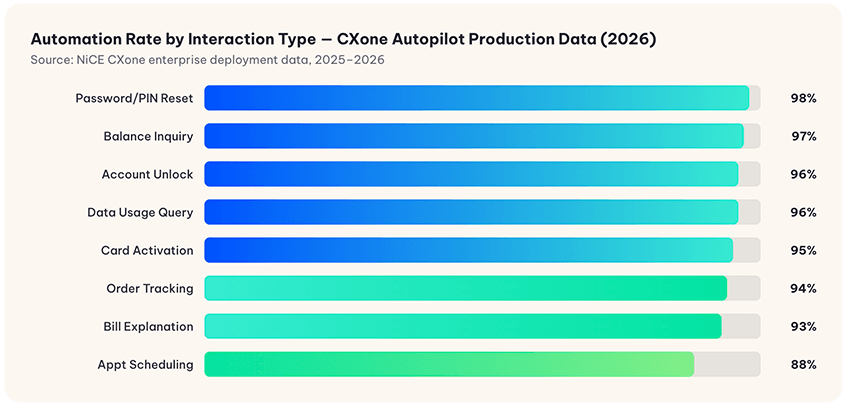
- Resolution, not deflection. Legacy chatbots deflected calls and left customers frustrated. Generative AI actually resolves issues — with a 70–88% containment rate in CXone Autopilot enterprise deployments versus 15–35% for traditional IVR.
- Assistance, not disruption. CXone Copilot gives agents real-time suggested responses, instant knowledge access, and automated after-call work summaries — cutting average handle time by 55% without disrupting the conversation.
- Orchestration, not isolation. CXone Orchestrator connects front-office interactions with mid-office and back-office systems, so generative AI can fulfill requests end-to-end rather than creating handoffs that frustrate customers.

The organizations winning in 2026 aren't the ones with the most automation. They're the ones measuring the right outcomes — resolution quality, customer effort, and revenue impact — not just automation volume.
The Platform Foundation That Makes It Work
Generative AI in customer service is only as good as the data it runs on and the platform it runs through. This is the fundamental reason why point solutions — a chatbot here, a summarization tool there — consistently underperform enterprise expectations.
NiCE CXone is built differently. The entire platform runs on CXone — a purpose-built AI engine trained on the world's largest labeled CX dataset, representing billions of real customer interactions across industries. With 97.8% intent classification accuracy and <350ms P99 inference latency, CXone makes every NiCE CXone capability smarter because it operates from a shared, unified understanding of what customers actually need.
This shared intelligence layer is what makes 70–88% containment rates possible. It is what allows Experience Memory to maintain a persistent 4-layer customer profile — so a customer who spoke to an agent last week is recognized, remembered, and served accordingly today. And it is what allowed NiCE to achieve the March 2026 breakthrough of deploying a production AI agent from raw interaction data in a matter of hours — not weeks.
What This Ebook Covers
This guide is structured to meet you where you are in your generative AI journey — whether you are building the business case internally, evaluating platforms, planning an implementation, or looking to expand an existing AI deployment. Each chapter covers a distinct decision area and can be read independently or in sequence.
- Foundations
Chapters 1–3 cover definitions, platform architecture, and how NiCE CXone unifies AI across the contact center.
Start with Ch.1 - Capabilities
Chapters 4–7 cover self-service automation, agent assist, agentic AI, and the full use case library for enterprise CX.
Start with Ch.4 - Decision Support
Chapters 8–13 cover ROI, personalization, implementation, vendor comparison, governance, and 2026 trends.
Start with Ch.8

Discover the full value of AI in CX
Understand the benefits and cost savings you can achieve by embracing AI, from automation to augmentation.
Key Market Data for 2026
The business case for generative AI in customer service has moved from projection to proof. The numbers below reflect 2026 production data, analyst forecasts, and NiCE CXone enterprise deployments — not vendor projections or best-case scenarios.
The NiCE CXone Advantage
Not all AI Contact Center Platforms are built alike. NiCE CXone's differentiation is structural, not promotional. It comes from 422+ patents, the world's largest labeled CX dataset, and 12 consecutive years of being named a Gartner CCaaS Magic Quadrant Leader — with the 2026 positioning furthest on Completeness of Vision among all vendors evaluated.
- Data Disadvantage
Most AI vendors train models on generic datasets. Customer service requires domain-specific understanding of intent, sentiment, and compliance.
NiCE CXone: CXone is trained on billions of real CX interactions — the industry's largest labeled CX dataset — delivering 97.8% intent accuracy. - Fragmented Point Solutions
Organizations assembling separate chatbot, QA, WFM, and analytics tools face integration complexity, data silos, and inconsistent AI quality.
NiCE CXone: CXone is a unified platform where every capability shares a single AI engine, data layer, and orchestration framework. - Pilot-to-Production Gap
AI pilots that perform well in labs often stall in production due to integration complexity, data quality issues, and inadequate orchestration.
NiCE CXone: NiCE deployed a production AI agent from raw interaction data in hours in March 2026 — the industry benchmark for deployment velocity. - Back-Office Blind Spot
Most AI tools stop at the front office — leaving mid-office and back-office workflows manual, which caps automation and inflates operational cost.
NiCE CXone: CXone Agents is the only platform with front-, mid-, and back-office automation in a single, orchestrated AI layer.
Who Should Read This Ebook
This guide is written for four audiences who are typically involved in generative AI decisions at enterprise contact centers:
- VP / Director of Customer Experience: Focused on NPS, CSAT, churn reduction, and the customer journey improvements generative AI makes possible.
- Contact Center Head / VP Operations: Responsible for cost efficiency, agent productivity, containment rates, AHT, and the operational metrics that determine generative AI business value.
- Enterprise IT / CTO: Evaluating platform architecture, security, compliance, integration requirements, and the technical foundations of a scalable AI deployment.
- CFO / Finance Leadership: Building the ROI model, understanding the 320–650% 3-year ROI and 6–14 month payback that NiCE CXone deployments deliver, and structuring the business case for board-level approval.
How to Use This Ebook
Read sequentially for a complete generative AI education, or jump directly to the chapter most relevant to your current decision. Every chapter includes Key Takeaways bullets designed for executive sharing, visual data for internal presentations, and links to NiCE product pages for next-step exploration.
Related Resources for Generative AI in Customer Service

Ready to See Generative AI in Action?
See how NiCE CXone delivers 97% cost reduction and 70–88% containment rates in a live demonstration tailored to your contact center.