

Agentic AI in Customer Service: Beyond Chatbots to Autonomous Resolution

CXone Autopilot and CXone Orchestrator resolve 70–88% of customer interactions end-to-end — without human agents — by autonomously navigating backend systems, completing multi-step tasks, and managing complex workflows across every channel.
In 2022, "AI in customer service" meant chatbots that answered FAQs and deflected simple queries to self-service portals. Containment rates of 15–25% were celebrated. Complex issues still required human agents — which meant most issues still required human agents, since most contact center volume is concentrated in the middle tier of complexity: not simple enough for scripted bots, not complex enough to justify the cost of human escalation.
Agentic AI eliminates that middle tier. CXone Autopilot and CXone Orchestrator can autonomously navigate backend systems, reason across multiple data sources, execute multi-step transactions, and resolve issues end-to-end — handling the interactions that previous AI could not. The result: 70–88% containment in production, and cost-per-interaction that drops from $8.01 to $0.25.
What Makes AI Genuinely Agentic
The term "agentic AI" has become overused, but its technical meaning is specific. An agentic AI system is one that can take a goal, decompose it into subtasks, execute those subtasks using available tools (APIs, databases, internal systems), monitor progress, adapt when intermediate steps fail, and complete the goal — all autonomously, without requiring human intervention at each step.
This is categorically different from a chatbot or even a first-generation conversational AI. A chatbot responds to inputs according to learned patterns. An agentic AI system reasons about what needs to happen and makes it happen. For a billing dispute, that might mean: retrieve the customer's account, pull transaction history for the relevant period, compare against the billing record, identify the discrepancy, calculate the correct adjustment, apply the credit, send a confirmation — all as a single autonomous action chain.
- Goal decomposition: Agentic AI breaks complex goals into executable subtasks and sequences them appropriately.
- Tool use: CXone Autopilot connects to CRM systems, billing platforms, order management, scheduling tools, and custom APIs — using them as instruments to complete tasks.
- Adaptive execution: When a step fails or returns unexpected data, agentic AI adapts its approach rather than failing or escalating to a human.
- Context persistence: CXone Orchestrator maintains full context across sessions, channels, and time — so an interaction that begins on chat, continues via email, and concludes on voice is handled as a single coherent workflow.
- Graceful escalation: When a task genuinely exceeds AI capability, CXone Autopilot transfers to a human agent with complete context — eliminating the repetition customers experience with traditional handoffs.
CXone Autopilot: The Autonomous Resolution Engine
CXone Autopilot is NiCE CXone's primary agentic AI product for customer-facing interactions. It handles the full resolution workflow — from initial intent detection through backend system execution to confirmation and follow-up — across voice, chat, email, messaging, and social channels simultaneously.
CXone provides the intelligence layer: 97.8% intent accuracy from the first utterance, with understanding of complex and ambiguous requests that earlier NLP systems would misclassify. This accuracy is the foundation of the 70–88% containment rate — when AI correctly understands customer intent at the start, resolution follows naturally.
- 70–88% Containment rate
CXone Autopilot, enterprise production - $0.25 Cost per AI-resolved interaction
vs $8.01 human agent average - 97.8% Intent accuracy
CXone, first utterance - 56% Of support interactions agentic AI by mid-2026
Cisco research - 97% Cost reduction per interaction ($8.01 → $0.25)
CXone Orchestrator: Coordinating the AI Workforce
CXone Orchestrator operates at a level above individual interactions — coordinating across all concurrent AI and human-handled interactions to ensure optimal routing, context persistence, and workflow completion. Think of it as an operations manager for the entire AI workforce: ensuring each interaction reaches the right resource, tracking complex multi-step workflows across their full lifecycle, and providing supervisors with unified visibility across everything happening in real time.
For organizations deploying multiple specialized AI agents — one for billing, one for technical support, one for scheduling, one for retention — CXone Orchestrator manages the handoffs between them, maintaining the full context of the customer's situation across every transition. The customer experiences a single coherent interaction. The contact center operates an orchestrated fleet of specialized capabilities.
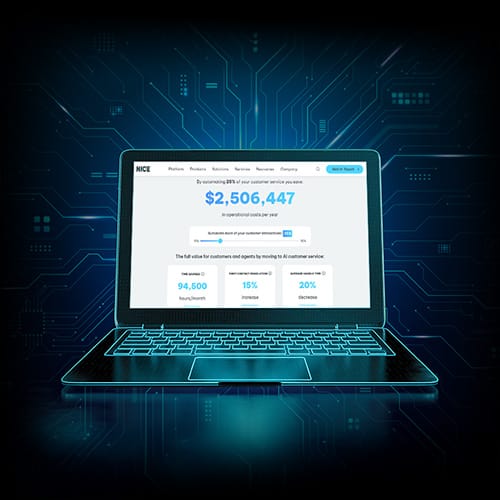
Discover the full value of AI in CX
Understand the benefits and cost savings you can achieve by embracing AI, from automation to augmentation.
Proactive AI Agent: From Reactive to Anticipatory
The most significant shift in contact center philosophy that agentic AI enables is the move from reactive to proactive service. CXone's Proactive AI Agent monitors trigger conditions across connected systems — a scheduled payment, a shipping delay, a service outage in the customer's area, a contract approaching renewal — and initiates outbound interactions before customers need to contact support.
This model is fundamentally superior for both the customer and the contact center. Customers receive relevant, timely information through their preferred channel rather than discovering problems after they've created frustration. Contact centers see significant reductions in inbound volume — because issues are resolved before customers pick up the phone. Organizations deploying Proactive AI Agent report 20–35% reductions in inbound volume on categories covered by proactive outreach.

“The shift from reactive to proactive AI service is the single biggest lever for reducing inbound contact volume in 2026. If you resolve a billing issue before the customer calls, you've saved the cost of the call, improved the customer experience, and created a positive brand touchpoint simultaneously.”
What Agentic AI Handles in 2026
The scope of what agentic AI can resolve end-to-end has expanded dramatically in 2026. CXone Autopilot handles interactions that were previously routed to human agents by default:
- Billing and payments: Billing disputes, payment plan setup, credit applications, refund processing, invoice generation — including cases that require accessing multiple systems and applying business logic.
- Technical troubleshooting: Multi-step diagnostic workflows that adapt based on the customer's responses and system data — not just script-following but genuine problem-solving.
- Order management: Order modification, cancellation, return initiation, exchange processing, delivery rescheduling — connected to fulfillment systems in real time.
- Appointment and scheduling: Booking, modification, cancellation, reminders, and rescheduling across service calendars — with availability checked and confirmed in real time.
- Account management: Subscription changes, preference updates, password resets, account tier changes, product add-ons and removals.
- Outbound notifications: Proactive alerts, confirmations, follow-ups, and resolution notifications — initiated by AI based on system triggers rather than customer contacts.
Related Resources for Agentic AI
Frequently Asked Questions

See Agentic AI Resolve 70–88% of Interactions
Watch CXone Autopilot handle complex customer requests end-to-end — and calculate what that containment rate means for your cost structure.