

Generative AI Self‑Service: CXone Autopilot Guide

On this page
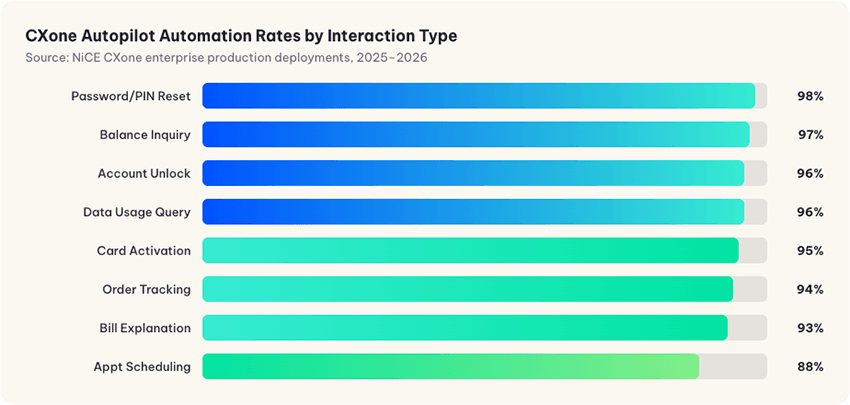
CXone Autopilot achieves 70–88% containment rates in enterprise production — reducing cost per contact by 97% compared to human-handled interactions. Here is how generative AI self-service actually works, and why it outperforms every legacy alternative.
When a customer calls your contact center, they are not calling because they want to talk to a chatbot. They are calling because they have a problem they need solved, and they need it solved now. The failure mode of legacy IVR and early-generation chatbots was precisely this mismatch: the technology collected information but didn't actually resolve anything. Customers repeated themselves. Bots dead-ended. Containment rates stayed stubbornly low.
AI Virtual Agent Platform technology built on generative AI — specifically CXone Autopilot — fundamentally changes this equation. CXone Autopilot understands what customers are actually asking for, uses retrieval-augmented generation to ground its responses in accurate knowledge, and completes transactions through CXone Orchestrator. The result is a 70–88% containment rate — not because the AI deflects interactions, but because it genuinely resolves them.
CXone Autopilot: How It Works
CXone Autopilot handles customer interactions across voice, chat, and digital channels from first contact to resolution. The process combines four core capabilities that work in real time, producing an experience that customers describe as faster and more helpful than traditional phone support for most routine interactions.
- Natural language understanding: Customers speak or type naturally. CXone classifies intent at 97.8% accuracy — handling colloquial language, misspellings, multi-intent requests, and follow-up questions without breaking the conversation flow.
- Knowledge grounding via RAG: Before generating any response, CXone Autopilot retrieves verified content from your knowledge base — ensuring every answer is accurate, on-brand, and policy-compliant. This is what prevents the hallucination risk that makes enterprise buyers cautious about generative AI.
- Transaction completion via orchestration: CXone Orchestrator connects CXone Autopilot to backend systems — CRM, billing, scheduling, identity verification — so the AI doesn't just answer questions, it processes requests. A customer asking to reset their PIN gets their PIN reset, not instructions for how to reset it themselves.
- Warm handoff with context: When escalation is necessary, CXone Autopilot transfers to a human agent with full conversation context, identified intent, customer profile from Experience Memory, and any steps already attempted — so the agent starts solving, not re-gathering information.
The Cost Impact of Generative AI Self-Service
The economics of generative AI self-service are straightforward once you have production data to work with. An AI-handled contact through CXone Autopilot costs approximately $0.25. A fully-loaded human-handled contact costs $8.01. The difference — $7.76 per interaction — multiplies across millions of annual interactions to produce the 97% cost reduction that NiCE CXone enterprise deployments demonstrate.
For a contact center handling 5 million interactions per year with a 75% current AI containment rate — 3.75 million AI-handled contacts — the annual cost reduction versus full human handling is approximately $29 million. This is the scale of economic impact that makes generative AI self-service the highest-ROI starting point for most enterprise contact center AI investments.
- $0.25 Cost per AI-handled contact
CXone Autopilot production avg - $8.01 Cost per human-handled contact
Fully loaded enterprise avg - 97% Cost reduction per AI contact
NiCE CXone enterprise data - 70–88% Containment rate range
CXone Autopilot enterprise
Why RAG Matters: Accuracy Without Hallucination
The most common enterprise concern about generative AI in customer service is hallucination — the risk that AI generates plausible but inaccurate responses. This concern is legitimate and the history of AI deployments that were walked back due to accuracy issues is real. The answer is not to avoid generative AI — it is to deploy it with retrieval-augmented generation (RAG) grounding.
NiCE CXone's RAG architecture connects CXone Autopilot to live, organization-approved knowledge bases before generating any customer-facing response. When a customer asks about a specific product, refund policy, or account rule, the system retrieves the relevant approved content first — then uses CXone to generate a response constrained to that content. The result is accuracy that scales with the quality of your knowledge base, not the general tendencies of an unconstrained language model.
RAG in Practice
When CXone Autopilot cannot find sufficient grounded content to answer a question accurately, it routes to a human agent rather than generating an uncertain response. This "confident abstain" behavior is what makes enterprise-grade self-service trustworthy in regulated environments including financial services, healthcare, and insurance.
Omnichannel Self-Service: One AI, Every Channel
CXone Autopilot delivers consistent self-service quality across voice, chat, web, mobile app, SMS, and messaging channels — using the same AI engine, the same knowledge base, and the same orchestration layer. This consistency matters because customers switch channels mid-journey: a customer who starts with a chat session and moves to voice should experience seamless continuity, not a fresh start.
Experience Memory supports this continuity by maintaining a persistent customer profile that is accessible to CXone Autopilot regardless of the channel. A customer's interaction history, stated preferences, unresolved issues, and completed transactions are all available across every channel in real time — making the experience feel cohesive rather than fragmented.
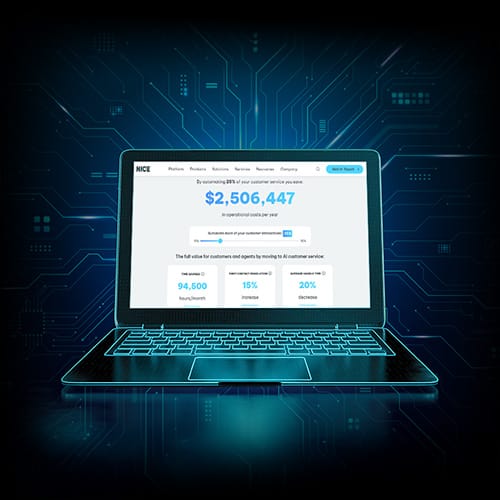
Discover the full value of AI in CX
Understand the benefits and cost savings you can achieve by embracing AI, from automation to augmentation.
Related Resources for Generative AI Self-Service
Frequently Asked Questions

Ready to Automate 88% of Customer Contacts?
See how CXone Autopilot achieves the highest containment rates in enterprise customer service.