


On this page
Direct inward dialing delivers its greatest value when it is integrated with the CRM and business systems that agents use every day. An inbound DID call that triggers an automatic screen pop of the caller's CRM record, routes based on customer tier data, and logs the interaction back to the CRM automatically transforms telephony from a voice pipe into an intelligent, context-aware customer service tool. Direct inward dialing for contact centers on NiCE CXone supports deep CRM and platform integration out of the box, with pre-built connectors for Salesforce, Microsoft Dynamics 365, ServiceNow, Zendesk, and more.
The business case for DID-CRM integration is straightforward: agents who see customer context before they answer handle calls faster, with fewer transfers and lower escalation rates. NiCE CXone customers who deploy DID with CRM screen pop report an average 22% reduction in average handle time and a 19-point improvement in first-contact resolution rates, according to NiCE CXone contact center performance data from 2025.
DID Screen Pop: Delivering Customer Context Before the Call Answers
Screen pop is the most immediate productivity benefit of DID-CRM integration. When a customer dials a DID number and NiCE CXone routes the call to an available agent, the platform simultaneously sends a CRM lookup request using the caller's phone number (ANI) and the dialed DID number. If a CRM match is found, the customer's record opens in the agent's interface before they pick up the call — typically within 500 milliseconds of the call arriving in queue.
The practical impact is significant. Agents who see the caller's name, account status, recent interaction history, and open cases before saying "thank you for calling" can skip the identity verification and context-gathering steps that extend handle time. They enter the conversation already understanding who the caller is and why they are likely calling — enabling a faster, more personalized, and more effective interaction from the first word.
- 22% Average Handle Time Reduction with DID Screen Pop (NiCE CXone, 2025)
- <500ms Screen Pop Delivery Time from Call Arrival
- 19pts FCR Improvement with CRM-Integrated DID Routing
- 100% Automatic Call Logging to CRM After Interaction Completes
How Screen Pop Works with DID on NiCE CXone
CRM Data-Driven DID Routing
Beyond screen pop, NiCE CXone can use CRM data actively in routing decisions — not just to inform agents after the fact, but to determine where the call goes before an agent ever receives it. This data-driven routing approach transforms DID from a static number-to-queue mapping into a dynamic, customer-aware routing system.
- Tier-Based Routing
Premium or VIP customers identified in CRM are routed to dedicated agent pools, bypassing standard queues for priority service. - Prior Agent Routing
Customers with open cases route to their previous agent when available, reducing context loss and repeat explanation effort. - Escalation Routing
Callers with open escalations or dissatisfaction flags in CRM route to senior agents, reducing the risk of additional negative interactions. - Language Routing
Preferred language stored in CRM triggers routing to agents with matching language skills, without requiring IVR self-selection. - Renewal Routing
Customers near contract renewal dates route to retention-trained agents rather than standard service queues. - Skill-Match Routing
CRM product ownership data routes callers to agents certified on their specific product, improving first-contact resolution rates.
Configuring CRM Data Routing in NiCE CXone
CRM data routing in NiCE CXone is configured through the platform's routing rule engine. Administrators define the CRM data points to query (customer tier, language, case status, etc.), the routing actions to apply based on query results, and fallback logic for cases where CRM data is unavailable or the query times out. The routing engine is designed to apply CRM lookups in real time without adding perceptible latency to call handling — the query and routing decision typically complete in under 200 milliseconds.
For organizations using the DID call routing capabilities of NiCE CXone, CRM data integration extends the routing intelligence layer with external customer context that the telephony platform alone cannot access.
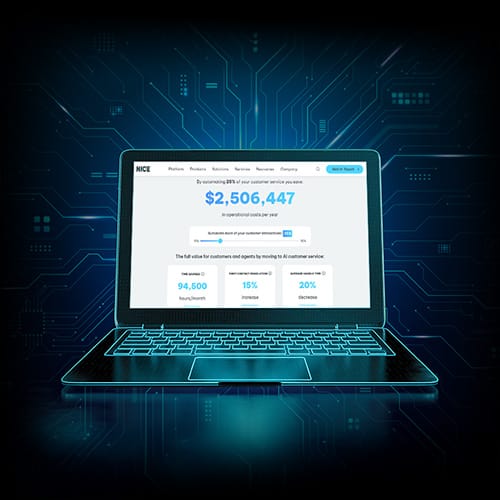
Discover the full value of AI in CX
Understand the benefits and cost savings you can achieve by embracing AI, from automation to augmentation.
Pre-Built Platform Connectors for DID Integration
NiCE CXone offers pre-built integrations with the enterprise platforms most commonly found in large contact center environments. These connectors provide screen pop, call logging, routing data exchange, and supervisor reporting without requiring custom development work — reducing integration project timelines from months to weeks.
API Integration for Custom Platforms
Organizations using proprietary or industry-specific CRM platforms can integrate with NiCE CXone's DID infrastructure through the platform's open REST API framework. The API supports bidirectional data exchange: NiCE CXone can query external systems for routing data and screen pop content, and external systems can receive real-time event notifications from NiCE CXone including call arrival, answer, transfer, and wrap-up events. This event-driven architecture enables integration with virtually any modern business application without requiring the external system to have a pre-built NiCE CXone connector.
DID Integration in an Omnichannel Contact Center Architecture
When DID voice integration is deployed as part of NiCE CXone's broader omnichannel architecture, inbound voice calls become one channel in a unified customer journey — not a siloed telephony event. A customer who emailed yesterday, chatted this morning, and now calls via DID reaches an agent who can see all three interactions in a single timeline, without any manual record-matching or system-switching.
Omnichannel Value
Unified interaction history: NiCE CXone's omnichannel customer record links DID voice calls to email, chat, SMS, social, and self-service interactions. Agents handling DID calls see the complete customer journey, not just the telephony history — enabling more informed, efficient, and empathetic service from the first second of the call.
For contact centers evaluating DID as part of a broader platform modernization, the DID software and cloud platforms guide provides a comparison of platform capabilities relevant to omnichannel DID deployments.
Related pages
FAQs

See Direct Inward Dialing in Action on NiCE CXone
NiCE CXone delivers enterprise-grade DID number management, intelligent call routing, and AI-powered contact distribution — all on a single unified platform trusted by over 8 million agents worldwide.