

Agentic AI Architecture for CX Platforms

What does the technical architecture of an enterprise-grade agentic AI platform for CX look like — and how do the orchestration layer, tool access management, context persistence, LLM integration, and safety guardrails work together to enable reliable autonomous operation at scale?
The pressure on customer experience operations has never been higher. Interaction volumes continue to climb, customer journeys have become fragmented across a dozen channels, and regulatory frameworks like DORA in EU financial services and CFPB oversight in the US demand unprecedented levels of documentation and compliance. Legacy contact center platforms—built for queues, not journeys—are straining under the weight.
This is why agentic AI architecture has moved from industry curiosity to operational necessity. Unlike the chatbots of the past decade, agentic AI systems don’t just answer questions. They perceive context, reason about intent, take coordinated actions across channels, and do so with human oversight baked into every step.
For CX leaders, this shift represents more than a technology upgrade. It’s a fundamental change in how customer care gets delivered.
The business outcomes are concrete: faster resolution, lower customer effort, fewer escalations, improved compliance capture, and a better experience for the agents who still handle the work that matters most.

From Chatbots to Agentic AI: The CX Architecture Shift
Between 2015 and 2022, most companies deployed FAQ bots and scripted IVRs. These tools worked reasonably well for predictable, high-volume questions. But they broke down the moment a customer’s situation became even slightly complex.
The 2023–2026 era looks fundamentally different. Large language models and reasoning engines now enable AI agents that pursue goals, not scripts. These systems can break down a customer’s problem into actionable steps, invoke tools and APIs to gather information, and adapt their approach based on what they learn along the way.
Traditional CX architecture was channel-centric. Voice IVR lived in one system, web chat in another, mobile app flows in a third. Each channel had its own logic, its own data, and its own limitations. Agentic AI requires something different: a journey-centric CX AI platform architecture with a shared context layer that follows the customer regardless of where they interact.
The distinction between generative AI features and agentic AI systems matters here. Generative AI can answer questions—it’s reactive. Agentic AI monitors signals, decides on actions, invokes tools, and escalates to human agents when necessary. It’s proactive and goal-directed.
Consider an airline or bank that previously offered a rules-based “check flight status” bot. Customers could ask a narrow set of questions and receive scripted answers. An agentic travel assistant operates differently: it can rebook flights within policy, issue vouchers when appropriate, notify customers proactively about delays, and document every step for audit purposes—all without waiting for the customer to ask.
Core Building Blocks of an Agentic CX Architecture
Building an effective agentic AI architecture for CX platforms requires more than deploying a large language model. It requires a coordinated system of capabilities that work together in closed-loop operation: detect signals, decide next best action, execute across systems, learn and improve.
The framework that powers platforms like NiCE CXone and CXone can be understood through four architectural layers: Experience, Intelligence, Orchestration, and Trust.
Each layer must be designed to operate continuously without breaking regulatory or operational requirements. And importantly, CX leaders—not just CIOs—should understand these blocks because they map directly to the KPIs that matter: FCR, NPS, CSAT, AHT, and compliance adherence.
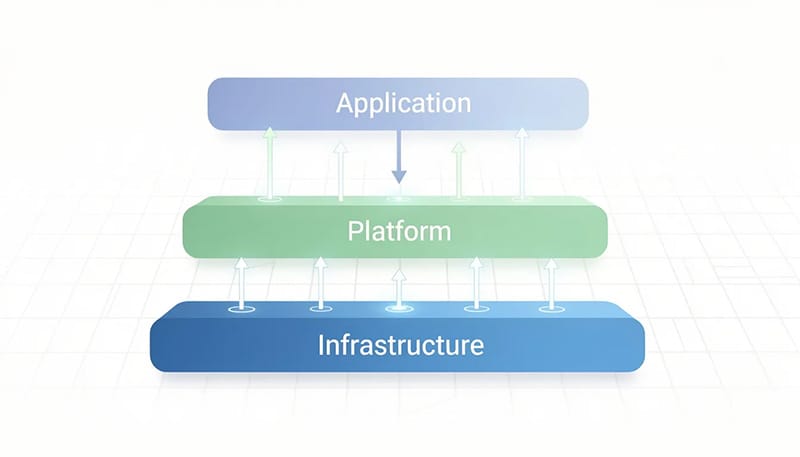
The Four-Layer Agentic CX Stack:
Experience Layer: Customer-facing entry points across voice, digital, and asynchronous channels
Intelligence Layer: Context, knowledge, and reasoning capabilities that power decision making
Orchestration Layer: Workflow coordination that delegates tasks across AI agents and humans
Trust Layer: Security, compliance, and governance guardrails that keep autonomous actions safe
Experience Layer: Omnichannel, Multimodal Journeys
The experience layer encompasses every customer touchpoint: voice (PSTN, VoIP), digital (web, in-app, messaging), and asynchronous channels (email, social, SMS, WhatsApp). This is where customer interactions begin and where context must be captured consistently.
For agentic AI to function effectively, this layer must surface the same “memory” regardless of how a customer chooses to engage. Whether someone calls, chats, or replies to an SMS three days later, the AI agents and human agents assisting them need access to the entire customer journey—not just the current session.
CXone already centralizes routing, interaction history, and real time data like transcription. Every touchpoint becomes a sensor for the agentic architecture, feeding AI-powered interaction analytics signals into the intelligence layer for reasoning and action.
Consider a concrete flow: a customer starts troubleshooting a billing issue in a mobile app chat. Based on sentiment signals and account data, an AI agent triggers a proactive outbound voice call to resolve the issue faster. Two days later, a compliant follow-up email confirms the resolution and captures satisfaction feedback. All three interactions share the same context object, so the customer never has to repeat information.
This continuity is what separates seamless experiences from frustrating ones.
Intelligence Layer: Context, Knowledge, and Reasoning
The intelligence layer serves as the brain of the agentic architecture. It combines customer profiles, journey history, knowledge bases, policy rules, and real-time signals like sentiment, intent, and behavioral patterns.
Speech analytics, text analytics, and predictive scoring become foundational signals here—not standalone tools. They feed into the reasoning engine that determines what action to take next, whether that’s answering a question, escalating to a specialist, or triggering a proactive outreach.
A unified customer record is essential. Customer data from CRM, billing, policy systems, and interaction transcripts must merge into a single context object available to both AI and human agents. Without this unified data fabric, AI agents reason from incomplete information, leading to errors and frustrated customers.
Intelligence Components and CX Impact:
Orchestration Layer: Agentic Workflows and Tooling
The orchestration layer acts as the conductor that coordinates multiple AI agents and human agents. It handles task assignment, escalation rules, and workflow branching based on outcomes.
In a CXone environment, orchestration spans interaction routing, robotic process automation, API calls to core business systems, and workflow engines that allow AI to trigger and chain complex workflows. This is where intelligent automation comes to life.
Consider a collections workflow for delinquent accounts:
An AI agent receives an inbound customer call and identifies the caller through voice biometrics and account lookup
The agent accesses real time data about the account status, payment history, and available restructuring options within compliance rules
Through natural conversation, the AI negotiates a payment plan that falls within policy limits
The agent modifies account records via secure API calls to the billing system
Exceptions that exceed policy thresholds get flagged for human intervention
All decisions, rationale, and customer responses are logged for audit and feedback loops
This closed-loop orchestration requires multi-agent patterns. One specialized agent handles compliance monitoring, another focuses on customer empathy and tone, and a third executes back-office actions. All are coordinated by policy-driven rules that ensure consistency and control.
Trust Layer: Security, Compliance, and Governance
The trust layer ensures every AI-driven action remains compliant with regulations: GDPR, PCI DSS, HIPAA where applicable, and industry-specific requirements like MiFID II call recording in financial services.
When AI starts acting autonomously, the heritage of risk and compliance capabilities becomes essential. Call recording, surveillance, AI-powered quality management—these foundations transform from passive documentation into active governance mechanisms.
Key architectural elements include:
Data minimization: AI agents access only the customer data required for the current task
Role-based access: Different agents (AI and human) have different permission levels
Redaction: Sensitive information is automatically masked in transcripts and logs
Explainable decision logs: Every AI action includes rationale that can be reviewed later
Approval workflows: New AI behaviors require sign-off before deployment
Consider an AI agent proposing a debt restructuring for a customer in the EU. The trust layer ensures the rationale, supporting evidence, and any required approvals are logged for later regulatory review. This isn’t optional—it’s what makes agentic AI viable in regulated industries.
Human-Centered Design: Making Agentic AI Work for Customers and Agents
Agentic architecture must be designed around people first. The goal is reducing customer effort and agent cognitive load—not maximizing automation for its own sake.
The design philosophy that guides effective implementation keeps human agents in control. Conversational AI and intelligent virtual agents propose actions, draft responses, and automate after-call work. But humans approve critical steps and supervise exceptions. This human AI collaboration model ensures accountability while still delivering operational efficiency gains.
Role changes in contact centers are already underway. Call center agents are becoming “resolution experts” aided by AI, handling the complex and emotional situations that require human judgment. Supervisors are evolving into “AI coaches,” reviewing AI performance and tuning behaviors, often supported by AI-based workforce management tools. New roles like journey designers are emerging to map and optimize the paths customers take.
Industry data consistently shows that agent burnout and turnover remain major challenges for large enterprises. The repetitive work that agentic AI can automate—looking up account information, summarizing previous interactions, drafting routine responses—is often the same work that drives agents to leave. By removing these burdens, agentic AI improves both service quality and retention.
Human-in-the-Loop Patterns for CX Platforms
Three primary patterns define how human oversight operates in agentic CX:
Pattern A: AI-Fronted with Human Backup AI handles initial triage and resolution attempts. Humans receive escalations when AI confidence is low or when policy requires human approval. Best for high-volume, routine customer interactions like password resets or order status inquiries. Primary impact: digital containment rate, average speed of answer.
Pattern B: Human-Fronted with AI Copilots Human agents lead conversations while AI listens, suggests responses, and automates documentation. Humans maintain full control but work faster with AI support. Best for complex scenarios like complaint resolution or technical troubleshooting. Primary impact: AHT, compliance adherence, FCR.
Pattern C: Fully Automated with Scheduled Review AI operates autonomously for defined task categories. Humans review samples and exceptions on a scheduled basis. Best for low-risk, high-volume transactions like appointment confirmations or notification delivery. Primary impact: cost per interaction, resource utilization.
Consider a 2025 UK retail banking contact center handling complaints. An AI agent can draft a complaint resolution based on account history and policy. But before that resolution is sent to the customer, a human must review and approve it. This pattern satisfies regulatory requirements while still delivering efficiency gains.
CX platforms like CXone expose these patterns through configuration, not code. Operations leaders can adjust human oversight levels based on risk tolerance and regulatory requirements without rebuilding systems.
Architecting the Agentic CX Data Foundation
Agentic AI is only as good as the data foundation beneath it. Unified interaction records, high-quality transcripts, normalized customer IDs, and connected operational systems determine what’s possible, making robust AI interaction analytics a critical enabler.
Many organizations in 2024–2026 still operate with fragmented CRM, billing, and ticketing tools. Data silos make it nearly impossible for AI to form a reliable “single customer truth.” Without this foundation, even the most sophisticated AI agents will make errors and frustrate customers.
CXone serves as a central interaction and analytics hub that can sit above or alongside legacy systems while feeding agentic AI models and agents. This approach lets enterprises introduce agentic workflows without ripping out every legacy application, leveraging comprehensive contact center solutions as the operational backbone.
Consider a global telco that operated 15+ regional systems for customer service. By consolidating interaction data into a CXone-powered analytics layer, they created a unified view of the entire customer journey. Agentic workflows could then be introduced incrementally—first for high-volume inquiries, then for proactive outreach—without requiring a complete digital transformation of legacy billing and provisioning systems.
Data Capabilities Required Before Deploying Agentic CX:
[ ] Unified customer ID across all interaction channels
[ ] Real-time transcription and analytics for voice and digital
[ ] API access to operational systems (billing, orders, tickets)
[ ] Normalized historical data from disparate data sources
[ ] Feedback data (CSAT, NPS, surveys) linked to interactions
[ ] Secure, governed data layer with role-based access
Unifying Interaction, Operational, and Feedback Data
Effective agentic AI relies on blending three data categories:
Interaction data: Customer calls, chats, emails—the raw material of every interaction
Operational data: Orders, tickets, logistics, account status—the context that explains what’s happening
Feedback data: CSAT scores, NPS, survey verbatims—the signal of how customers actually feel
When these streams merge, AI agents can make informed decisions. For example: a customer who received a failed delivery yesterday and submitted a low CSAT score should receive proactive outreach today. Without the combined view, that opportunity is invisible.
Analytics and feedback tools can transform free-text feedback and transcripts into structured signals—topics, sentiment, effort scores—that feed directly into agentic decision engines. This transformation turns qualitative customer voice into actionable intelligence.
The result is a “customer state object” that represents everything relevant about a customer’s current situation: their history, their current issue, their sentiment, and the outcomes of previous resolution attempts. Both AI and human agents access this same object, ensuring continuity across every interaction.

Discover the full value of AI in CX
Understand the benefits and cost savings you can achieve by embracing AI, from automation to augmentation.
Design Patterns: How Agentic AI Operates on a CX Platform
Enterprise CX teams benefit from concrete, reusable design patterns rather than abstract theory. The following patterns represent proven approaches that can be implemented on platforms like CXone, each tied to measurable business outcomes.
These patterns apply across industries—financial services, government agencies, large retail—where compliance, scale, and customer expectations intersect, especially for organizations modernizing on cloud CCaaS contact center solutions.
Pattern 1: Autonomous Triage and Routing with Context Preservation
Triage agents listen across channels—IVR, chat, social—to classify intent, check customer history, and dynamically route to the best resolution resource. The resource might be an AI bot, a human agent, or a specialist queue, depending on complexity and context.
Architectural components:
Real-time transcription and intent detection
Customer profile and history lookup
Dynamic routing engine with skill-based matching
Context object that persists from triage through resolution
Before agentic triage: A customer calls about a billing dispute. They navigate an IVR menu, wait in queue, explain their issue to an agent, get transferred to billing, and explain the issue again. Total time: 15+ minutes. Customer effort: high.
After agentic triage: The AI identifies the billing dispute intent within seconds, pulls account history and recent transactions, determines this is a straightforward credit, and either resolves it directly or routes to a specialist with full context. The customer never repeats information. Total time: under 5 minutes. Customer effort: low.
In large operations, intelligent triage can reduce misrouted calls by 15–25% and cut average speed of answer by 10–20 seconds—measurable results that translate directly to happier customers and lower costs.
Pattern 2: Agentic Copilots for Live Agents
AI copilots sit within the agent desktop, listening to customer interactions in real time. They summarize previous contacts, suggest next best actions, surface relevant knowledge articles, and automate after-call work.
Architectural requirements:
Secure, low-latency streaming of audio and text
Integration with knowledge bases and policy libraries
Real-time compliance prompts and script adherence monitoring
Logging of all AI suggestions for quality review and coaching
The copilot interface should be visually unobtrusive—suggestions appear as options, not commands. Compliance prompts highlight required disclosures and can feed directly into AI-driven quality management workflows. Journey context is always visible so agents don’t need to navigate away to understand the customer’s history.
Value metrics to track:
AHT reduction (typical range: 8–15%)
Script and disclosure adherence improvement
Agent satisfaction scores over 90-day windows
Reduction in after-call work time
Importantly, copilots also become coaching tools. Supervisors can review where AI suggestions were accepted, modified, or rejected—creating feedback loops that improve both AI behavior and agent training.
Pattern 3: Proactive Journey Orchestration
Proactive agents watch for risk or opportunity signals and trigger outreach before customers need to call. Failed logins, cart abandonment, multiple knowledge article views, upcoming payment due dates—all become triggers for personalized engagement.
Pattern structure:
Governance guardrails are essential: when and how to contact customers, time-of-day restrictions, frequency limits, and opt-out handling must all be built into the orchestration logic.
Pattern 4: Embedded Risk and Compliance Guardians
Specialist AI agents focused solely on compliance monitor live conversations for required disclosures, risky statements, or off-policy promises. When issues arise, they nudge agents in real time rather than catching problems after the fact.
These guardians connect directly to the risk and compliance stack: call recording, transcription, policy libraries, and AI quality management and case management tools for investigations and audits.
Example scenario: A call center agent in North America is discussing a credit card upsell with a customer. The compliance guardian detects that the agent is about to quote an interest rate without the required disclosure language. A real-time prompt appears on the agent desktop with the correct disclosure. The agent reads it, the interaction continues, and no violation occurs.
Dual value delivered:
Reduced regulatory exposure: Violations caught and corrected in real time, not discovered during audits
Improved coaching: Supervisors see patterns of where AI intervention was needed, identifying training opportunities
For financial services, healthcare, and government contact centers, these guardians transform compliance from a post-hoc review function into a continuous improvement capability.
Governance, Change Management, and Operating Model
Building an agentic CX architecture is as much about operating model as technology. Who owns the AI agents? Who approves changes to their behavior? How is performance monitored?
New cross-functional governance structures are emerging. CX leaders, CIOs, COOs, risk and compliance officers, and data teams must collaborate on shared roadmaps and outcome metrics. The vice president of customer care can’t operate in isolation from the chief technology officer when AI agents are making real-time decisions that affect both customer satisfaction and regulatory risk.
Enterprises typically start with pilot projects in 2024–2025, building internal “AI councils” and defining clear policies for where AI is allowed to act autonomously. These policies become the foundation for scaling.
Recommended governance framework:
AI ownership clarity: Each agent type has a designated owner responsible for performance and compliance
Change approval process: Model updates and behavior changes require sign-off from operations, compliance, and technology
Performance monitoring: Daily dashboards for AI containment, escalation rates, and quality scores
Exception review: Weekly review of edge cases and escalations to identify improvement opportunities
Quarterly audits: Fairness, bias, and drift analysis to ensure AI behavior remains aligned with ethical guidelines
Shared accountability matters because agentic AI crosses traditional organizational boundaries. When an AI agent makes a decision that affects a customer, multiple teams share responsibility for that outcome.
Key Guardrails for Enterprise-Grade Agentic CX
Practical guardrails ensure that autonomous agents operate within acceptable boundaries:
[ ] Human approval required for financial commitments above defined thresholds
[ ] Restrictions on AI-initiated outreach in jurisdictions with specific consent requirements
[ ] Mandatory logging of every AI action with decision rationale
[ ] Automatic escalation when AI confidence scores fall below threshold
[ ] Prohibition on AI making promises that exceed policy authority
[ ] Regular review of AI suggestions that were rejected by human agents
[ ] Continuous evaluation for bias in routing, offers, and resolution outcomes
These guardrails align with emerging frameworks like EU AI Act discussions and OECD guidelines on artificial intelligence. Ethical considerations aren’t separate from operational design—they’re embedded in how agentic systems get built.
Practical Roadmap: Evolving Your CX Platform into an Agentic Architecture
For large organizations starting from today’s CCaaS deployments, a pragmatic 18–24 month roadmap provides structure for the transition to an agentic CX architecture.
The principle is “start small, scale intentionally.” Begin with high-volume journeys where data is accessible and regulations are clear. Password resets, order status inquiries, and billing questions make excellent starting points. For those interested in the future of customer experience innovation, consider attending NiCE World London 2026.
The typical progression moves through phases: establish the data and insight foundation, pilot copilots and triage agents, then broaden to proactive journeys and embedded compliance guardians.
Phase 1 (0–6 Months): Consolidate Data and Instrument Journeys
The first phase focuses on foundation work:
[ ] Map top 5–10 contact reasons driving volume
[ ] Consolidate interaction data into a central platform
[ ] Enable analytics and transcription for all key channels
[ ] Connect disparate data sources to create unified customer profiles
[ ] Define success metrics: target improvements in FCR, containment, or CSAT for selected journeys
[ ] Establish baseline measurements for comparison
During this phase, AI is mostly observational and assistive. Deploy ai agents in listen mode to understand patterns before allowing them to act autonomously. This learning period builds the historical data foundation that enables effective agentic behavior later.
Phase 2 (6–12 Months): Introduce Agentic Copilots and Smart Triage
The second phase introduces active AI assistance:
[ ] Roll out AI copilots for a subset of agents handling high-volume journeys
[ ] Implement context-aware triage at the front door of voice and chat channels
[ ] Run rigorous A/B testing comparing AI-assisted vs. traditional handling
[ ] Establish feedback loops with agents to refine AI suggestions
[ ] Communicate clearly about AI’s role to avoid fear and resistance
[ ] Conduct compliance reviews at each deployment step
Pilot projects in this phase typically show measurable results: 12% AHT reduction, 8-point increase in agent satisfaction, 20% improvement in FCR for targeted journeys. These metrics justify continued investment and expansion.
For financial services and public sector settings, compliance reviews at each step are non-negotiable. Document everything with robust knowledge management. Create audit trails. Build confidence with regulators through transparency, partnering with a trusted CX provider like NiCE.
Phase 3 (12–24 Months): Scale Proactive Journeys and Governance
The final phase expands scope and formalizes operations:
[ ] Extend proactive orchestration across channels and use cases
[ ] Embed compliance guardians in more interaction types
[ ] Formalize governance: AI change management boards, standard operating procedures
[ ] Implement quarterly audits for fairness, bias, and model drift
[ ] Connect CX outcomes to enterprise KPIs: churn reduction, collections performance, digital adoption
[ ] Train the next generation of journey designers and AI coaches
At this stage, an “agentic CX operating model” becomes visible in daily operations. Supervisors start their day reviewing AI performance dashboards alongside traditional queue metrics. Executives receive reports that show business impact from AI-assisted resolutions powered by AI customer service automation solutions. The continuous improvement cycle—observe, adjust, measure—becomes routine.
Looking Ahead: Agentic AI as the CX Infrastructure of Record
Agentic AI isn’t a passing trend or a feature to bolt onto existing platforms. It represents the next generation of CX infrastructure—akin to the shift from on-premises PBXs to cloud CCaaS in the 2010s. The organizations that build this foundation thoughtfully will operate with advantages their competitors can’t easily replicate.
Looking toward 2028–2030, the trajectory becomes clearer: millions of coordinated AI agents quietly handling routine work, surfacing complex cases to humans, and continuously improving journeys based on every interaction through leading AI customer experience platforms. The technology becomes invisible—infrastructure, not spectacle.
The vision that guides this evolution centers on calm, connected, human-centered experiences. Customers feel known and protected. Agents feel supported and in control. Customer expectations are met not through heroic effort but through intelligent systems that anticipate needs and remove friction. AI serves as the invisible fabric that makes these experiences possible, increasing pressure on organizations that delay to catch up with those already building.
For CX leaders navigating this transition, the path forward requires equal attention to technology, governance, and people. The AI contact center platform architecture matters. The guardrails matter. And ultimately, the commitment to keeping humans at the center—both customers and the agents who serve them—matters most of all.
Also related to Agentic AI in CX:
- Agentic AI for Real Time Agent Coaching
- KPIs for Agentic AI CX
- Autonomous AI Agents in Contact Centers
- Agentic AI Governance Frameworks
- AI Agents for Quality Management
- Agentic AI in Retail Customer Experience
- Copilot vs Autopilot AI in CX
- Agentic AI in Healthcare Contact Centers
- Agentic AI for CX Operations Management
- Agentic AI in Financial Services CX
Frequently Asked Questions (FAQs)

Ready to experience the power of one platform?
Let us show you how NiCE can unify, automate and elevate your entire customer experience - with AI at the core and outcomes at the forefront.