

KPIs for Agentic AI CX
Measuring What Matters in Autonomously Orchestrated Contact Centers

How do you measure agentic AI performance in customer experience — and which KPIs (autonomous containment rate, time-to-resolution, task completion accuracy, escalation rate, CSAT) actually connect AI activity to business outcomes in a way leadership will act on?
Something fundamental has shifted in how enterprise contact centers operate. The scripted chatbots and rigid IVR trees that defined the last decade of automation are giving way to something far more capable: agentic AI that can reason, decide, and act across customer journeys without constant human supervision.
This isn’t incremental improvement. By 2026, industry analysts project that over 60% of customer interactions in large contact centers will touch at least one AI system. Organizations running AI-first programs are targeting 20–40% reductions in cost per resolved interaction while simultaneously improving satisfaction scores.
Platforms like NiCE CXone now enable agentic AI to handle end-to-end tasks—intelligent routing, real-time agent guidance, omnichannel self-service, and compliance monitoring—while keeping humans in control of what matters most. The AI operates as invisible infrastructure, orchestrating intelligence across every touchpoint so customers experience calmer, faster resolutions and agents can focus on complex issues that genuinely need human judgment.
But here’s the challenge: legacy KPIs weren’t built for this reality. Average handle time tells you how long calls last, not whether AI is reducing effort across an entire journey. Basic deflection rates show volume shifted away from agents, but say nothing about whether customers actually got their problems solved or left frustrated.
CX leaders need a new measurement framework—one that captures customer effort, agent experience, adaptive intelligence, and compliance as AI autonomy grows. The old metrics remain useful, but they’re no longer enough on their own.
This article provides a structured KPI framework for agentic AI in customer experience, with practical definitions, target ranges, and guidance on operationalizing these metrics in dashboards. Whether you lead operations, oversee risk, or drive CX strategy, you’ll find actionable approaches to measure real ROI from agentic AI.
Foundations: From Legacy Metrics to Agentic AI CX KPIs
Contact center measurement evolved in an era when the telephone was king, and foundational concepts like contact center KPIs were defined around human-only, voice-centric interactions. Service Level 80/20 meant answering 80% of calls within 20 seconds. Abandon Rate tracked how many callers gave up waiting. Average handle time measured efficiency in minutes and seconds.
These metrics served their purpose, but they assume a world where each interaction is a discrete event handled by a single human agent on a single channel. That world is disappearing. Today’s customers move fluidly between chat, voice, messaging apps, and self-service portals—often within a single issue. Agentic AI perceives context across all these channels, decides next best actions autonomously, and learns from outcomes to improve over time.
This demands KPIs that go beyond “was the call answered” to ask “was the customer’s problem actually solved, with minimal effort, while staying compliant?”
Legacy KPIs: Still Essential, But Incomplete
These traditional metrics remain important for context, but must be interpreted differently when AI is in the loop:
Average Handle Time (AHT): Time from interaction start to wrap-up
First Contact Resolution (FCR): Percentage resolved without follow-up contact
Service Level: Percentage answered within target time threshold
CSAT: Customer satisfaction score, typically post-interaction
NPS: Net Promoter Score measuring relationship loyalty
Cost per Contact: Total cost divided by interaction volume
Abandon Rate: Percentage who leave before resolution
Agent Attrition: Annual turnover rate for contact center staff
Each of these tells part of the story, but none captures how AI is changing the nature of work, the quality of decisions, or the effort customers expend across journeys.
A Layered KPI Framework for Agentic AI CX
To measure what actually matters in autonomously orchestrated contact centers, consider six interconnected layers:
Core Operational KPIs – The heartbeat metrics, reinterpreted for AI involvement
Customer Effort & Experience KPIs – Measuring friction, sentiment, and journey completion
Agent Experience & Augmentation KPIs – Tracking how AI supports human performance
Automation & Agentic Path KPIs – Understanding how autonomous agents make decisions
Risk, Compliance & Governance KPIs – Ensuring AI acts within policy boundaries
Business & Financial Value KPIs – Proving ROI in terms executives understand
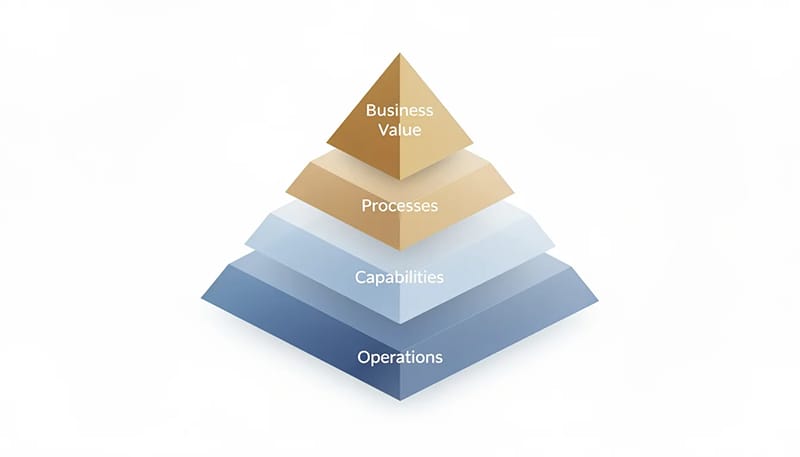
These layers build on each other. You can’t claim financial value if customer experience is suffering. You can’t sustain automation gains if compliance risks go unmonitored. The framework works as an integrated system, not a menu of isolated metrics, especially when implemented on an AI-first customer experience platform that unifies data and orchestration.
The sections that follow walk through each layer with concrete examples of how enterprise contact centers can measure and benchmark performance in the new era of agentic AI.
Core Operational KPIs in an Agentic AI Contact Center
Core operational metrics remain the heartbeat monitor of any contact center. What changes is how you interpret them when agentic AI handles a growing share of work.
Redefining Average Handle Time
AHT has always been a double-edged metric. Optimize too aggressively, and agents rush customers off calls without solving problems. But in an agentic AI environment, the meaning of AHT shifts again.
When AI successfully contains straightforward inquiries, human agents inherit only the complex issues that require judgment, empathy, or multi-step problem solving. Their AHT may actually increase—and that’s not a problem. It reflects appropriate work distribution.
Track AHT alongside automation depth and resolution quality. A higher AHT for human-handled interactions is acceptable, even desirable, if AI has routed only genuinely difficult cases to people.
First Contact Resolution in a Blended World
Traditional FCR measured whether a human agent resolved an issue without the customer calling back. In 2025, that definition is incomplete.
Modern FCR must include:
AI-only resolutions: Virtual agents, chatbots, and asynchronous channels that solve problems end-to-end
Blended resolutions: AI handles intake, context gathering, and initial troubleshooting, then hands off seamlessly to a human who completes the task
Human-only resolutions: Complex cases routed directly to agents
Segment FCR across all three categories. This reveals where agentic AI is performing well and where handoffs may be creating friction that erodes customer satisfaction.
Segmenting Service Level and Abandon Rate
Service Level and Abandon Rate become more useful when segmented by queue type:
Extended Operational Metrics
NiCE customers typically track several extensions of core metrics:
Contacts per resolved case: How many times did the customer reach out before the issue closed?
Containment rate in automation: What percentage of AI interactions resolved without human involvement?
Handoff rate from AI to agents: How often does the AI need to escalate?
These metrics provide visibility into whether agentic AI is genuinely solving problems or simply deflecting volume.
Legacy vs. Agentic AI Definitions
Customer Effort and Experience KPIs for Agentic Journeys
In agentic AI CX, customer effort becomes a central success measure. The less a customer has to repeat information, navigate menus, or wait in queues, the more value AI is delivering. Effort reduction is where agentic AI proves its worth.
This matters because customers don’t evaluate their experience based on whether a bot or a human helped them. They care about whether the problem got solved quickly and easily. Faster resolutions with fewer escalations translate directly to loyalty.
Customer Effort Score (CES)
CES captures how much work customers had to do to get their issue resolved. You can measure it two ways:
Survey-based CES: Post-interaction question asking customers to rate agreement with “The company made it easy to handle my issue” on a 1–5 or 1–7 scale.
Behavioral proxies:
Steps to resolution (fewer is better)
Channel-hopping count (how many times did the customer switch channels?)
Self-service completion rate (percentage who finished without escalating)
Both approaches matter. Surveys capture perception; behavioral data captures reality.
How Agentic AI Reduces Effort
NiCE CXone and broader AI customer service automation solutions enable agentic AI to reduce customer effort through:
Pre-populating context from CRM and interaction history so customers don’t repeat themselves
Orchestrating across channels with conversational AI and chatbots so a chat conversation can continue seamlessly in voice without restarting
Proactively offering next-best actions before customers have to ask—for example, surfacing a billing credit option when the system detects a service outage in the customer’s area
This creates a seamless experience where AI works invisibly to remove friction.
Sentiment and Emotion-Based KPIs
Real-time AI interaction analytics adds another dimension to experience measurement:
Average sentiment score per interaction or journey
Frustration spikes per 100 interactions (moments where sentiment drops sharply)
Sentiment recovery rate (how often does a negative interaction end positively?)
These metrics apply to both AI and human interactions. They help identify where the experience goes wrong—and whether AI is helping or hurting.
Experience-Focused Metrics
Practical Example
A regional bank implemented agentic AI routing and virtual agents across digital channels. Within nine months:
CES dropped from 3.2 to 2.3 on a 5-point scale
CSAT increased by 12–15 points
Repeat contact rate fell by 22%
The improvement came not from replacing agents, but from reducing the manual work customers had to do—fewer transfers, less repetition, faster resolutions.
Target benchmarks for digital self-service flows:
CES < 2.5 (on a 5-point scale where 1 = very easy)
Journey Completion Rate > 85%
Channel-hopping count < 1.5 per resolved issue
Agent Experience and Augmentation KPIs
Agentic AI isn’t about replacing agents. It’s about giving them a co-pilot that reduces cognitive load, eliminates repetitive tasks, and helps them perform at their best, often as part of holistic contact center solutions that blend automation with human expertise. When AI handles routine work, agents can focus on complex data gathering, empathetic conversations, and decision making that genuinely requires the human touch.
This directly affects retention. Contact centers struggle with attrition rates that often exceed 30% annually. When agents feel overwhelmed, under-supported, or stuck doing tedious work, they leave. AI that removes friction from their day changes that equation.
Agent Experience Index
Consider developing a composite Agent Experience Index (AXI) that combines measures aligned to how an AI CX leader like NiCE thinks about agent wellbeing and productivity:
Survey-based satisfaction: “I feel supported by the tools I use”
Perceived tooling usability: “I can find information quickly when helping customers”
Burnout indicators: “I feel I have what I need to resolve customer issues”
Track AXI quarterly alongside operational metrics. A drop in agent satisfaction often precedes a drop in customer satisfaction—and an increase in attrition.
Operational Augmentation KPIs
These metrics show how AI is helping agents perform:
Quality and Coaching KPIs
Agentic AI on NiCE CXone enables new approaches to quality management:
Percentage of interactions automatically scored: Move from 2–3% sample to 100% coverage
Coaching opportunities auto-identified per agent per month: AI flags specific skill gaps
Quality Score improvement rate: Compare agents who receive AI-powered coaching vs. manual sampling alone
When AI handles quality scoring at scale, supervisors can focus on actual coaching rather than listening to random call samples.
Real-World Impact
A large insurance carrier rolled out AI-guided workflows on CXone, providing agents with real-time next-best-action recommendations and automated after-call summaries. Within 12 months:
Annual attrition dropped by 8–10 percentage points
ACW time fell by 25%
New hire time-to-proficiency improved by 20%
Agent satisfaction scores increased by 18%
The change wasn’t about automating routine tasks away from agents—it was about automating routine tasks that were draining them.

Connecting to Retention Metrics
Agent experience KPIs should link directly to retention outcomes:
Agent Attrition Rate: Annual turnover percentage
Internal mobility rate: Agents moving to higher-value roles
Adherence stability: Consistency in schedule compliance (often improves when AI removes frustrating, low-value work)
When agents perform better and feel better about their work, they stay longer. That’s sustainable growth for the contact center.
Automation, Containment, and Agentic Path Analytics
Classic “deflection” metrics are too coarse for agentic AI. Knowing that 50% of volume went to a bot tells you nothing about whether those interactions succeeded, failed gracefully, or left customers frustrated. Enterprises need to understand how autonomous agents choose paths, when they ask for help, and what that means for customer experience.
Automation Containment Rate (ACR)
ACR measures the percentage of interactions fully resolved without human intervention. This is the headline automation metric, but it requires careful definition:
Include only true resolutions, not abandonments or transfers
Segment by intent type (some intents are inherently more containable than others)
Track alongside satisfaction to ensure containment isn’t coming at the expense of experience
Mature programs target 50–70% containment for well-defined Tier 1 intents while protecting CSAT. Pushing containment higher often backfires if customers feel trapped in automation.
Agentic Path Analytics
Beyond containment rates, track how AI agents navigate decision trees:
Most common decision paths: What sequences do AI agents follow most often?
Divergence from recommended flows: When do customers deviate from expected paths?
Loop rates: How often does AI bounce customers between options or channels?
This visibility reveals where journeys work smoothly and where they break down.
Supporting KPIs for Automation
Visualizing Paths in CXone Analytics
NiCE customers can visualize agentic paths within CXone analytics to identify where to:
Simplify dialogues that confuse customers
Inject human assistance earlier in high-friction paths
Enrich AI with additional knowledge or integrations where it’s getting stuck
This closes the loop between measurement and improvement.
Practical Example: SIM Activation Flow
A telecommunications provider analyzed their “SIM activation” path using agentic path analytics. Initial containment was 40%, which seemed reasonable for a moderately complex task.
Path analysis revealed that 30% of handoffs occurred at a specific configuration step where the AI lacked integration with a legacy provisioning system. Customers reached that point, hit a wall, and escalated.
After adding the integration:
Containment rose to 65%
Total cost per activation dropped by 35%
Customer satisfaction on the journey increased by 20 points
The path analytics didn’t just measure performance—they identified exactly where to intervene.
Example Agentic Path Structure
A typical containable flow might look like:
Identify intent: Customer states “activate my new SIM”
Authenticate: AI verifies identity via account number and PIN
Retrieve context: Pull device info, current plan, and account status
Execute action: Provision SIM in backend system
Confirm and log: Verify activation, send confirmation, close interaction
Each step is a measurement point. If step 4 causes 30% of failures, that’s where engineering effort should focus—not on tweaking the greeting in step 1.
Risk, Compliance, and Governance KPIs for Autonomous CX
As AI agents act autonomously in regulated industries—financial services, healthcare, government—governance metrics become as important as speed or cost. An AI that saves money while creating compliance violations isn’t delivering value; it’s creating risk.
CX leaders in regulated environments need clear visibility into whether AI is staying within policy boundaries, how often humans override AI decisions, and whether the AI’s behavior is drifting over time.
Compliance Adherence Rate
Measure the percentage of interactions where required disclosures, consent statements, and policy steps were followed. Track this across both human and AI-handled journeys to create a true compliance picture.
Key questions:
Did the AI deliver required disclosures at the appropriate moment?
Were consent statements captured before proceeding with regulated actions?
Did routing follow jurisdictional rules for specific product types?
For more on the company's organizational structure, see Global Leadership | NiCE.
Risk-Specific KPIs
NiCE’s risk and compliance capabilities enable:
Auto-monitoring 100% of interactions (not just random samples)
Detecting risky language using speech and text analytics
Generating audit-ready evidence (recordings, transcripts, policy checks) for each high-risk case
Quantified Compliance Impact
Organizations implementing AI-based compliance monitoring typically see:
60–80% reduction in undetected compliance violations
50% reduction in manual QA effort within 12 months
Significantly faster response to regulatory inquiries with automated evidence retrieval
This isn’t just about avoiding fines. It’s about building trust with customers and regulators alike.
Governance KPIs
Beyond compliance, governance metrics track whether AI is behaving as expected:
Explainability Coverage: Percentage of AI decisions where the system can show which data and policies influenced the outcome
Human Override Rate: How often supervisors or agents override AI recommendations (high rates may signal AI misalignment)
Model Drift Alerts per quarter: Changes in AI behavior that need review (e.g., containment dropping, escalation patterns shifting)
Stakeholder Mapping
Business and Financial Value KPIs: Proving ROI of Agentic AI CX
Agentic AI investments compete with other strategic priorities for budget and executive attention. CX leaders must tie AI metrics to financial and board-level KPIs in ways that are clear, auditable, and credible. This is where you prove tangible business value.

Discover the full value of AI in CX
Understand the benefits and cost savings you can achieve by embracing AI, from automation to augmentation.
Cost per Resolved Interaction (CRI)
CRI serves as a potential north-star metric for AI economics:
CRI = Total operating cost of the contact center / Number of fully resolved interactions
This single number incorporates automation, quality, and re-contacts. If AI is working, CRI should decline while satisfaction holds steady or improves.
Segmenting CRI for Insight
Break down CRI by:
Additional Financial KPIs
Real ROI Example
An enterprise contact center handling 10 million interactions per year implemented agentic AI across voice and digital channels. Within 12 months:
CRI decreased by 25%
CSAT increased by 20 points
Repeat contact rate dropped by 18%
Containment rose from 35% to 58%
The financial impact: approximately $15 million in annual savings from fewer escalations, reduced repeat contacts, and improved handling efficiency—while simultaneously improving customer loyalty.

Building an ROI Model
NiCE recommends a structured approach to ROI modeling:
Define 3–5 baseline KPIs before deployment: CRI, FCR, ACR, CSAT, Compliance Violations
Track monthly changes across pilot and rollout phases: Build a time series that shows improvement trajectory
Attribute impact conservatively: Separate AI effects from seasonal variation, staffing changes, and other initiatives
Report consistently: Same definitions, same timeframes, same methodology each period
Conservative attribution builds credibility. Overclaiming early destroys trust in the metrics.
Board-Ready Metrics
When presenting to executives, focus on:
Cost per resolved interaction trend (quarterly)
Customer satisfaction and loyalty trajectory
Compliance adherence rate
Volume handled per FTE
Time saved by automation (converted to dollar value)
Consistent, transparent reporting builds trust and supports continued investment in AI-first CX strategies that drive real ROI for the business.
Operationalizing the KPI Framework with NiCE CXone
Metrics only matter if they’re visible and acted on. A beautifully designed KPI framework sitting in a quarterly PDF accomplishes nothing. The goal is embedding these metrics into daily operations, enabling smarter decisions at every level of the organization.
Multi-Layered Dashboard Design
Set up dashboards on NiCE CXone that serve different audiences:
Practical Implementation Steps
Step 1: Define a data model Tag every interaction with:
AI involvement level (none, partial, full)
Channel
Intent category
Resolution outcome
Satisfaction score (if captured)
This tagging enables all downstream analysis.
Step 2: Align definitions across teams Operations, finance, and compliance must agree on how each metric is calculated. A “resolved interaction” needs the same definition whether you’re discussing it with the CFO or the floor supervisor.
Step 3: Set target ranges Establish 6–12 month targets for each agentic metric. Targets should be ambitious but achievable, informed by baseline performance and industry benchmarks.
Closing the Loop with NiCE CXone
NiCE CXone can:
Integrate data from telephony, digital channels, workforce management, and quality systems
Apply AI analytics across 100% of interactions
Feed insights back into routing, scripting, and agent guidance
This creates a continuous improvement cycle where measurement drives action, and action drives better outcomes.
Example Roadmap
Phase 1 (0–3 months): Baseline legacy KPIs, implement basic containment tracking, establish data tagging
Phase 2 (3–9 months): Add agentic path analytics, CES measurement, real-time sentiment monitoring
Phase 3 (9–18 months): Full ROI tracking with CRI, CLV, and compliance KPIs across all channels; predictive analytics for demand forecasting
Common Pitfalls to Avoid
Over-optimizing for containment: Pushing containment rates too high often damages CSAT. Monitor both together and consider utilizing AI Workforce Management tools for contact centers and broader AI-based workforce management capabilities to optimize staffing and be willing to accept lower containment if it protects experience.
Metric proliferation: Too many KPIs create noise. Focus on 10–15 metrics that matter, not 50 that create confusion.
Quarterly-only reporting: By the time quarterly data arrives, opportunities have passed. Build real-time and daily views for operational metrics; reserve quarterly views for strategic trends.
Conclusion: Building a Human-Centered, Metrics-Driven Future for Agentic AI CX
The right KPIs for agentic AI CX start with customer and agent experience, safeguard trust and compliance, and only then optimize for cost and scale. This order matters. Efficiency gains built on eroded satisfaction or compliance violations don’t represent success—they represent risk.
The six-layer framework outlined in this article—Core Operational, Customer Effort, Agent Experience, Automation Analytics, Risk & Governance, and Business Value—provides a comprehensive approach to measuring what matters. These layers should evolve as AI capabilities, regulations, and customer expectations change through 2026 and beyond. What works today will need refinement as agentic AI becomes more sophisticated and customer demands continue rising.
Contact centers will increasingly rely on continuous, real-time metrics rather than static monthly reports. AI will quietly monitor, learn, and orchestrate behind the scenes, with visibility surfacing only when human attention is needed. The future of CX measurement isn’t more dashboards—it’s smarter signals that help leaders focus on what actually requires their attention.
From NiCE’s perspective, agentic AI should feel like invisible infrastructure: making interactions calmer, easier, and more effective for customers and agents alike, while giving leaders clear, trusted numbers to steer the business. The goal isn’t AI for its own sake. It’s experiences that build trust, solve problems efficiently, and create value for everyone involved.
Consider auditing your current KPI set against the framework presented here. Which agentic AI CX metrics could you start piloting in the next 90 days? The organizations that measure well will be the ones that improve fastest—and deliver the effortless, human-centered experiences that new customers and loyal customers alike increasingly expect.
Also related to Agentic AI in CX:
- Agentic AI for Real Time Agent Coaching
- Autonomous AI Agents in Contact Centers
- Agentic AI Governance Frameworks
- AI Agents for Quality Management
- Agentic AI in Retail Customer Experience
- Copilot vs Autopilot AI in CX
- Agentic AI in Healthcare Contact Centers
- Agentic AI for CX Operations Management
- Agentic AI Architecture for CX Platforms
- Agentic AI in Financial Services CX
Frequently Asked Questions (FAQs)

Ready to experience the power of one platform?
Let us show you how NiCE can unify, automate and elevate your entire customer experience - with AI at the core and outcomes at the forefront.