

Agentic AI in Healthcare Contact Centers
How do you deploy agentic AI in healthcare contact centers where HIPAA compliance, patient data sensitivity, and care coordination workflows create constraints that most general-purpose AI platforms simply weren't designed to handle?
When a patient calls their health system on a Monday morning, they often face a frustrating reality. The hold music plays for four, five, sometimes eight minutes before a voice finally answers. When they explain they need to reschedule an MRI appointment, the representative asks them to repeat their date of birth, insurance information, and the reason for their visit—details they’ve already provided to the automated system. After another hold to check provider availability, the call ends with uncertainty about whether their insurance will cover the new date.
This experience is common across healthcare organizations today. According to HFMA benchmarks, the target for patient hold times should be around 50 seconds. The reality for many U.S. health systems is over four minutes, with abandonment rates approaching 30% after just one minute of waiting. Patients give up. They call back later. They miss appointments. Some delay care entirely.
Healthcare contact centers have evolved far beyond simple call handling. They now serve as the front door for both providers and payers, responsible for patient access, benefits clarity, care coordination, and everything in between. The demand for seamless, accurate service has never been higher—yet the complexity of healthcare operations makes delivering that service extraordinarily difficult with manual processes alone.
Agentic AI offers a new approach: always-on digital staff that can understand patient intent, follow healthcare-specific rules, and act across systems to complete tasks rather than just converse. NiCE, through its CXone AI-first customer experience platform offerings, provides cloud-native, AI-powered customer experience infrastructure that large healthcare organizations use to orchestrate these agentic experiences across voice, chat, and digital channels.
This article explores how agentic AI solves real operational problems in healthcare call centers while improving both patient experience and agent experience—without sacrificing the human connection that healthcare requires.
What Is Agentic AI in a Healthcare Contact Center Context?
Agentic AI refers to AI-driven software agents that can interpret intent, make decisions based on policies and real time data, and take autonomous actions within defined guardrails. In a healthcare contact center, this means intelligent agents that can book appointments, verify coverage, process routine requests, and escalate complex issues—all without requiring a human to manually complete each step.
The distinction from traditional AI matters. Traditional IVRs route calls based on button presses. Basic chatbots answer FAQs using scripted responses. Even early generative AI primarily generates text responses without taking action. Agentic AI is fundamentally different because it orchestrates multi-step workflows end-to-end, connecting to EHR/EMR systems, practice management platforms, payer databases, and CRM tools to actually complete tasks.
Consider how an agentic AI agent handles a typical interaction. A patient calls and says, “I need to move my MRI to next week because my work schedule changed.” A rules based chatbot might respond with a link to an online portal or transfer the call to a scheduler. An agentic AI agent, by contrast, captures the natural language request, applies the relevant rules (modality requirements, provider availability, location preferences, insurance authorization status), checks the system for open slots, and either completes the rescheduling or explains exactly what’s needed to make it happen.
In NiCE’s approach, agentic AI is embedded into contact center infrastructure rather than bolted on as a standalone tool. This means AI agents share context and data across all channels. When a patient starts in chat and later calls, the agentic AI already knows what happened in the earlier conversation. When a human agent takes over, they see the full history without asking the patient to start from scratch.

A scheduling scenario: A patient contacts a regional health system through the mobile app, asking to schedule a follow-up with their cardiologist. The AI scheduling agent checks the patient’s care plan, confirms the visit type (established patient, 30-minute appointment), reviews the cardiologist’s template for availability, and offers three options within the next two weeks. The patient selects one, and the agent books it, sends confirmation via text, and triggers a pre-visit intake form. Total interaction time: under two minutes, with no human agent involvement.
A benefits scenario: A member calls their health plan asking whether a specific medication is covered. The AI benefits agent accesses the member’s plan details, checks the formulary, identifies the tier and cost-sharing requirements, and explains the copay in plain language. If prior authorization is required, the agent explains the process and offers to initiate the request. The member gets a clear answer in one call rather than being transferred between departments.
The Pressure on Healthcare Contact Centers: Access, Complexity, and Cost
Healthcare contact centers operate under mounting pressure from multiple directions. Call volume has increased significantly since 2020, driven by patient expectations for digital access, staffing constraints that push more interactions to phone and chat, and the growing complexity of healthcare benefits and care pathways.
A typical mid-size health system handles between 300,000 and 500,000 patient calls annually. Of those, roughly 25-40% relate to appointment management or benefits questions—high volume interactions that often involve repetitive, predictable workflows. Yet the complexity beneath these seemingly simple requests makes automation challenging without the right technology.
On the provider side, scheduling complexity multiplies quickly:
Visit type rules determine whether a patient qualifies for a new or established appointment
Provider preferences dictate which appointment types each clinician accepts
Referral requirements must be verified before certain specialty visits
Modality constraints define which visits can be telehealth versus in-person
Booking windows and template rules vary by department and location
Each of these variables requires data from different systems and adherence to organization-specific policies. When agents handle these manually, errors happen. When automation lacks the intelligence to navigate this complexity, patients get frustrated and call back.
On the payer side, the burden is equally heavy. Members call about eligibility verification, prior authorizations, accumulators like deductibles and out-of-pocket maximums, and appeal processes. These calls often run long—average handle time for benefits inquiries can exceed six to eight minutes—and frequently end with unresolved questions that generate repeat contacts.
The operational impact is significant. Labor typically represents nearly half of contact center costs. Long wait times and high abandonment rates erode patient satisfaction and customer satisfaction scores. Scheduling errors lead to no-shows. Benefits confusion contributes to claim denials. Many organizations find themselves trapped in a cycle of hiring more staff to handle rising volume while struggling to retain experienced agents in a competitive labor market.
A Monday morning scenario: At a regional health system’s access center, the queue builds quickly after the weekend. Patients who couldn’t reach anyone on Saturday are calling back. Others received test results Friday evening and want to discuss follow ups. Still others need to cancel or reschedule appointments for the week ahead. By 9 AM, hold times have stretched past five minutes. Agents are working through complex scheduling requests as fast as they can, but the backlog grows. By lunchtime, several hundred calls have been abandoned. This pattern repeats every Monday, every holiday return, every flu season—predictable surges that overwhelm a purely human workforce.
Core Use Cases for Agentic AI in Healthcare Contact Centers
The most effective starting points for agentic AI are high volume, rules-based workflows that span both provider and payer operations. These use cases share common characteristics: they’re repetitive, they follow predictable logic, and they require access to data from multiple systems.
Provider Contact Center Use Cases
Appointment scheduling, rescheduling, and cancellation represents the highest-volume opportunity for most health systems. Agentic AI agents can handle the full workflow: interpreting the patient’s request, checking eligibility for the requested visit type, querying provider templates for availability, applying booking rules, and completing the transaction. When edge cases arise—like a patient requesting a provider who doesn’t accept their insurance—the agent can either resolve the issue or hand off to a human agent with full context.
Pre-visit preparation extends the value of agentic AI beyond the initial scheduling call. AI agents can proactively reach out to patients before appointments to capture insurance information, update demographics, and send digital intake forms. This type of automation and operational efficiency has been demonstrated in other sectors as well, such as in the AeC case study, where AI-powered workforce management enhanced contact center scheduling and improved service delivery. This outreach reduces check-in time, minimizes claim denials due to incorrect insurance data, and improves the patient experience by eliminating redundant questions at the front desk.
Post-visit follow-up creates new opportunities for proactive engagement. Agentic AI can notify patients when test results are available, remind them about care plan activities, and schedule follow-up appointments based on clinical protocols. If a patient was supposed to schedule a follow-up imaging study and hasn’t done so within two weeks, the AI agent can reach out via their preferred channel to facilitate scheduling.
Payer Contact Center Use Cases
Real-time eligibility and benefits explanation transforms one of the most frustrating aspects of healthcare for members. Rather than reading code lists or transferring calls, agentic AI agents can interpret natural language questions (“What’s my copay for an ER visit?”) and provide clear, personalized answers based on the member’s specific plan. The agent accesses real time data on deductibles, coinsurance, and accumulators to give accurate, up-to-date information.
Claims status and simple dispute resolution addresses another high-volume category. When members call asking why a claim was denied or when a payment will process, AI agents—including those supporting online appointment scheduling—can pull claim details, explain the status in plain language, and—for straightforward issues—initiate corrections or send detailed explanations via text or email. This reduces average handle time while giving members faster, clearer answers.
Prior authorization intake and status checks streamlines one of healthcare’s most notorious pain points. Agentic AI can collect the clinical criteria needed for authorization requests, verify that documentation is complete, route cases appropriately to utilization management, and provide status updates when members or providers inquire. This removes friction from a process that traditionally involves multiple phone calls and fax exchanges.
Operational Tasks Across Both Environments
Several workflow types apply equally to provider and payer contact centers. Agentic AI excels at verifying and updating contact details, capturing consent for communications or procedures, updating communication preferences, and routing complex cases to human agents with full context. In NiCE CXone, these handoffs preserve the entire interaction history, so agents never ask patients to repeat information.
The Game-Changing Benefits: Experience, Efficiency, and Clinical Impact
The value of agentic AI in healthcare contact centers flows through three connected outcomes: easier access for patients, calmer workdays for agents, and measurable reductions in operational cost and error.
Patient Experience Benefits
Reduced hold times and faster resolution make the most immediate impact. When agentic AI resolves 15-30% of routine appointment or benefits interactions end-to-end, patients who previously waited in queue now get instant service. Those who do need human agents wait less because the queue is shorter.
Access expands beyond business hours. Patients can change or confirm appointments, check benefits, or get status updates at 10 PM or 6 AM without waiting for the contact center to open. For working patients juggling healthcare around job schedules, this flexibility matters enormously.
Fewer handoffs mean fewer frustrations. When an AI agent has real-time access to EHR/EMR and payer data, patients don’t get transferred between departments or called back later. First-contact resolution improves because the agent can actually complete tasks rather than just answer questions.
Agent Experience Benefits
Human agents benefit when agentic AI handles the repetitive, tightly scripted work that dominates many shifts. Insurance verification, address changes, basic eligibility questions—these tasks require focus but not judgment. When AI handles them, agents can concentrate on the interactions that require empathy, clinical knowledge, or complex problem-solving.
Real-time guidance enhances agent performance on difficult calls. NiCE’s platform surfaces suggested next best actions, compliance prompts, and relevant knowledge articles while agents work. When a patient asks a complicated question about specialty referral processes, the agent doesn’t have to search through documentation—the answer appears in context.
Training and onboarding improve when AI handles routine tasks. New agents can focus on developing skills for complex scenarios rather than memorizing scripts for straightforward requests. This accelerates time-to-productivity and reduces burnout from monotonous work.
Operational and Financial Benefits
Automating thousands of routine calls monthly delivers direct cost savings. For many organizations, this automation is equivalent to several FTEs—without reducing access or service quality. The savings compound as automation rates increase over time.
Fewer errors in scheduling and benefits communication reduce downstream costs. Accurate appointment booking decreases no-shows. Correct insurance verification prevents claim denials. Clear benefits explanations reduce appeals and repeat contacts. Each improvement ripples through revenue cycle operations.
Clinical and Safety Benefits
Proactive outreach becomes reliable when AI agents orchestrate it. Reminders for follow-up imaging, chronic disease visits, or medication refills reach patients consistently rather than depending on staff availability. Adherence improves because patients actually receive the reminders.
Better documentation of patient intent and commitments captures information that might otherwise be lost. When a patient confirms they understand their pre-procedure instructions or agrees to a follow-up timeline, that information flows into their record and becomes visible to clinicians.

One regional health system deploying agentic AI on CXone reduced call abandonment by 22% within three months while simultaneously improving patient satisfaction scores. The gains came primarily from handling appointment confirmations and basic scheduling changes through AI agents, freeing human agents to focus on complex access issues.
How Agentic AI Works in Practice with NiCE CXone
Understanding how agentic AI functions within a modern CCaaS platform reveals why embedded solutions outperform standalone point products. The technology works not as an isolated bot but as part of integrated infrastructure, built on scalable AI contact center platform architecture, that connects every patient touchpoint.
Orchestration Across the Journey
NiCE CXone uses a single AI fabric to connect voice, digital channels, workforce management, and analytics, including conversational AI and intelligent chatbots for patient self-service. This unified architecture means agentic AI can act consistently regardless of how a patient makes contact. A benefits question asked via chat receives the same accurate answer as one asked by phone. Context carries forward when interactions move between channels or from AI to human agents.
The orchestration layer manages complexity that would otherwise fragment across multiple systems. When an AI agent needs to schedule an appointment, it simultaneously queries provider availability, checks insurance authorization, applies booking rules, and updates the patient record—all within milliseconds, through secure integrations.
Technical Building Blocks
Intent recognition uses natural language understanding specifically tuned for healthcare. The system understands procedure codes, benefits terminology, and the many ways patients describe the same request. “I need to see my heart doctor” and “Can I schedule a cardiology follow-up” route to the same workflow.
Policy and rules engines encode each organization’s specific requirements. Scheduling templates, provider preferences, benefits rules, compliance requirements—all become structured logic that AI agents apply automatically. When rules change, updates propagate across all channels immediately.
Secure integrations connect to core systems including major EHRs and EMRs, practice management platforms, payer databases, and CRM tools. AI agents read data to answer questions, feed AI interaction analytics, and write data to complete transactions. All integrations follow healthcare security standards and maintain full audit trails.
The Human-in-the-Loop Model
NiCE’s platform hands off gracefully when AI confidence is low. Rather than guessing or providing potentially incorrect information, the system routes to a live agent while surfacing full context, transcripts, and prior steps. The agent picks up exactly where the AI left off.
Human agents can see AI recommendations, override decisions when judgment dictates, and provide feedback that improves models over time. This creates a learning loop where the system gets smarter from real-world interactions while maintaining human oversight for edge cases.
Governance and Compliance Controls
Healthcare organizations require robust safeguards for any technology handling PHI. CXone provides HIPAA-aligned security, encrypted data handling, and complete auditable interaction histories. Configurable guardrails prevent AI agents from taking actions outside pre-approved workflows.
A prescription refill micro-journey: A patient texts their pharmacy asking to refill a blood pressure medication. The AI agent identifies the patient, pulls their medication history, confirms the prescription is eligible for refill (not expired, refills remaining), checks for any alerts or interactions, and initiates the refill process with the pharmacy system. If the prescription requires provider renewal, the agent explains the situation and offers to send a renewal request to the prescribing clinician. The patient receives confirmation via text, and the interaction is logged for compliance purposes.
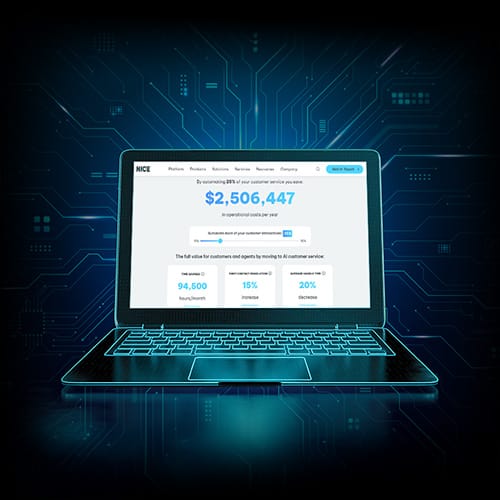
Discover the full value of AI in CX
Understand the benefits and cost savings you can achieve by embracing AI, from automation to augmentation.
From Pilot to Scale: Implementing Agentic AI in Healthcare Contact Centers
Success with agentic AI depends on starting with the right workflows, proving value quickly, and expanding thoughtfully. Organizations that try to automate everything at once often struggle. Those that begin with focused pilots and scale based on results build sustainable programs.
Phase 1: Discovery and Design (0-3 Months)
The first phase maps current operations to identify opportunities. Teams analyze call reason codes, volumes, and handle times to understand where patients spend time and where agents face repetitive work. The goal is selecting one or two high-volume, low-risk workflows for an initial pilot.
Good starting points often include appointment confirmations, basic eligibility checks, or simple status inquiries. These workflows are frequent, follow predictable patterns, and carry minimal risk if something goes wrong during early deployment.
During this phase, organizations also assess technology readiness—the state of existing workflows, system integrations, and data quality. NiCE provides healthcare-focused consulting to help teams identify quick wins and build realistic timelines.
Phase 2: Limited Deployment (3-6 Months)
The second phase deploys agentic AI agents in a limited scope, often in specific queues or for specific request types. Tight measurement tracks automation rate, customer satisfaction, and average handle time changes.
This phase reveals how AI agents perform with real patients and real data. Teams identify edge cases, refine rules, and adjust handoff thresholds based on actual results. Success metrics provide the evidence needed to expand scope.
Phase 3: Scaling Across Channels and Use Cases (6-12 Months)
With proven results from initial workflows, organizations add complexity. Rescheduling joins simple confirmations. Claims status joins eligibility checks. Proactive outreach extends reactive service. Voice channels join digital.
Workforce management adjusts based on new patterns. As AI handles more routine tasks, staffing models shift, often supported by AI workforce management for contact centers. Agents may handle fewer total interactions but spend more time on complex cases that benefit from human judgment.
Change Management
Frontline agents need early involvement. When staff understand that AI reduces repetitive tasks rather than replacing their roles, adoption improves. Training focuses on how agents interact with AI-driven journeys—when to intervene, how to provide feedback, what the AI can and cannot do.
Clear playbooks define escalation paths and override procedures. Agents should feel empowered to take control when situations require human judgment, not constrained by automation they don’t understand.
Key Metrics to Track
Effective measurement spans multiple domains:
Automation and containment rates show what percentage of interactions AI handles end-to-end
First-contact resolution indicates whether patients get answers without callbacks
Abandonment rates reveal whether reduced hold times improve access
Schedule utilization tracks whether accurate booking reduces no-shows
Denial rates measure whether better benefits communication prevents claim issues
Agent occupancy and quality scores ensure human agents aren’t overwhelmed or underutilized
NiCE provides pre-built analytics and AI quality management for contact centers within CXone to track these metrics and identify optimization opportunities as programs mature.

A scaling example: A multi-hospital health system began with appointment confirmation calls, automating roughly 40% of that volume within four months. With proven results—including a 15% reduction in no-show rates—they expanded to include rescheduling, pre-visit insurance verification, and post-procedure follow-up calls. By month twelve, AI agents handled portions of over 100,000 monthly interactions, equivalent to eight FTEs, while patient satisfaction scores improved and agent turnover decreased.
Risks, Governance, and Responsible Use of Agentic AI in Healthcare
Healthcare leaders are rightly cautious about autonomous technology. The same capabilities that make agentic AI powerful can create risk if not governed correctly. Responsible deployment requires clear frameworks, technical safeguards, and ongoing oversight.
Key Risk Areas
Hallucinated or incomplete answers represent a primary concern. Generative AI can produce confident-sounding responses that are partially or entirely incorrect. In healthcare, wrong information about benefits coverage or clinical preparation instructions can have real consequences for patients.
Misinterpretation of patient intent can lead to incorrect actions. If an AI agent books a new patient appointment when the patient actually needs an urgent same-day visit, the error creates downstream problems. Natural language is inherently ambiguous, and healthcare terminology adds complexity. For comprehensive solutions that offer seamless aggregation of real-time and historical cross-domain data, consider platforms like the NiCE CXone Dashboard.
Integration failures or stale data can provide outdated information. If coverage details haven’t synced from the payer system, or provider templates are out of date, AI agents may give inaccurate answers despite functioning correctly from a technical standpoint.
Governance Practices
Establish an AI oversight committee that includes compliance, clinical leadership, IT, and contact center operations. This cross-functional group defines policies, reviews performance, and makes decisions about expanding or restricting AI scope.
Define workflow eligibility clearly. Some workflows are appropriate for full automation. Others require AI-assist with human oversight. Still others should remain fully human-handled. Clear categorization prevents inappropriate automation of sensitive scenarios.
Set explicit escalation rules that define when AI agents must hand off to humans. These rules should cover low-confidence situations, patient expressions of frustration or distress, and any request type that falls outside defined automation boundaries.
Technical Safeguards
Confidence thresholds determine when AI agents act versus escalate. If the system isn’t sufficiently confident in its interpretation of a request, it routes to a human rather than guessing.
Continuous monitoring using NiCE analytics and quality tools flags anomalies, errors, or drift in AI performance. Regular review of interaction samples catches issues before they affect large numbers of patients.
Role-based access controls and encryption protect all PHI processed by AI agents. The CXone platform maintains detailed audit logs showing exactly what data was accessed and what actions were taken.
Regulatory Context
HIPAA requirements apply to agentic AI just as they do to any system handling PHI. Growing regulatory interest in AI transparency and accountability means healthcare organizations must be able to explain how AI makes decisions. NiCE’s focus on auditability and explainability supports compliance in an evolving regulatory environment.
A well-governed agentic AI program protects patients through accurate information, protects agents by handling routine burden while preserving meaningful work, and protects the organization through defensible decision-making and comprehensive documentation.
The Future of Healthcare Contact Centers with Agentic AI
Imagine a patient in 2028 managing a chronic condition. They receive a proactive message through their health system’s app noting they’re due for quarterly bloodwork. They tap to schedule, and an AI agent offers three nearby lab locations with next-day availability. They select one, and the confirmation includes parking directions and an estimated wait time.
Two days later, results arrive. The same AI agent—maintaining context from earlier interactions—explains that one value is slightly elevated and offers to connect them with a clinical pharmacist to discuss their medication. The conversation happens via video, and by the end, an adjusted prescription is already being sent to their pharmacy.
This seamless, proactive, contextual experience represents where healthcare contact centers are heading. The transformation is already underway.
From Reactive to Proactive
Contact centers evolve from call-takers into proactive access hubs. Rather than waiting for inbound calls, AI agents identify patients who need outreach—those at risk of missing follow ups, facing financial barriers, or approaching gaps in care—and initiate contact through preferred channels.
The shift changes staffing models. Instead of measuring success by calls answered per hour, organizations measure gaps closed, appointments kept, and barriers resolved.
From Siloed to Connected
Provider and payer operations have traditionally operated separately, forcing patients to navigate between multiple organizations with fragmented information. Agentic AI creates opportunities for more connected experiences where information flows across organizational boundaries—with appropriate consent and security—to reduce redundant questions and conflicting answers.
Emerging Capabilities
Predictive outreach becomes more sophisticated as AI identifies patterns in patient behavior and clinical data. Patients who historically struggle with medication adherence might receive tailored support. Those facing high out-of-pocket costs might get connected to financial assistance programs proactively.
**Workforce intelligence helps leaders forecast demand, tailor training, and prevent burnout. NiCE’s AI-based workforce management tools, informed by AI analysis of interaction patterns and agent performance, enable smarter staffing decisions and more sustainable work environments.
The Invisible Fabric
The most valuable AI is often invisible. Rather than a distinct “bot” experience that patients tolerate, agentic AI becomes underlying fabric that simplifies every interaction for patients, agents, and clinicians. Technology recedes into the background while outcomes improve.
Healthcare will always require human connection. Clinical decisions need clinical judgment. Complex emotions need empathetic listeners. Difficult conversations need skilled communicators. What agentic AI provides is the infrastructure to ensure human talent focuses on these moments rather than on routine tasks that technology handles better.
When embedded in a platform like NiCE CXone, agentic AI turns healthcare contact centers into connected, efficient, human-centered access points that scale without sacrificing trust. The technology handles the predictable complexity—the scheduling rules, the benefits lookups, the status checks—so that healthcare organizations can deliver on their fundamental promise: making care easier for every patient who needs it.
Also related to Agentic AI in CX:
- Agentic AI for Real Time Agent Coaching
- KPIs for Agentic AI CX
- Autonomous AI Agents in Contact Centers
- Agentic AI Governance Frameworks
- AI Agents for Quality Management
- Agentic AI in Retail Customer Experience
- Copilot vs Autopilot AI in CX
- Agentic AI for CX Operations Management
- Agentic AI Architecture for CX Platforms
- Agentic AI in Financial Services CX
Frequently Asked Questions (FAQs)

Ready to experience the power of one platform?
Let us show you how NiCE can unify, automate and elevate your entire customer experience - with AI at the core and outcomes at the forefront.