On this page
- From Static to Autonomous AI Agents
- Core Cost Levers in CX Operations
- AI Agents in Digital Self-Service
- Optimizing Human Labor Costs
- Reducing Risk, Rework, and Costs
- Platform Economics with NiCE
- Implementation Roadmap
- KPIs for Cost and Experience
- Looking Ahead: Better CX
- Security and Autonomous AI
- Training for a Hybrid Workforce
- From Static to Autonomous AI Agents
- Core Cost Levers in CX Operations
- AI Agents in Digital Self-Service
- Optimizing Human Labor Costs
- Reducing Risk, Rework, and Costs
- Platform Economics with NiCE
- Implementation Roadmap
- KPIs for Cost and Experience
- Looking Ahead: Better CX
- Security and Autonomous AI
- Training for a Hybrid Workforce

How autonomous agents differ from traditional automation and why that matters for cost structure
The specific cost buckets where AI agents deliver the fastest returns
Realistic implementation timelines and ROI expectations
Governance frameworks that ensure sustainable savings
KPIs that connect cost reduction to experience quality
A forward-looking perspective on where CX operations are heading
From Static Automation to Autonomous AI Agents in the Contact Center
The evolution from rules-based systems to autonomous ai systems represents a fundamental shift in what’s possible for customer service operations. Unlike traditional AI systems, which require human oversight and are limited in scope, autonomous AI agents can independently perform complex tasks, make decisions, and adapt in real-time. Understanding this progression clarifies why cost structures are changing so dramatically.In the early 2000s, contact centers deployed IVR systems and basic RPA tools that followed rigid decision trees. These worked well for predictable scenarios but struggled with exceptions. A customer calling about a billing dispute that also involved a service outage would bounce between queues, frustrating everyone involved.The 2010s brought machine learning algorithms that could handle more variability, but these models still operated within narrow parameters. They could classify intent or predict outcomes, but couldn’t reason through novel situations or take independent action.The current wave—emerging strongly since 2022–2023—introduces agentic ai: autonomous systems that can plan multi-step workflows, call internal APIs, maintain context across channels, and self-improve based on outcomes. This represents significant innovation, as these technologies are transforming industries by enabling new capabilities and driving cost efficiencies. AI developers play a crucial role in this evolution, creating, training, and ethically guiding these autonomous agents to ensure responsible deployment and avoid biases. An autonomous agent handling a bank account issue can verify identity, check transaction status, execute a change, confirm the outcome, and summarize the interaction—all without human oversight for routine cases.NiCE positions AI as an invisible infrastructure layer inside CXone, orchestrating customer interactions rather than serving as a standalone product. This approach means AI enhances every touchpoint without customers or agents needing to consciously “interact with AI.” The intelligence flows through the journey, surfacing real time insights where they matter and automating decisions where confidence is high.Why this evolution matters for cost structure:Moving from “per-script” automation to “per-intent” automation at scale
Handling exceptions that previously required human escalation (agents handling 5-10x more edge cases than RPA)
Maintaining context across channels eliminates redundant data collection
Continuous learning reduces the cost of maintaining automation over time
Collaboration between autonomous agents and human agents ensures hand-offs happen with full context
Where the Savings Come From: Core Cost Levers in CX Operations
Understanding where costs actually live in a contact center operation reveals where autonomous agents can deliver the greatest impact. Most large centers see costs distributed across five primary buckets.Labor represents 60–75% of total operating expense in most contact centers. This includes frontline agents, supervisors, trainers, and workforce management staff. Autonomous agents reduce labor costs through higher self-service containment, shorter handle times, and fewer escalations—not by replacing human workers wholesale, but by handling routine tasks that consume agent capacity.Technology stack costs often fragment across IVR platforms, chatbot vendors, workforce management tools, quality assurance software, and analytics solutions. Each carries licensing fees, integration overhead, and administrative burden. Consolidating onto a unified platform with built-in autonomous AI dramatically simplifies this landscape. Autonomous AI agents further reduce operational costs by minimizing errors and reducing the need for manual intervention, leading to more efficient and scalable processes.Training and onboarding drain resources continuously in high-turnover environments. New agents typically require 4–8 weeks to reach proficiency. AI-assisted onboarding and in-the-flow coaching compress ramp-up time by 20–30%, reducing the cost of each hire and accelerating time to productivity.Quality and compliance consume significant headcount in regulated industries. Traditional models sample 1–2% of interactions for manual review—missing systemic issues and requiring large QA teams. Autonomous monitoring of 100% of customer interactions identifies problems faster while reducing manual effort. AI agents handle data processing at scale and help identify inefficiencies in workflows, improving compliance and operational effectiveness.Failure demand may be the most overlooked cost bucket. Repeat contacts, escalations, and complaints that result from poor first-contact resolution waste agent time and frustrate customers. Proactive outreach and autonomous resolution of issues before they escalate cut this hidden expense significantly.Beyond contact centers, autonomous AI agents are increasingly used in inventory management and production processes, complementing comprehensive contact center solutions that enhance customer experience and operational efficiency. They enable real-time stock monitoring, predictive maintenance to reduce unplanned downtime and repair costs, and optimize supply chains by analyzing large datasets to forecast demand and manage logistics. Additionally, these agents can detect anomalies in real-time, reducing financial losses from fraud by up to 60%.Example scenario: A 3,000-seat financial services contact center deployed autonomous digital agents and AI-driven routing across voice and messaging channels using AI customer service automation solutions. Over 24 months, the organization reduced annual operating costs by 18–22% while maintaining service hours and improving CSAT scores. The savings came from higher containment, faster resolution, reduced training overhead, and near-elimination of compliance sampling costs.
Two Leaders.
One platform.
At NiCE, we’re setting the standard for AI-first customer experience.
Get the reports
Autonomous AI Agents in Digital Self‑Service: The Fastest Path to Cost Reduction
The most immediate cost reductions typically emerge from digital self-service channels—web, mobile app, messaging, and AI-powered voicebots that conduct natural, human-like conversations—where autonomous agents can fully resolve high-volume intents without live agent involvement. These agents are capable of performing tasks and handling data processing within digital self-service channels, optimizing workflows and reducing manual efforts.This isn’t about deflecting customers to inferior experiences. It’s about resolving their needs faster and more completely than traditional channels often allow. When done well, digital self-service delivers both significant cost savings and higher customer satisfaction.High-volume use cases where autonomous agents achieve >70% resolution:Telecom: Plan changes, SIM activation, billing inquiries, roaming setup, data add-ons
Banking: Balance and transaction queries, card limits, travel notices, basic disputes, payment scheduling
Retail/e-commerce: Order status, returns and exchanges, delivery changes, store availability, loyalty point redemption
Insurance: Claims status, policy document requests, beneficiary updates, payment history
High-volume intents typically represent 40–60% of total contact volume
Autonomous resolution at >60% containment shifts thousands of interactions per day from $5–8 assisted cost to $0.80–1.50 automated cost
Per-interaction savings compound rapidly at scale—a center handling 10 million annual contacts can achieve annual savings of $15–25 million from digital containment alone
First-year deployments typically target top 5–10 intents, expanding to 20–30+ intents by year two
Case Example: Reducing Cost per Contact in a 5,000‑Seat Contact Center
Consider a global retail brand running NiCE CXone, handling 40 million customer contacts per year across voice, chat, and messaging. Before deploying autonomous agents, the operation relied heavily on live agents for most inquiries, with limited self-service capability beyond basic FAQ pages.The deployment approach:The organization started with order status, returns, and delivery changes—three intents representing 35% of total volume. Autonomous digital agents were deployed on web chat and messaging channels, integrated with order management and logistics systems to provide real time data on specific customer orders. These agents also automated inventory management and data processing tasks, enabling seamless updates on stock levels, order fulfillment, and logistics, while reducing manual oversight and improving operational efficiency.The results over 18 months:25% of simple inquiries deflected from voice to digital self-service
60% resolution rate achieved within digital self-service (no escalation to live agent)
Effective cost per contact reduced by 22%
Optimizing Human Labor Costs Without Sacrificing Agent Experience
Autonomous agents deliver cost reduction not by eliminating human workers, but by removing low-value work that consumes their time and energy. By reducing the need for manual intervention and minimizing errors, autonomous AI agents streamline operations and improve process accuracy, leading to lower operational costs. This distinction matters both ethically and practically—organizations that pursue automation as a pure headcount reduction play often see quality erode and attrition spike.The smarter approach uses AI to amplify what human agents do best: handling complex tasks, showing empathy, and building trust through genuine human connection. By automating complex workflows, autonomous AI agents enable businesses to respond quickly to changing market conditions and customer needs.How autonomous agents reduce cost per FTE:Pre-contact automation: Authentication, data gathering, and intent clarification happen before the agent connects, reducing handle time by 30–60 seconds per interaction
In-contact assistance: Real-time guidance, suggested responses, and next-best-actions help agents resolve issues faster without searching knowledge bases or consulting supervisors
Post-contact automation: Automatic call summarization and data entry eliminate 2–5 minutes of after-call work per interaction
Scheduling optimization: AI-driven workforce management matches staffing to demand patterns with greater precision, reducing both overstaffing costs and understaffing stress
10–20% reduction in average handle time with AI-assisted agents
20–30% faster ramp-up time for new hires using AI-guided training
15 hours per week saved on data aggregation and administrative tasks per agent

Workforce Engagement and Retention: Hidden Cost Savings
Attrition represents one of the most expensive—and most overlooked—cost drivers in contact center operations. Industry benchmarks show replacement costs of $7,000–$15,000 per agent, accounting for recruiting, training, and productivity loss during ramp-up. In a 2,000-agent center with 40% annual turnover, that’s $5.6–$12 million in hidden annual expense.Autonomous AI agents and AI-driven workforce engagement address the root causes of attrition and are also reshaping labor markets by displacing some traditional roles, creating new ones, and requiring workers to adapt and develop new skills to stay competitive:Reduced burnout: Removing repetitive tasks and emotionally draining volume gives agents more meaningful work
Personalized coaching: AI-powered performance insights provide development feedback that helps agents grow, not just compliance metrics that feel punitive
Calmer workdays: Smarter routing and load balancing prevent the peaks and valleys that exhaust agents and erode morale
Career visibility: Data driven insights help supervisors identify growth opportunities and match agents to work that fits their strengths
Reducing Risk, Rework, and Compliance Costs with Autonomous Agents
A significant share of operational cost in regulated industries ties not to direct service handling, but to risk management, rework, disputes, and compliance failures. These expenses often hide in different budget lines, making them easy to underestimate.Autonomous agents fundamentally change the economics of compliance and quality assurance:Automatic documentation: AI agents capture and summarize every interaction in real time, eliminating manual note-taking errors and creating complete audit trails. One analysis showed organizations reducing documentation-related human error by 75%, avoiding costly invoice and processing mistakes. By reducing manual intervention and minimizing errors in compliance processes, autonomous AI agents further lower operational risks and costs.100% monitoring: Traditional QA samples 1–2% of interactions—a statistical approach that misses systemic issues and requires large review teams. AI governance through autonomous monitoring evaluates every interaction against compliance criteria, surfacing problems immediately rather than weeks later.Real-time intervention: Rather than catching violations after the fact, autonomous agents can trigger prompts for mandatory disclosures, payment handling rules, or regulatory requirements during the interaction. This prevents violations rather than remediating them.Risk assessment automation: Machine learning algorithms continuously evaluate interaction patterns for fraud indicators, complaint escalation risk, and regulatory exposure, enabling proactive mitigation strategies. Advanced data processing by autonomous AI agents allows for more accurate and timely risk assessments, reducing the need for manual intervention and improving overall compliance.In financial services, insurance, and healthcare, automated compliance monitoring routinely achieves:60% reduction in compliance-related workload
Double-digit decreases in dispute-related recontact
Avoidance of multi-million-dollar penalties through early detection
Quality Management at Scale: From Manual Sampling to AI‑Driven Assurance
The traditional quality management model strains under modern volume and complexity. Large QA teams manually review a tiny fraction of interactions, applying subjective criteria that vary between evaluators. The result: inconsistent feedback, delayed insights, and limited ability to identify systemic issues before they become costly problems. Autonomous AI agents reduce the need for manual intervention and help minimize errors, leading to more accurate and efficient quality assurance processes.Autonomous agents and AI-infused customer interaction analytics tools transform this equation, with platforms like NiCE Interaction Analytics (formerly Nexidia Analytics) enabling deep insight at scale:Objective auto-scoring: Every interaction receives evaluation based on consistent criteria—adherence to process, empathy markers, resolution effectiveness, compliance requirements. Advanced data processing enables these systems to analyze large volumes of interactions efficiently, supporting higher quality management standards.
Exception-based human review: Rather than random sampling, AI surfaces high-risk or low-quality interactions for human attention, focusing expert judgment where it creates the most value
Faster feedback loops: Agents receive coaching within hours or days rather than weeks, accelerating informed decisions and behavior change
50–70% reduction in manual QA workload
Faster identification of training needs and process gaps
Improved first-contact resolution as coaching becomes timelier and more targeted
Higher agent satisfaction as feedback becomes more consistent and actionable

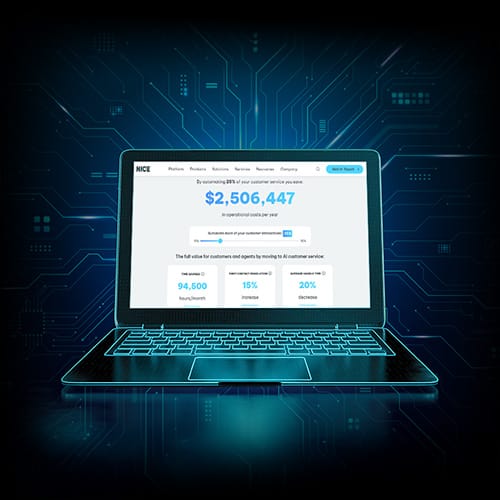
Discover the full value of AI in CX
Understand the benefits and cost savings you can achieve by embracing AI, from automation to augmentation.Calculate your savingsPlatform Economics: Consolidating Tools and Simplifying Operations with NiCE
Beyond direct operational savings, autonomous AI agents deployed on unified platforms deliver significant infrastructure cost reductions. Most enterprise contact centers operate a patchwork of point solutions—separate vendors for IVR, chatbots, workforce management, quality assurance, analytics, and compliance. Each carries its own:Licensing and subscription fees
Integration requirements and maintenance overhead
Administrative burden and vendor management costs
Upgrade cycles that rarely align
Reduced licensing costs: One platform replaces multiple point solutions, often at lower total cost
Lower integration overhead: Native connections between AI, routing, workforce management, and analytics eliminate custom integration maintenance
Simplified vendor management: One relationship, one roadmap, one contract renewal cycle
Reusable AI infrastructure: Models, data, and orchestration logic apply across journeys, reducing the marginal cost of adding new use cases
Cloud, Scale, and Pay‑as‑You‑Grow Economics
Autonomous AI agents deployed through CCaaS platforms avoid the heavy upfront capital expenditure typical of on-premise systems. This shift from CapEx to OpEx changes how organizations plan and budget for CX technology.Cloud economics offer several cost advantages:Elastic scaling: Handle peak demand without permanent overstaffing or infrastructure overprovisioning
Usage-based pricing: Costs align with actual interaction volume, protecting budgets during downturns
Continuous updates: Platform improvements arrive automatically, without costly upgrade projects
Reduced infrastructure burden: No on-premise servers, networking equipment, or associated maintenance
Lower operational costs: Cloud-native autonomous AI agents reduce operational costs by minimizing errors and manual intervention, leading to more efficient and accurate processes.
Implementation Roadmap: Realizing Cost Reduction in 6–24 Months
Deploying autonomous AI agents for meaningful cost reduction requires a phased approach that balances quick wins with sustainable transformation. The successful implementation of these systems relies heavily on the expertise of AI developers, who are responsible for creating, training, and ethically guiding autonomous agents, often in close partnership with solution providers who offer dedicated guidance and support through resources like NiCE’s contact and expert consultation channels. The integration of generative AI technologies and the drive for significant innovation are transforming business operations, enabling new capabilities, and fostering industry-wide change. Most enterprise implementations follow a pattern:Months 0–3: Discovery and BaseliningMap top 20–30 intents by volume and complexity
Calculate current cost per contact by channel and intent category
Identify compliance hotspots and high-rework areas
Assess data foundations: clean interaction data, knowledge bases, API access to core systems
Define success metrics and governance structure
Deploy autonomous digital agents for top 5–10 high-volume, lower-complexity intents
Integrate with core business systems (CRM, order management, billing)
Refine conversational flows based on performance data
Establish monitoring and escalation protocols
Begin measuring containment, cost per contact, and customer satisfaction
Extend autonomous handling to more complex workflows and additional intents
Deploy AI-assisted agent tooling (real-time guidance, auto-summarization)
Expand to additional channels (voice, additional messaging platforms)
Implement AI-driven quality monitoring and compliance automation
Optimize workforce engagement with predictive scheduling and coaching
Integrate workforce engagement, quality, and compliance into unified AI orchestration
Implement advanced demand forecasting and resource allocation optimization
Deploy proactive outreach for issue prevention
Refine strategic planning based on accumulated performance data
Establish continuous improvement processes
Governance, Risk Management, and Change Enablement
Sustainable cost reduction depends on strong ai governance for autonomous agent deployments. Organizations that treat governance as an afterthought often see initial gains erode as edge cases accumulate and oversight gaps emerge.Essential governance elements:Clear ownership: Define accountability across IT, operations, risk, and compliance—autonomous agents touch all these domains
Escalation guardrails: Establish confidence thresholds that trigger human oversight for uncertain or high-stakes decisions
Continuous monitoring: Track for bias, drift, and unintended impacts on customer segments; AI systems require ongoing attention, not set-and-forget deployment
Ethical considerations: Ensure transparency about AI involvement where appropriate and maintain human agency for sensitive situations
Training that helps agents work effectively alongside AI tools
Career development programs that prepare workers for higher-value roles
Recognition that autonomous agents enable agents to perform tasks that better utilize their human skills
Feedback channels that surface issues and improvement opportunities from the front line
Measuring What Matters: KPIs for Cost Reduction and Experience Quality
Effective measurement connects cost reduction efforts to experience outcomes. Autonomous AI deployments that optimize for cost alone often create downstream problems—higher effort, lower satisfaction, increased churn—that erode savings over time.Essential KPIs for tracking cost reduction with autonomous ai agents:Track metrics at the intent level, not just aggregate—some use cases may underperform while overall numbers look healthy
Monitor experience metrics alongside efficiency metrics; cost reductions that damage trust aren’t sustainable
Establish baselines before deployment and measure incrementally
Use journey analytics to identify where automation creates friction versus where it accelerates resolution
Review metrics monthly in cross-functional forums that include operations, technology, and experience leaders
Looking Ahead: Cost Reduction as a By‑Product of Better CX
The most durable cost reductions from autonomous AI agents arise when organizations focus on easier, more human customer journeys—not simply on cutting headcount. This perspective reframes the opportunity: AI isn’t primarily a cost reduction tool. It’s an experience transformation enabler that happens to reduce cost.The autonomous agent economy is maturing rapidly and is poised to have a profound economic impact on the global economy, as illustrated in real-world case studies and stories showcased in the Why NiCE? video series. Over the next 3–5 years, we can expect:A growing share of simple customer interactions fully handled by autonomous agents, with human agents increasingly specialized for complex problem-solving and empathy-driven work
AI operating as invisible infrastructure across all channels, orchestrating experiences and surfacing real time insights without customers needing to consciously “interact with AI”
Self-optimizing agents using reinforcement learning to auto-tune for efficiency, with some projections suggesting 90%+ efficiency gains in specific use cases by 2027
Hybrid human-AI orchestration becoming standard practice, with seamless hand-offs that preserve context and trust
ROI timelines compressing as tools mature and implementation patterns become more established

Cost reduction achieved through effortless resolution, not deflection to inferior channels
Agent experience improved through removal of mundane work, not elimination of meaningful roles
Customer trust built through consistency and competence, enabled by AI that operates invisibly behind the scenes
Economic growth created by freeing human capacity for the work that only humans can do
Security and Autonomous AI: Safeguarding Operations and Data
As autonomous AI agents become integral to business operations, their ability to operate independently and make real-time decisions brings both transformative benefits and new security challenges. The shift toward autonomous ai systems means less human intervention in day-to-day processes, which can minimize human error—a frequent source of security incidents—but also requires organizations to rethink their approach to safeguarding sensitive data and critical operations.Robust AI governance is essential to ensure that ai agents act within defined boundaries and that their actions are transparent and auditable. Implementing comprehensive security frameworks for autonomous ai systems helps prevent unauthorized access, data breaches, and other cyber threats that could undermine significant cost savings achieved through automation. By leveraging autonomous ai agents, businesses can enhance their security posture, as these intelligent systems are capable of continuously monitoring operations, analyzing real time data, and identifying potential threats before they escalate.AI-powered security solutions can detect anomalies and respond to incidents faster than traditional methods, reducing the risk of costly breaches that could offset operational cost savings. As the autonomous agent economy grows, organizations must prioritize security investments that keep pace with the evolving capabilities of autonomous ai. This proactive approach not only protects business operations but also ensures that the benefits of cost savings and efficiency gains are not compromised by preventable security incidents.Training and Autonomous AI: Building Skills for a Hybrid Workforce
The rise of autonomous AI agents is reshaping the labor market, ushering in a new era of hybrid workforces where humans and intelligent systems collaborate seamlessly. To fully leverage the potential of autonomous ai agents in business operations, organizations must invest in training programs that empower human workers to thrive alongside these advanced technologies.Upskilling is critical—employees need to develop expertise in areas such as machine learning, data analysis, and effective human ai collaboration. By automating repetitive tasks, autonomous ai systems free up human workers to focus on complex problem-solving, creative thinking, and strategic decision making. This shift not only enhances job satisfaction but also drives greater value for the business, as employees can dedicate more time to activities that require uniquely human skills.Sales teams, for example, can benefit from real time insights and data driven recommendations provided by autonomous ai agents, enabling more informed decisions and improved customer engagement. As business processes become increasingly data driven, the ability to interpret and act on AI-generated insights will be a key differentiator for organizations aiming to stay ahead in a competitive landscape.Prioritizing training and upskilling ensures that the workforce is prepared to adapt to new roles and responsibilities, supporting both economic growth and operational efficiency. By fostering a culture of continuous learning and embracing the opportunities presented by autonomous ai, organizations can maximize the benefits of intelligent systems while creating new pathways for job creation and professional development.Also related to Agentic AI in CX:
- KPIs for Agentic AI CX
- Autonomous AI Agents in Contact Centers
- Agentic AI Governance Frameworks
- AI Agents for Quality Management
- Agentic AI in Retail Customer Experience
- Copilot vs Autopilot AI in CX
- Agentic AI in Healthcare Contact Centers
- Agentic AI for CX Operations Management
- Agentic AI Architecture for CX Platforms
- Agentic AI in Financial Services CX
Frequently Asked Questions (FAQs)