

Agentic AI for CX Operations Management
How is agentic AI being applied to CX operations management — and what changes for supervisors and managers when AI handles autonomous workforce scheduling, real-time capacity rebalancing, automated reporting, and proactive SLA management in their place?
Contact center leaders in 2025 face a familiar pressure: interaction volumes keep climbing, customer journeys grow more complex across channels, and budgets remain stubbornly flat. The expectation to deliver faster resolutions, higher customer satisfaction, and lower costs simultaneously has never been more intense.
Agentic AI offers a fundamentally different approach. Unlike traditional automation that follows rigid scripts, agentic AI systems can autonomously manage significant portions of CX operations—routing interactions, adjusting staffing, monitoring quality, ensuring compliance—while keeping human agents and supervisors firmly in control. By 2029, analysts forecast that agentic AI will autonomously resolve 80% of common customer service issues without human intervention in leading enterprises. That shift translates directly to operational KPIs: reduced average handle time, improved first contact resolution rates, and stronger NPS scores.
NiCE, as a global leader in CX and cloud contact center solutions through CXone contact center solutions, uses agentic AI as infrastructure to orchestrate the entire customer journey. This isn’t about replacing call center agents. It’s about giving operations teams intelligent systems that can act across routing, workforce engagement, quality management, and compliance in real time.
This article focuses specifically on CX operations management: how agentic AI changes day-to-day decisions about routing, staffing, quality, and control in large contact centers. We’ll walk through practical use cases, implementation steps, and the human-centered principles that make this technology work.

The contrast between traditional automation and agentic AI–orchestrated operations is stark:
What Is Agentic AI in the Context of CX Operations?
Agentic AI refers to autonomous, goal-driven AI agents that can observe conditions, reason through options, decide on actions, and execute across multiple systems on behalf of customers, human agents, and supervisors. These intelligent systems go far beyond what traditional bots or IVR menus can accomplish.
The core differences from legacy automation:
Multi-step reasoning: Instead of following a decision tree, agentic AI evaluates complex situations, weighs trade-offs, and determines the best path forward—even when circumstances change mid-interaction.
Tool use and system integration: AI agents can call APIs, update CRM records, check backend systems, process refunds, and trigger workflows across platforms without waiting for human intervention.
Continuous adaptation: Rather than requiring manual reprogramming, agentic AI systems learn from customer interactions and adjust their behavior based on outcomes.
Memory and context: These ai systems maintain context across channels and over time, remembering past interactions and using that history to inform current decisions.
In CX operations, think of agentic AI as an “operations conductor.” It monitors queues, agent states, customer sentiment, and system performance in real time. When conditions change—a sudden volume spike, an agent calling in sick, a product incident generating contacts—the AI can adjust routing, reprioritize work, or trigger callbacks without waiting for a supervisor to notice the problem.
The core enabling technologies include large language models for understanding intent and generating responses, orchestration layers that coordinate actions across systems, memory systems that maintain context, analytics for continuous improvement, and deep integrations with CRM, billing, and workforce engagement platforms.
Concrete example: It’s Monday morning, and your voice queue suddenly spikes 40% above forecast due to a billing system glitch over the weekend. Traditional automation would keep routing calls through the same static skills-based trees, overwhelming your tier-1 agents. An agentic AI operations agent detects the spike, identifies the root cause from early call transcripts, adjusts routing to prioritize customers with payment issues, surfaces relevant knowledge articles to agents, and even triggers proactive SMS messages to affected customers—all within minutes, without supervisor intervention.
How Agentic AI Reshapes Day-to-Day CX Operations Management
The shift from reactive queue management to proactive orchestration changes how CX operations leaders spend their time. Instead of constantly firefighting—adjusting schedules, overriding routing rules, escalating stuck cases—supervisors can focus on strategy, coaching, and cross-functional initiatives.
Agentic AI continuously monitors queues, SLAs, agent states, and customer sentiment across every channel. When it detects a problem—or better yet, predicts one before it happens—it can take immediate action: re-routing interactions, reprioritizing work, adjusting staffing, or triggering proactive outreach.
Dynamic routing represents one of the most impactful changes. Instead of static skills-based routing trees that require manual maintenance, AI assigns each interaction based on real time data access: predicted intent, customer history, sentiment signals, agent occupancy, and forecasted handle time. The result is better matching between customer needs and agent capabilities, reducing transfers and improving first contact resolution.
Key operational shifts with agentic AI:
From reactive to anticipating customer needs: AI spots patterns in interaction data and triggers action before customers need to call—payment reminders, appointment confirmations, service alerts.
From channel silos to journey orchestration: AI tracks context across the entire customer journey, maintaining context whether someone moves from web self service to chat to voice.
From periodic reviews to continuous optimization: Instead of weekly WFM reviews, AI makes intraday adjustments automatically based on live conditions.
From manual exception handling to intelligent escalation: AI handles routine tasks autonomously and routes complex cases to human agents with full context already assembled.
From fragmented data sources to unified intelligence: AI pulls from CRM, billing, knowledge bases, and analytics to inform every decision, eliminating the customer data silos that slow resolution.
Operational scenario: A regional utilities provider faces unpredictable storm-driven volume spikes. In 2025, using agentic AI through CXone, their operations team sets policies that allow AI to automatically shift agents between voice and digital channels as demand fluctuates. During a major storm event, the AI detects rising call volumes, identifies the affected service area from early interactions, activates outage-specific IVR messaging, routes high-priority customers (medical equipment users, seniors) to live agents first, and proactively sends SMS updates to affected areas. Service levels stay stable despite a 300% volume increase.
From Static Scripts to Autonomous Service Journeys
Legacy IVR scripts and pre-defined workflows break when customers deviate from expected paths. One wrong keypress, one ambiguous request, and the whole interaction stalls.
Agentic ai works differently. These systems adapt based on customer intent, behavior, and policy constraints:
Before: Customer calls about a billing dispute. IVR routes to general queue. Agent spends 4 minutes pulling up history, verifying identity, understanding the issue. Transfers to billing specialist. Customer repeats story. Resolution takes 18 minutes.
After: AI agent handles initial contact, authenticates using purchase history and verification questions, retrieves relevant billing data, identifies the likely dispute based on recent charges, applies policy-appropriate resolution (credit, adjustment, explanation), confirms with customer, sends documentation. If the case requires human judgment, it routes to a specialist with full context already assembled. Resolution: 6 minutes.
Cross-channel continuity matters enormously. Agentic AI remembers prior steps even when customers move between channels. Start a conversation on chat, continue on phone, finish via email—the AI maintains complete context, eliminating the frustrating “let me look up your account” moments that erode trust.
This continuity directly reduces repeat contacts and transfer loops, improving first contact resolution rates and customer effort scores.
Real-Time Decisioning Across the Entire CX Stack
Agentic AI can coordinate multiple CX systems—CCaaS, CRM, billing, fraud detection, knowledge management—acting as an intelligent layer on top of existing infrastructure. This is crucial for enterprises with existing legacy systems they can’t replace overnight.
Practical examples of real-time decisioning:
Outbound campaign coordination: AI detects unexpected inbound volume spike and automatically pauses outbound campaigns to preserve inbound service levels. Impact: 15% improvement in service level adherence during peak periods.
Back-office prioritization: After a product recall announcement, AI reprioritizes back-office work queues to expedite return processing and customer communications. Impact: 40% reduction in customer callback rates.
Cross-region load balancing: AI identifies that APAC queue is understaffed due to unexpected absences and routes appropriate interactions to North American agents during overlap hours. Impact: ASA maintained under 45 seconds despite 20% staffing shortfall.
Fraud intervention: AI detects conversation patterns suggesting potential fraud attempt and triggers additional verification steps or supervisor review without disrupting legitimate customer interactions. Impact: 60% faster fraud identification.
NiCE’s cloud-based AI operates across hybrid environments using APIs and connectors, connecting to on-prem telephony, cloud CRM, and legacy billing systems through its Open Cloud CX AI platform architecture. This avoids the need for disruptive rip-and-replace projects while still delivering intelligent automation.
The measurable results for CX teams: fewer manual overrides for supervisors, more stable SLAs, and better consistency across regions and lines of business.
Key Use Cases of Agentic AI for CX Operations Leaders
CX operations leaders should think in terms of concrete use cases, not technology features. Agentic AI delivers business value when it solves specific operational pain points: staffing volatility, quality gaps, compliance risk, and fragmented journeys.
The use cases below represent areas where enterprises in financial services, government, and telecommunications are moving from pilot projects to scaled deployment between 2024 and 2026.

Self-Optimizing Contact Routing and Queue Management
Traditional skills-based routing treats each interaction as independent, routing based on what the customer says they need. Agentic AI routing agents evaluate each incoming interaction using predicted intent, sentiment, and complexity—often understanding the real need better than the customer’s initial description.
How it works:
AI analyzes real-time signals: customer data from CRM, recent support interactions, speech patterns indicating frustration, and predicted handle time.
AI evaluates available agents: current occupancy, recent performance on similar interactions, skills, and forecasted load.
AI assigns the interaction to the best-fit human or virtual agent based on all factors, updating continuously as conditions change.
Scenario: A global bank uses agentic AI to maintain a 60-second average speed of answer (ASA) target for priority customers across EMEA, APAC, and North America. The AI monitors real-time queue depth, agent availability, and customer tier across all regions. When EMEA experiences unexpected volume, it routes appropriate interactions to early-shift North American agents, maintaining the ASA target while avoiding overtime costs. Result: 23% improvement in service level adherence, 18% reduction in abandon rates for priority segment.
Workforce Management and Intraday Optimization
Traditional workforce management relies on forecasts created days or weeks in advance, with supervisors making manual adjustments when reality diverges from plan. AI workforce management for contact centers augments WFM by making intraday adjustments automatically.
The AI continuously analyzes real-time demand versus staffing and can:
Offer voluntary overtime to available agents via app notifications
Shift agents between channels based on current demand patterns
Identify agents with skills gaps who could be moved to training during unexpected low-volume periods
Recommend schedule swaps that benefit both coverage and agent preferences
Scenario: A retail contact center in Q4 2025 experiences sudden spikes in cart-abandonment-related chats during flash sales. The AI detects the pattern within minutes, identifies agents currently handling email who have chat skills, and offers them the opportunity to switch channels. Agents who accept get a gamified incentive. Within 15 minutes, chat capacity increases 30% without overtime costs. Adherence remains stable, and the marketing teams can run promotions without overwhelming the contact center.
Key metrics impacted: adherence, shrinkage, utilization, and overtime costs—all improving without adding headcount when supported by AI-based workforce management.
Quality, Coaching, and Agent Assist at Scale
Traditional quality management samples 1-3% of interactions, missing the vast majority of coaching opportunities and compliance issues. AI-powered quality management for contact centers and agentic AI monitor 100% of interactions in real time, flagging risk, detecting customer effort, and triggering targeted guidance.
Think of AI, powered by advanced interaction analytics, as a silent operations coach:
Surfaces live prompts during complex calls (“Customer mentioned prior authorization—here’s the updated policy”)
Suggests next-best actions based on conversation flow
Links to relevant knowledge articles without agent having to search
Flags potential compliance issues before they become problems
Scenario: A healthcare insurer in 2026 uses agentic AI to ensure agents always follow updated prior-authorization rules. When regulations change, the AI immediately incorporates new requirements into its real-time guidance. Agents receive contextual prompts during calls without needing to attend training sessions or memorize new procedures. Error rates drop 35%, rework decreases 28%, and repeat calls related to authorization issues fall 42%.
This approach directly supports service quality, compliance, and customer trust—without slowing agents down or adding manual effort for supervisors.
Proactive Service and Journey-Level Operations
Reactive service waits for customers to call with problems. Agentic AI spots early warning signs across the entire customer journey and triggers outreach before customers need to contact you.
Early warning signals the AI monitors:
Payment failures or declined transactions
Repeated login issues
Unusual usage patterns
Churn risk indicators from behavioral analysis
Service degradation in customer’s area
Proactive journey stories:
Telecom outage response: Regional network outage detected at 2:15 PM. By 2:25 PM, AI has identified affected customers from service data, sent proactive SMS notifications with estimated restoration time, activated IVR messaging for affected area codes, and scheduled automated callbacks for customers who attempted to call during the outage. Inbound call volume reduced 60% compared to previous similar incidents.
Card issuer fraud prevention: AI detects suspicious transaction pattern on customer account at 9:47 AM. Within 2 minutes, customer receives SMS alert. Customer confirms fraud, and card is frozen before additional charges occur. Customer expresses gratitude rather than frustration. Trust increases, and the interaction becomes a loyalty moment rather than a complaint.
Subscription renewal optimization: AI identifies customers whose usage patterns suggest they may not renew. Triggers personalized outreach 45 days before renewal with relevant offers based on purchase history and usage data. Renewal rate improves 18% compared to standard renewal campaigns.
The business outcomes are clear: fewer inbound contacts, lower cost per resolution, and higher customer satisfaction because customers feel looked after rather than ignored until they complain.
Risk, Compliance, and Real-Time Controls
For regulated industries—financial services, healthcare, government—agentic AI serves as a compliance co-pilot for operations managers. Instead of relying on post-call audits that catch problems too late, AI monitors conversations in real time.
Real-time compliance monitoring capabilities:
Verifying required disclosures are made at appropriate points
Detecting prohibited language or promises
Confirming consent is obtained before proceeding
Identifying potential fraud indicators
Ensuring procedural steps (PCI-DSS, MiFID II, HIPAA) are followed
Scenario: A European financial services contact center in 2025 must enforce MiFID II requirements across thousands of daily interactions. Agentic AI monitors each conversation, providing agents with real-time prompts when disclosures are required, blocking certain actions until compliance steps are completed, and automatically triggering supervisor review when risk thresholds are met. Agents focus on helping customers rather than remembering regulatory checklists. Compliance incident rate drops 67%.
When risk thresholds are met, AI can automatically adjust workflows—requiring supervisor approval for exceptions, blocking certain actions, or escalating to compliance teams. This represents responsible ai in practice: maintaining human oversight while enabling agents to work efficiently.
NiCE’s heritage in risk and compliance analytics, including recording, audit trails, and policy enforcement, as outlined in its company background as a global CX leader, provides the foundation for robust guardrail design in agentic AI deployments.
Implementing Agentic AI in CX Operations: A Practical Roadmap
Successful agentic AI implementation requires a phased approach tailored to contact center realities. Over-ambitious projects that try to automate everything at once typically fail. The path forward involves solving specific operational problems with measurable results, then expanding from proven success.
NiCE CXone and CXone serve as the foundational AI-first customer experience platform for orchestrating these steps, providing unified customer data, integration capabilities, and the governance framework needed for responsible AI deployment.

1. Diagnose Operational Bottlenecks and Define Outcomes
Start with your own data. Before considering what AI might do, understand what’s actually happening in your contact center:
Top contact reasons: Which categories drive the most volume? Which have the longest handle times?
Repeat contact rates: Where are customers calling back because issues weren’t resolved?
Channel performance gaps: Which channels have notably worse CSAT or longer resolution times?
Agent pain points: What tasks do agents find most tedious or error-prone?
Select 1-2 high-value domains as initial candidates for agentic AI support. Billing inquiries, appointment changes, order status, and password resets are common starting points because they’re high-volume, relatively standardized, and have clear success criteria.
Define KPIs upfront. Vague goals like “improve customer experience” won’t guide implementation effectively. Specific targets work:
2. Assess Data, Systems, and Process Readiness
Effective agentic AI depends on accessible, trustworthy interaction data. AI agents need information to make good decisions, and that information must be available in real time.
Before proceeding, review the Contact Center Customer Service Representative role definition to ensure your team's readiness.
Readiness checklist:
Data sources: Are voice recordings, chat transcripts, CRM histories, and knowledge bases accessible via API?
System integrations: Can AI connect to routing engines, WFM platforms, ticketing systems, and payment processors?
Current routing logic: How complex are existing routing scripts? Are they documented?
Existing automation: What bots or IVR flows exist? How well do they perform?
Common obstacles and workarounds:
Data silos: Customer data fragmented across systems. Start with use cases that rely on fewer data sources while building integration roadmap.
Legacy routing scripts: Complex, poorly documented IVR trees. Map critical paths first; don’t try to replicate everything.
Inconsistent knowledge bases: Outdated or conflicting articles. Prioritize knowledge curation for initial use cases.
Integration limitations: Older systems lack modern APIs. Use middleware or start with use cases that don’t require deep integration.
NiCE’s AI-powered customer interaction analytics and unified interaction data across channels provide a strong foundation, but successful implementation requires honest assessment of gaps and practical plans to address them.
3. Design Narrow, High-Value Agentic Use Cases First
Start with constrained but high-impact workflows. Ideal initial use cases have these characteristics:
High volume (enough interactions to demonstrate value quickly)
Relatively standardized process (clear steps, limited exceptions)
Defined success criteria (measurable outcomes)
Low risk if AI makes mistakes (not life-safety or high-dollar)
For each use case, map the process in detail:
Data needed: What information must AI access to handle this request?
Systems to call: Which APIs, databases, or tools must AI interact with?
Decision points: Where does AI need to make choices? What criteria apply?
Guardrails: What limits should AI respect? When must it escalate?
Escalation paths: How does handoff to human agents work? What context transfers?
Example journey map: A government agency in Q3 2025 launches an AI agent to manage address changes end-to-end:
Citizen initiates address change via web, mobile, or phone
AI verifies identity using existing verification questions plus recent transaction history
AI confirms new address and validates against postal database
AI updates primary record and propagates to dependent systems
AI sends confirmation via citizen’s preferred channel
Exception path: If verification fails, AI routes to human agent with full context and specific reason for escalation
Clear escalation rules prevent AI from attempting to handle situations beyond its capability while ensuring human agents receive complete context when they do take over.
4. Build Guardrails, Governance, and Human Oversight
Agentic AI must operate within well-defined policies. Autonomous decision making requires clear boundaries:
Action limits: What can AI do independently versus what requires approval?
Monetary thresholds: Up to what dollar amount can AI issue credits or refunds?
Data access boundaries: What customer data can AI access and for what purposes?
Escalation triggers: What conditions require immediate human involvement?
Learn more about delivering superior customer service.
Establish an AI governance group before large-scale deployment. This cross-functional team typically includes:
Operations leadership (defines acceptable actions and policies)
Risk and compliance (ensures regulatory requirements are met)
IT/Engineering (maintains technical guardrails and monitoring)
Frontline representation (provides practical feedback on AI behavior)
Real-time monitoring dashboards should track:
AI decisions by category (approvals, denials, escalations)
Actions taken (refunds issued, accounts updated, tickets created)
Exception rates and patterns
Customer satisfaction for AI-handled interactions
Governance in practice: Weekly AI review meetings examine edge cases flagged during the previous week. The team reviews transcripts of interactions where AI made unexpected decisions, identifies patterns that require policy adjustments, and authorizes changes to AI behavior. This continuous improvement cycle ensures AI remains aligned with business outcomes and customer expectations.
5. Pilot, Measure, and Iterate in Production-Like Conditions
Lab tests and sandboxes have their place, but pilots must run on real traffic to validate agentic AI performance. Design pilots with clear control groups or A/B setups:
Treatment group: Interactions handled by agentic AI
Control group: Interactions handled by existing process
Duration: 60-90 days minimum for statistical significance
Scope: Enough volume to generate meaningful data (typically 500+ interactions minimum)
Typical pilot KPIs:
AI behavior in edge cases
Handoff quality and context transfer
Coaching and prompt usefulness
Suggestions for improvement
Rapid iteration cycles (every 2-4 weeks) allow adjustment of prompts, policies, and integration logic based on real-world performance.
90-day pilot example: A telecommunications provider pilots agentic AI for plan change requests.
Week 0: Baseline established (8.2 min AHT, 71% FCR, 3.8 CSAT)
Week 4: Initial deployment shows 6.8 min AHT but FCR drops to 68% due to unclear escalation paths
Week 6: Escalation paths refined, FCR improves to 74%
Week 10: Additional integrations enable AI to handle add-on services, AHT reaches 5.1 min
Week 12: Final results: 5.3 min AHT (35% improvement), 82% FCR (15% improvement), 4.2 CSAT (11% improvement)
6. Scale Across Channels, Regions, and Use Cases
After successful pilots, organizations can extend agentic AI while maintaining consistent governance:
Additional use cases: Apply proven patterns to adjacent workflows (billing inquiries → payment arrangements → account closures)
New channels: Expand from chat to voice, or from voice to digital
Additional regions: Bring successful approaches to new geographies
Localization requires attention to:
Language capabilities and dialectical variations
Regional regulations and compliance requirements
Cultural expectations for service interactions
Time zone and staffing considerations
Operational discipline becomes crucial at scale:
Change management: Communicate clearly with agents about AI’s expanding role
Training: Help agents understand how to work effectively with AI
Monitoring: Maintain visibility as AI touchpoints multiply
Governance: Ensure consistent policy enforcement across regions
Vision for 2026+: A network of agentic AI agents coordinates a global CX operation. Routing agents optimize assignment across regions. Quality agents monitor compliance in real time. Workforce agents balance staffing dynamically. Journey agents orchestrate proactive outreach. All operate under unified governance with human oversight focused on strategy, exceptions, and continuous improvement.
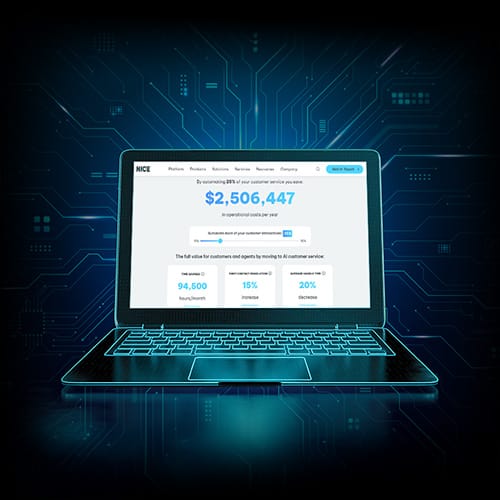
Discover the full value of AI in CX
Understand the benefits and cost savings you can achieve by embracing AI, from automation to augmentation.
Human-Centered Operations: How Agentic AI Supports, Not Replaces, People
NiCE’s approach is human-first: AI is infrastructure that makes work calmer, clearer, and more effective for both customers and agents, aligned with its broader vision of seamless, personalized, intelligent experiences. The goal isn’t automation for its own sake—it’s freeing human agents to do work that requires human judgment, empathy, and creativity.
Agentic AI removes repetitive workload from agents:
Automated tasks like status checks, identity verification, and data entry
Reducing manual effort on documentation and case notes
Eliminating context-gathering that customers find frustrating
This shift enables agents to focus on complex, emotional interactions where human connection matters most.
Benefits for supervisors are equally significant:
Less time fighting intraday fires and making manual overrides
More time for coaching, development, and strategic initiatives
Better visibility into performance through AI-powered analytics
Proactive alerts rather than reactive problem-solving
Agent perspective: “Before, I spent the first three minutes of every call pulling up information and asking customers to repeat themselves. Now the AI handles that. When I pick up, I already know who’s calling, what they’ve tried, and what’s likely to help. I can actually listen and problem-solve instead of just navigating systems.”
With cloud contact center software like CXone augmenting operations, the impact on agent experience extends beyond efficiency:
Reduced burnout from repetitive tasks
Better schedule adherence (when AI handles demand fluctuations, schedules become more predictable)
More meaningful work focused on complex problem-solving
Clearer career paths as roles evolve toward AI oversight and specialized expertise
Redesigning Roles and Skills in the AI-Augmented Contact Center
The AI-augmented contact center built on AI customer service automation solutions creates new roles while transforming existing ones:
Training priorities for 2025-2026:
Judgment and decision-making for complex cases
Empathy and de-escalation for emotionally charged interactions
AI dashboard interpretation and intervention
Cross-functional collaboration with IT and compliance
Continuous improvement practices for AI performance
Clear communication about AI’s role prevents fear and resistance among frontline staff. Agents who understand that AI handles routine tasks so they can focus on more meaningful work are far more likely to embrace the technology than those who fear replacement.
Involving agents in designing AI workflows fosters ownership and trust. Agents understand edge cases and customer pain points better than anyone—their input improves AI performance while building buy-in.
Ethics, Transparency, and Trust in Agentic CX Operations
Customer expectations around transparency continue to evolve. Organizations need clear policies about:
When customers are interacting with AI versus a person
How AI decisions are made and what factors influence them
How customers can escalate to human support when they prefer it
Regulatory frameworks are developing rapidly. The EU AI Act, OECD AI principles, and industry-specific guidelines emphasize:
Fairness: AI systems should not discriminate based on protected characteristics
Accountability: Organizations remain responsible for AI decisions
Explainability: AI reasoning should be understandable and auditable
Human oversight: Meaningful human control must be maintained
NiCE supports observability and auditability through comprehensive recording, AI interaction analytics, and policy enforcement. Operations leaders can trace AI decisions, identify patterns, and correct issues quickly, especially when those decisions are tightly integrated into Salesforce-based customer service workflows.
Practical transparency policy for 2025:
Clearly identify AI-handled interactions at the start of conversation
Provide easy path to human support at any point
Explain AI decisions when customers ask (“I’m applying a credit based on your account history and our service guarantee”)
Maintain complete records of AI decisions for review
Conduct regular fairness audits across customer segments
Never use AI for final decisions on sensitive matters (fraud disputes, vulnerability disclosures, health-related issues) without human review
The Road Ahead: Agentic AI as the Operational Backbone of Modern CX
The shift from reactive queue management to proactive, journey-level orchestration is already underway. Early adopters in 2024-2026 are using agentic AI as an operational backbone—not just deploying chatbots on the front end, but fundamentally rethinking how CX operations run.
By 2030, most large contact centers will use agentic AI to continuously balance customer effort, operational cost, and compliance risk. The technology will be infrastructure: invisible, reliable, and always working to create happier customers and more effective human teams.
NiCE’s vision centers on connected, effortless, human-centered experiences, powered by its AI contact center platform architecture and CXone contact center solutions. Agentic AI serves as the invisible infrastructure tying channels, customer data, and support teams together—orchestrating seamless experiences while keeping human judgment at the center of complex decisions.
The path forward doesn’t require a massive transformation project. Start with one well-chosen operations problem: a high-volume contact reason with clear success metrics. Implement ai agents with proper guardrails and governance. Measure results honestly. Learn from what works and what doesn’t. Then expand thoughtfully.
The benefits of agentic ai compound over time. Each successful use case builds capability, confidence, and organizational muscle for AI-augmented operations. The organizations that start building this capability now—with appropriate human oversight, clear governance, and genuine focus on customer and agent experience—will define what excellent CX operations looks like for the next decade.
The technology is ready. The question is whether your operations team is ready to integrate ai in ways that create measurable business value while maintaining the human connections that customers still need and want. That’s the balance agentic AI for CX operations management is designed to achieve.
Also related to Agentic AI in CX:
- Agentic AI for Real Time Agent Coaching
- KPIs for Agentic AI CX
- Autonomous AI Agents in Contact Centers
- Agentic AI Governance Frameworks
- AI Agents for Quality Management
- Agentic AI in Retail Customer Experience
- Copilot vs Autopilot AI in CX
- Agentic AI in Healthcare Contact Centers
- Agentic AI Architecture for CX Platforms
- Agentic AI in Financial Services CX
Frequently Asked Questions (FAQs)

Ready to experience the power of one platform?
Let us show you how NiCE can unify, automate and elevate your entire customer experience - with AI at the core and outcomes at the forefront.