



What Are Customer Journey Analytics?
Last Updated September 22, 2026
Customer journey analytics is the analysis of customer interactions and events across channels and time to understand how people move through a journey and where they encounter friction. Predictive journey analytics extends that analysis by using historical and real-time signals to estimate likely next events or outcomes so organizations can respond earlier.
What journey analytics connects
- Website and app behavior.
- Search and self-service activity.
- Chat, messaging and voice interactions.
- CRM and case events.
- Transactions and account changes.
- Customer feedback.
- Resolution, abandonment, conversion and repeat-contact outcomes.
Descriptive vs. predictive journey analytics
High-value predictive use cases
- Identify customers likely to abandon a digital task.
- Predict escalation from self-service to assisted service.
- Prioritize proactive outreach after a failed journey event.
- Estimate likelihood of repeat contact after a service interaction.
- Detect journeys associated with churn or dissatisfaction.
- Recommend the next-best service action based on current context.
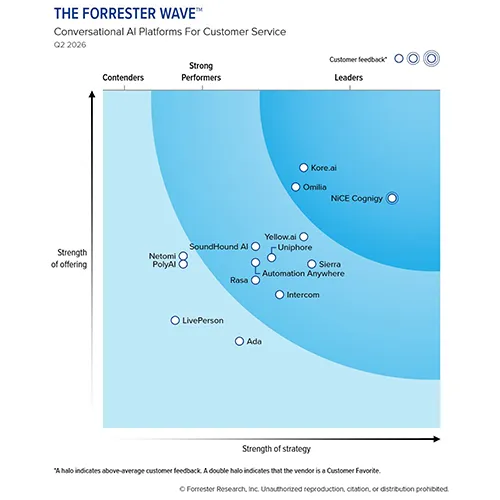
Named a Leader in The Forrester Wave™ 2026
Conversational AI Platforms
Ranked highest in the Strategy category. Above-average customer feedback among evaluated vendors.
Why identity and intent matter
Journey data is difficult to interpret when events cannot be connected confidently to the same customer or when the organization does not know what the customer was trying to accomplish. Identity resolution and intent classification help turn a sequence of clicks and contacts into a meaningful journey.
Where identity is uncertain, analytics should avoid making high-impact assumptions about the customer.
Turn predictions into useful action
A prediction creates value only if the organization can respond appropriately. If a model predicts that a customer is likely to abandon a payment journey, the response might be contextual help, proactive messaging or routing to a specialist. The intervention should be relevant and proportionate to the signal.
Teams should compare outcomes for customers who receive the intervention with an appropriate baseline.
How to evaluate predictive journey analytics
- Define the outcome to predict and why it matters.
- Validate the quality and completeness of journey data.
- Train and test the model on representative populations.
- Measure prediction accuracy and business usefulness.
- Monitor for drift as products and customer behavior change.
- Review whether interventions actually improve the customer outcome.
Also related
How NiCE is Redefining Customer Experience
NiCE offers the industry’s only unified AI platform for customer service automation. CXone revolutionizes how organizations automate customer service from start to finish—with channels, data, end-to-end workflows, and enterprise knowledge converging to improve customer experience at scale. With domain specific AI trained on the industry’s largest CX dataset, an open framework with endless integration possibilities, and a complete suite of advanced AI applications, CXone is one platform built for organizations of all sizes to deliver seamless customer service experiences, boost operational efficiency, and drive better outcomes.
Agentic Experience Automation
AI Agents for Sales and Marketing
AI Agents for Proactive Engagement
Engagement Orchestration
Workforce Empowerment
Contact us
If you would like to know more about our platform or just have additional questions about our products or services, please submit the contact form. For general questions or customer support please visit our Contact us page.