



What Is Predictive Analytics for Customer Service?
Last Updated September 22, 2026
Predictive analytics for customer service uses statistical models and machine learning to estimate future outcomes from customer, interaction and operational data. Instead of only describing what already happened, predictive models help teams anticipate demand, risk and likely customer behavior.
Predictive vs. descriptive analytics
Descriptive analytics tells you what happened: contact volume increased, satisfaction declined or transfers rose.
Predictive analytics estimates what may happen next: which customers are at risk of churn, which interactions are likely to escalate or how much contact volume a queue is likely to receive tomorrow.
Prescriptive analytics goes one step further by recommending or selecting an action based on that prediction.
Customer-service use cases
Demand forecasting
Historical volume, seasonality, events and operational patterns can be used to estimate future workload for workforce planning.
Churn and retention risk
Models can combine interaction history, sentiment, product usage and customer behavior to identify customers who may be at higher risk of leaving.
Escalation prediction
Conversation and account signals can help identify interactions likely to require a supervisor or specialist, allowing earlier intervention.
Repeat-contact prediction
Organizations can estimate which interactions are likely to result in another contact and proactively complete follow-up actions.
Next-best action
Predictive models can help prioritize offers, support steps or outreach based on the customer's context and likely outcome.
Proactive customer service
When a model detects a likely problem, the organization can notify the customer or resolve the issue before the customer initiates contact.
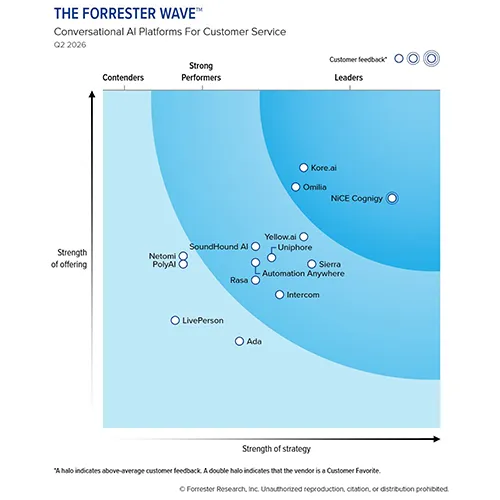
Named a Leader in The Forrester Wave™ 2026
Conversational AI Platforms
Ranked highest in the Strategy category. Above-average customer feedback among evaluated vendors.
Data used in predictive customer-service models
Potential inputs include interaction history, intent, channel, sentiment, customer tenure, product data, transaction history, previous resolutions, digital behavior, service incidents and operational conditions.
More data is not always better. Features should be relevant, permitted and reliable. Sensitive attributes require particular care.
Cloud analytics for customer service
Cloud analytics can centralize interaction and operational data from distributed customer-service systems and make models available to teams across locations and channels.
A cloud platform can also support continuous model monitoring and faster deployment, but organizations still need strong data governance, access controls and retention policies.
Turning a prediction into action
A prediction has limited value if no one knows what to do with it. Each model should have an owner, a decision threshold and a defined workflow.
For example, a churn-risk score might trigger a retention offer, a proactive message or specialist routing. A demand forecast may change staffing. An escalation score may prompt a supervisor alert.
Model quality and governance
Track accuracy using metrics appropriate to the problem, but also monitor drift and business outcomes. A model can remain statistically accurate while becoming operationally less useful if customer behavior or policy changes.
Teams should document training data, intended use, protected decisions and review requirements. High-impact actions may require human oversight or explanation.
Predictive analytics and generative AI
The technologies serve different purposes. Predictive models estimate an outcome or probability. Generative AI creates or summarizes language. They can work together: a predictive model identifies churn risk, and generative AI prepares a grounded explanation or suggested next step for an agent.
How NiCE supports customer-service analytics
NiCE CXone brings interaction, workforce, quality and customer-service data together with AI and analytics. That allows organizations to use predictive signals within routing, workforce planning, agent assistance and proactive customer-service workflows.
How NiCE is Redefining Customer Experience
NiCE offers the industry’s only unified AI platform for customer service automation. CXone revolutionizes how organizations automate customer service from start to finish—with channels, data, end-to-end workflows, and enterprise knowledge converging to improve customer experience at scale. With domain specific AI trained on the industry’s largest CX dataset, an open framework with endless integration possibilities, and a complete suite of advanced AI applications, CXone is one platform built for organizations of all sizes to deliver seamless customer service experiences, boost operational efficiency, and drive better outcomes.
Agentic Experience Automation
AI Agents for Sales and Marketing
AI Agents for Proactive Engagement
Engagement Orchestration
Workforce Empowerment
Contact us
If you would like to know more about our platform or just have additional questions about our products or services, please submit the contact form. For general questions or customer support please visit our Contact us page.