
Watch the on-demand session: The Agentic Engagement Plane: Why CX Needs a New Architecture
Something strange happens when AI adoption actually works: the tickets get easier to close, and the job gets harder.
This post extends the second session in NiCE's Orchestrated Intelligence Advantage webinar series, The Agentic Engagement Plane: Why CX Needs a New Architecture, which I hosted with Ian Jacobs, VP & Lead Analyst, and Derek Top, Principal Analyst & Research Director, both of Opus Research. Here’s how the theory and new agentic architecture we explored translate to how leaders are rethinking their CX operations.
Here's the paradox. Successful AI adoption doesn't just shrink and reshape the human workload inside the enterprise, it concentrates that workload into fewer, harder, more consequential interactions. And now, at the same time customers are arriving represented by their own personal AI agents. Meta's Muse hit 2.8 million downloads in 12 days. The customer sending an AI agent on their behalf is no longer hypothetical. Most operations, workspaces, and handoff processes were never designed to handle either shift, let alone both at once.
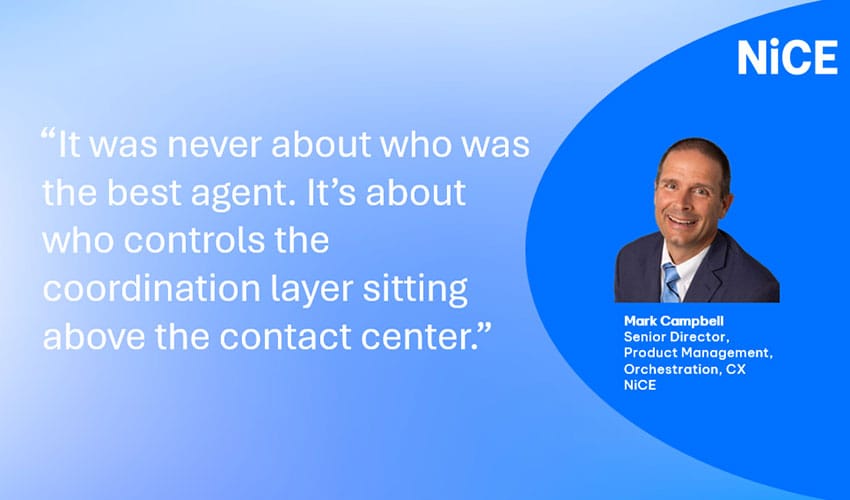
Automation removes the routine friction first: password resets, order-status checks, basic account changes. What's left skews toward the ambiguous, the emotionally loaded, the multi-system exception. At the same time, some customers are letting software act on their behalf, booking, negotiating, disputing, without ever picking up the phone.
So the real question isn't whether your AI agents are good enough. It's whether your operating model, the workspace, the data, the handoffs, the governance, was designed for a world where remaining work gets harder and the customer might be a machine.
The volume shift nobody budgeted for
Self-service success doesn't just change how much work reaches a human. It changes the mix.
When a virtual agent absorbs the routine cases, what remains skews toward exception handling, ambiguity, emotional stakes, and problems that cross several systems at once. IDC's FutureScape 2026 predictions put a number on the scale of this shift: by 2026, 40% of job roles at the world's 2,000 largest public companies will involve working alongside AI agents. That's not a distant forecast, it's describing the operation many of you are running right now.
At the same time, the customer side of this equation is changing too. Personal AI agents are becoming a new entry point for customer intent. Meta's Muse reached 2.8 million downloads in 12 days and hit No.1 in the US App Store; a clear consumer signal that personal AI agents have moved from early adopters to mass distribution.
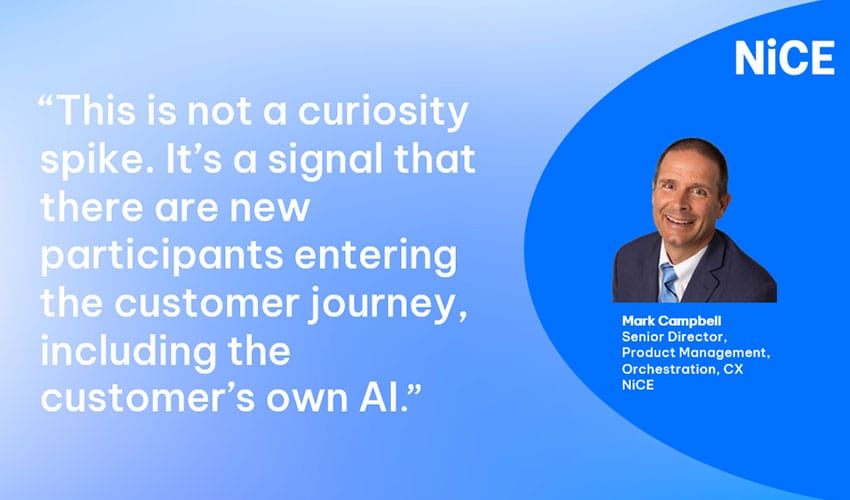
Put those two shifts together and the operational implication is straightforward: you now have to plan for engagements that span a customer's AI, your enterprise AI, human judgment, several systems, shared context, and policy, sometimes all inside one interaction. Neither shift on its own would strain most CX operations. Both arriving together, on infrastructure that was built one channel and one tool at a time, is what actually breaks things.
The expectations squeeze
Customers don't lower the bar because their case becomes complicated. If anything, they raise it.
A difficult interaction feels worse when the customer has to repeat their identity, their issue, or a promise someone already made them. That repetition is what most customers actually remember about a bad experience, not the underlying policy dispute. And it points to a measurement problem hiding underneath the workload problem.
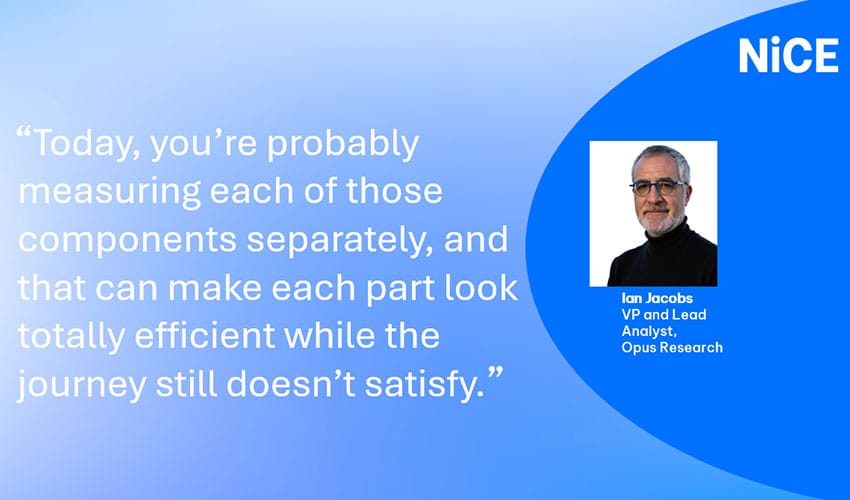
Deflection rate and individual-agent efficiency look reassuring on a dashboard. They're also incomplete. A self-service agent can hit its targets, a live agent can close the ticket fast, and the end-to-end journey can still fail the customer. That gap between components looking fine and journeys still failing is a big part of why MIT NANDA's research on the "GenAI divide" found that 95% of enterprise generative-AI pilots haven't shown measurable P&L impact. The tools work. The scorecard doesn't see the journey.
The fix isn’t a better dashboard for any one tool. It’s a unified view of one journey and one workforce, measured through one scorecard. That scorecard captures human and AI contributions—as well as what they achieve together—across handoff quality, escalation accuracy, resolution quality, cognitive load, business impact, and traceability.
A personal AI agent raises the bar further. Software acting on a customer's behalf tends to expect machine-speed consistency and clear authorization, not patience. That doesn't mean every interaction is becoming machine-to-machine. It means the standard for what "good" looks like keeps climbing, on both sides of the conversation, and your measurement has to climb with it.
The handoff problem: Where efficiency goes to die
Here's a scenario we walked through on the webinar, because it shows exactly where efficiency goes to die.
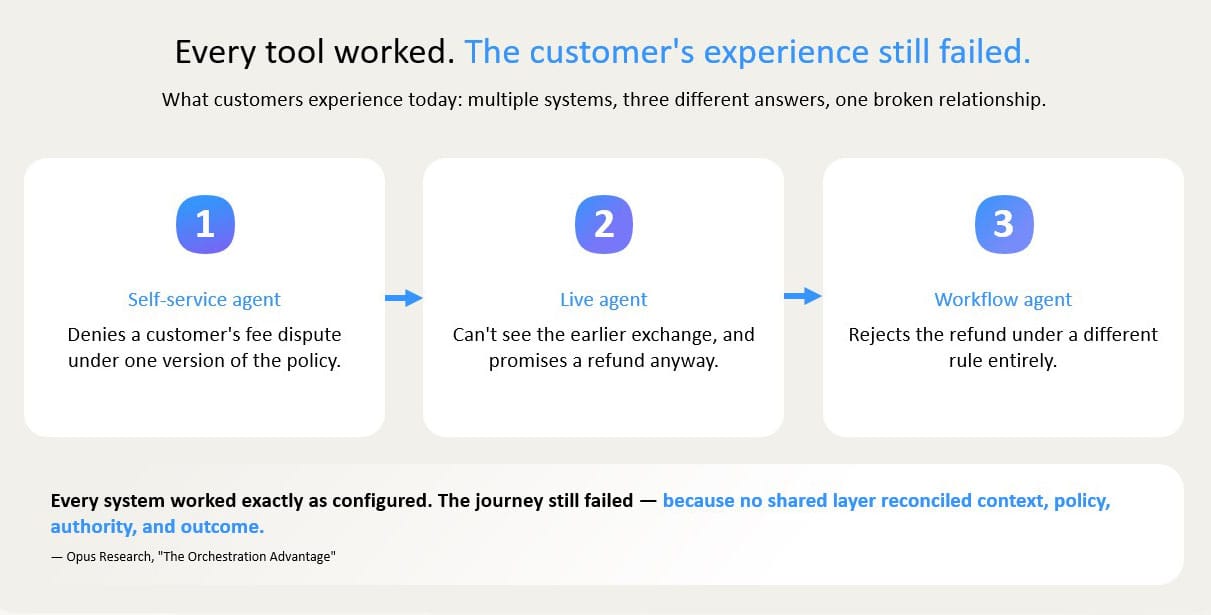
A customer disputes a fee. A self-service agent denies the request under its version of the policy, correctly, as configured. Unsatisfied, the customer escalates. A live agent can't see the earlier exchange, so they promise a refund, also correctly, from what they can see. A workflow agent then rejects that refund under a third, different rule. Three systems, three answers, one broken relationship. Nobody made a mistake. Every component worked exactly as configured. The journey still failed, because no shared layer reconciled context, policy, authority, and outcome across the handoff.
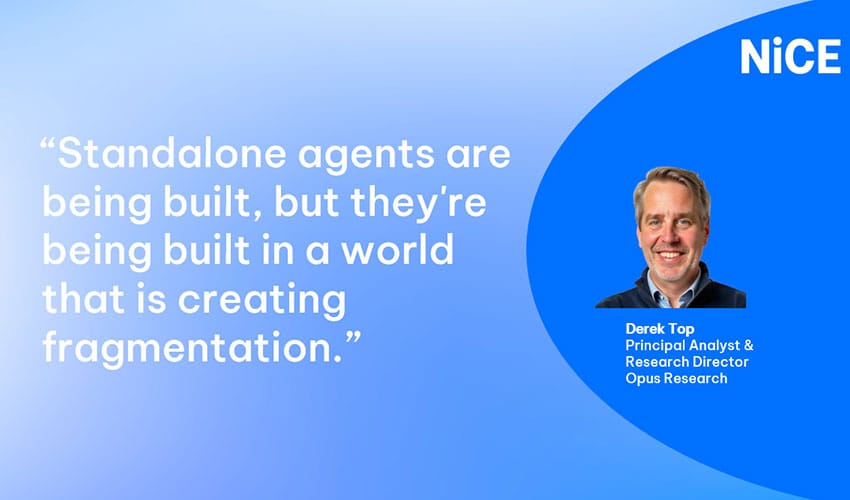
The structural causes are familiar if you've built a CX stack over the last decade: channels bolted on one at a time, AI layered onto each platform separately, customer records that capture a moment rather than a relationship, and policy that drifts between systems faster than anyone can track.
Personal AI agents raise the same failure mode with sharper edges, because now identity, authentication, authorization, and consent have to be established for software you didn't build and may never have verified before. Opus Research's report makes a useful distinction here: a connection protocol like MCP or A2A gives agents a technical socket to talk through. It doesn't, by itself, preserve journey state, enforce policy, resolve conflicting knowledge, or produce an audit trail. Protocols move messages. They don't coordinate outcomes. That coordination has to come from somewhere else in the stack.
For a closer look at how personal agents are already reaching enterprise CX — and what the front door needs to handle them, see Personal AI agents just went mainstream. Is your CX ready?
The job should get better, not smaller
"The job should get better, not smaller" is a design objective, not a promise about headcount. It's worth being precise about the difference.
AI can absorb the repeatable work. That leaves more of what's left to judgment, ambiguity, exceptions, and emotionally consequential decisions, the parts of the job that were always harder to do well. Getting that outcome takes deliberate redesign, not just more automation layered on top. Humans need to be treated as first-class participants in the orchestration model, reachable and informed at every step, not a disconnected fallback looped in once everything else has failed. The operator, not the vendor, should decide where autonomy sits and when a human review is required.
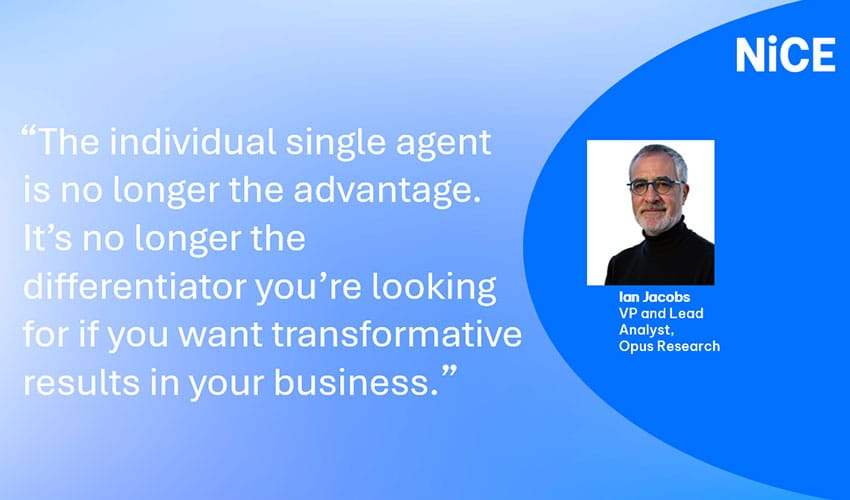
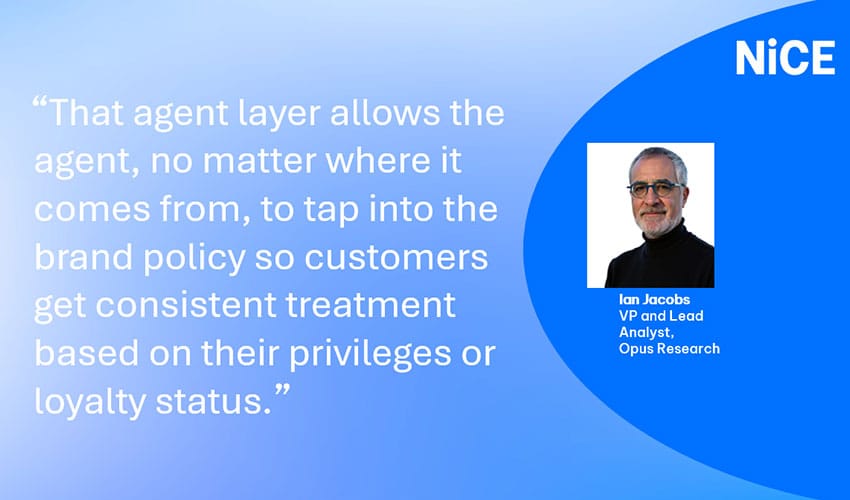
Opus Research describes the shared operating layer that makes this possible as a control plane, coordinating people, AI agents, systems, and workflows.
NiCE's architectural response to that same problem is the Agentic Engagement Plane, the governed front door and coordination layer spanning AI agents, human employees, systems, workflows, channels and the technology you’ve already invested in, without disrupting any of it. The two terms describe a similar function from different vantage points: one is an analytical framework, the other is a product architecture built to deliver it.
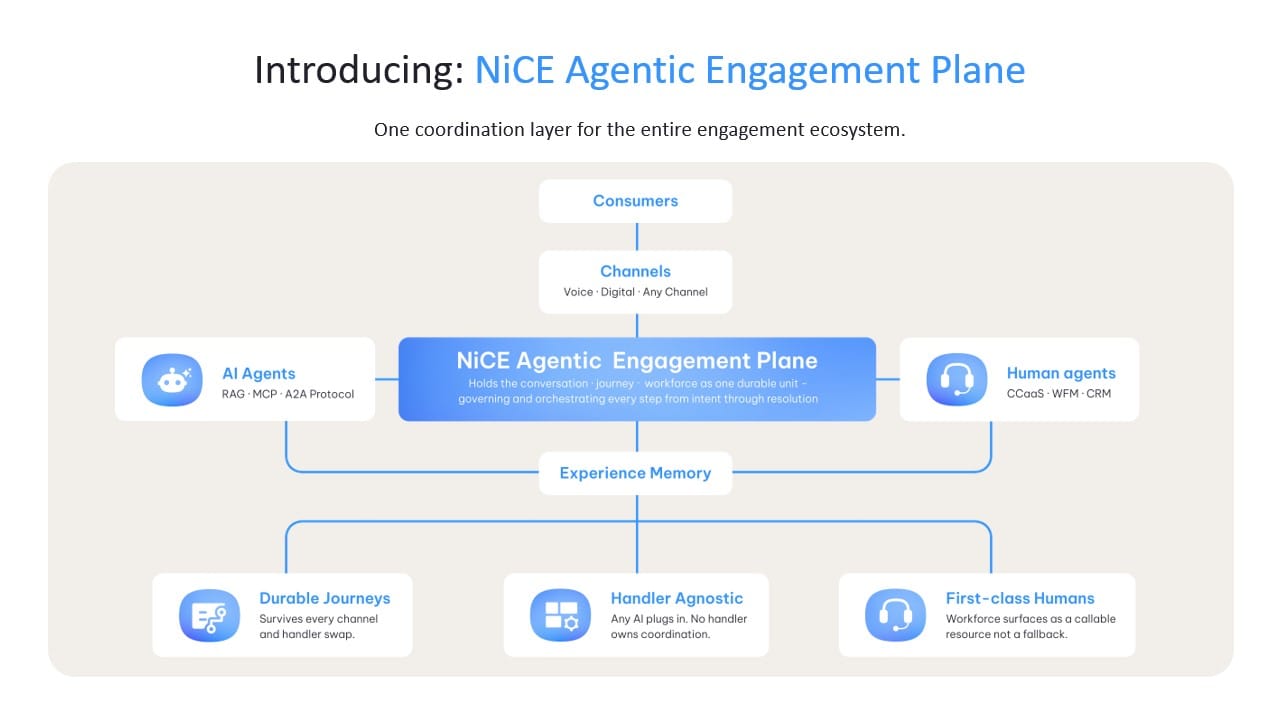
What has to travel across that layer is identity and authentication state, journey history, workforce state, and outcome and reasoning data. NiCE Experience Memory is our name for that living record. The payoff isn't a longer feature list. It's continuity, consistent policy, less rework, sharper human judgment, and a trail you can actually reconstruct.
A 12-month readiness check
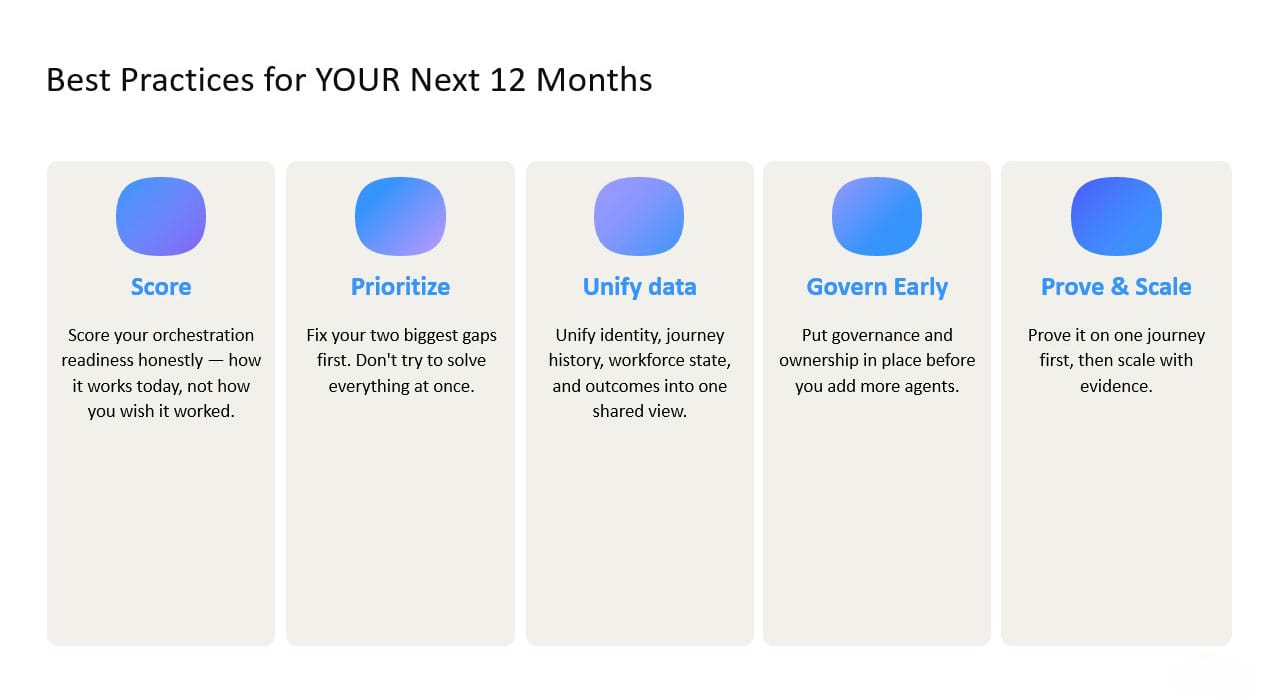
Architecture is a foundation, not a finish line. Here's a focused sequence for the next 12 months.
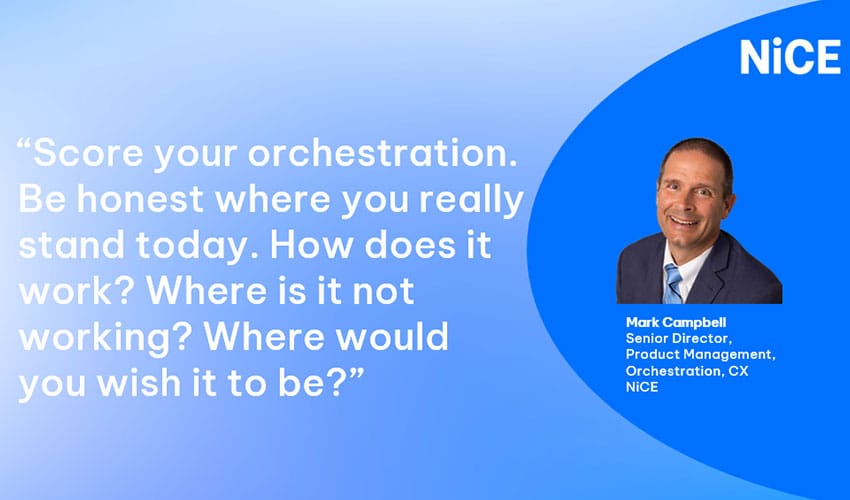
Score honestly. Assess your operating reality today, not your roadmap. Where does context survive a handoff, and where does it quietly disappear?
Prioritize. Pick the two weakest, highest-friction areas rather than an enterprise-wide overhaul. Two high-leverage fixes usually move a program further than ten simultaneous ones.
Unify context and data. Give human and AI participants a shared view of identity, journey state, history, workforce activity, promises made, and outcomes.
Govern early. Establish ownership, decision rights, escalation paths, policy controls, knowledge governance, testing, and audit before adding more agents, not after.
Prove, then scale. Choose one meaningful, complex journey and scale only with evidence.
Opus Research's advice on that last point runs counter to instinct: start where the work gets messy rather than proving the concept on a password reset. Fabletics took this approach, choosing complex membership issues over an easy use case. The difficulty surfaced real requirements, escalation rules, policy boundaries, handoff logic, measurement, and post-launch ownership, early enough to build them properly.
One more question as personal AI agents enter the picture: can your operation recognize that software is acting for a customer, verify its identity, authority, scope, and consent, and reconstruct afterward what happened? For most operations, the honest answer today is "not fully." That's not a failure, it's the next line item. Before adding your next agent, it's worth knowing whether your operating model compounds shared intelligence or compounds fragmentation.
Watch the full session on demand: The Agentic Engagement Plane: Why CX Needs a New Architecture