

Blockbuster dominated movie rentals. Netflix made the video store obsolete. Kodak built an empire around photography, only to watch digital cameras, smartphones, and platforms like Instagram transform how the world captured and shared memories. BlackBerry ruled mobile communications before Apple reinvented the smartphone.
These weren’t simply examples of new technologies replacing old ones. Entire markets were disrupted as customers embraced fundamentally different ways of engaging. Those that struggled often spent too long protecting the advantages that had made them successful.
Personal AI agents represent the next great market shift. This time, what changes hands isn’t a product or a distribution channel. It’s control of the customer journey.
The company no longer owns the customer journey. The customer's AI agent does.
For decades, businesses have invested billions designing how customers discover products, evaluate alternatives, make purchases, and receive service. Websites, mobile apps, advertising, loyalty programs, and contact centers have all been organized around the assumption that enterprises could guide customers through journeys they designed. Personal agents upend that assumption.
Consider someone who wants to find a better mobile plan, dispute an unexpected charge, or adapt their vacation on the fly. Rather than researching options, contacting providers, and navigating multiple service processes, the customer can assign the task to a personal AI agent. That agent can gather information, compare offers, engage businesses, and pursue resolutions while the customer focuses elsewhere.
The customer still determines what they want. But their agent can determine where to look, whom to contact, what to compare, and how to accomplish the task. It has no inherent reason to follow the protocols or processes an enterprise has carefully designed.
Personal AI agents are not simply another digital channel into the contact center. They represent a new way for customers to engage with brands, through an agent that understands their intent, represents their interests and acts on their behalf to get things done. It changes who controls discovery, comparison, negotiation, and execution when businesses compete for customers and earn their loyalty.
Competition becomes continuous
That changes the nature of competition itself. Until now, it happened at moments the company could see and shape: the first purchase, the renewal, the service call. A personal AI agent removes those boundaries. It can work 24/7 to compare alternatives, negotiate terms, and act for the customer, measuring every provider against that person’s preferences for price, quality, reliability, service, and trust. Competition then is always in play.
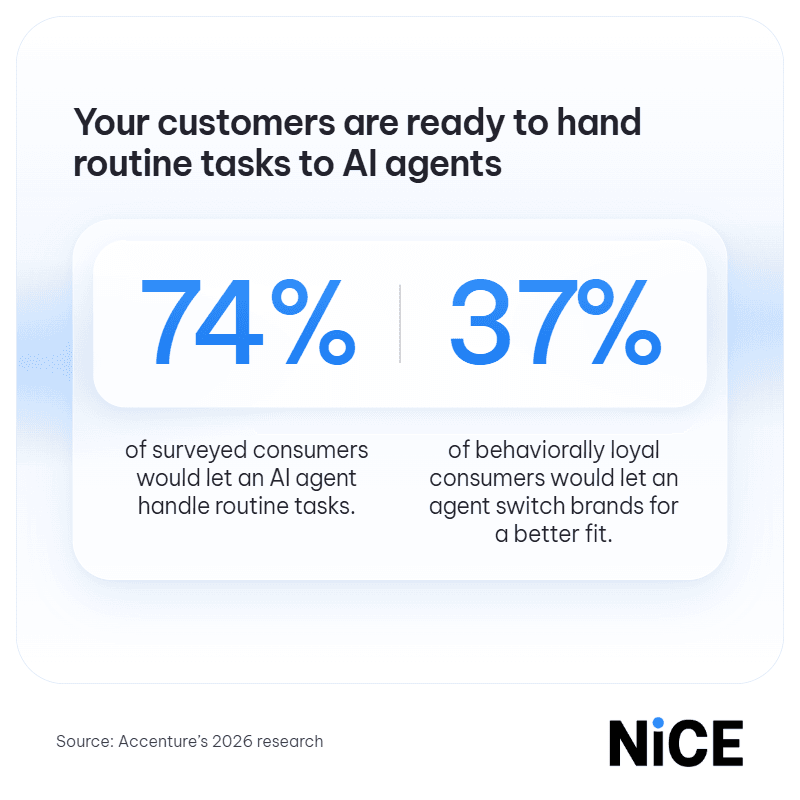
Consumers appear ready for this change. In Accenture’s 2026 research, 74% of surveyed consumers said they would let an AI agent handle routine tasks, while 37% of behaviorally loyal consumers said they would let an agent switch brands for a better fit. At the same time, 56% said they would instruct their agent which brands to consider. Customers aren’t surrendering their preferences. They’re gaining a more capable way of acting on them.
When customers can continuously evaluate their options, businesses must continuously earn their preference.
That puts pressure on pricing power, customer acquisition, retention, and lifetime value. The competitive advantage shifts from controlling the customer journey to performing well within a journey the customer controls.
Enterprise readiness becomes a competitive advantage
Earning an agent’s preference starts with being reachable. Imagine a personal agent contacting a business to compare services or resolve an account issue. Can it discover the right capabilities, verify that it represents an authorized customer, and complete the task? Or does it hit a bot wall, a human-only login, or a phone system that can’t recognize its purpose?
Enterprises have legitimate reasons to protect their systems. Fraud prevention, privacy, identity verification, and authorization become more important when software can act on behalf of individuals. But to be clear, protecting customers and preventing their authorized agents from engaging are fundamentally different objectives.
Most companies won’t deliberately choose to reject legitimate personal agents. Their existing technology will make that decision for them, often without anyone in the business realizing it. The loss won’t show up in abandoned-call reports or satisfaction scores, because the interaction may never reach the company.
Think about what happens when the customer behind an agent approaches a subscription renewal. Their agent reviews the available options, recalls which providers were accessible, and recommends a shortlist. A business that couldn’t engage with the agent earlier could be excluded before a human ever considers its offer.
Simply put, every agent you turn away becomes a salesperson for the competitor that engaged with it.
NiCE sees this shift at global scale, supporting customer interactions for leading brands around the world. That’s why we are a design partner in the emerging Personal Agent Protocol, a draft open standard developed by Meta and other industry leaders to enable trusted interactions between personal agents and businesses. We also already support A2A and MCP, the open protocols that let AI agents work with each other and connect to business systems and data. But a standard only opens the door. Delivering the outcome requires AI agents, employees, knowledge, and business systems to work together with shared context and clear accountability.
The customer can delegate the interaction, but the enterprise remains accountable for the experience. When a customer’s agent gets the runaround, the customer does too.
A new imperative for enterprise leaders
The shift to personal AI agents is not simply a technology project for CIOs or another service initiative for CX leaders. It is a strategic decision about how enterprises intend to compete when customers control more of the engagement process.
Every CEO should be able to answer three questions: What happens when a customer’s AI agent engages with our business today? Who owns that experience, and have we designed it intentionally? And when that agent represents a customer we want to win or retain, can we deliver the outcome that customer expects?
The customer can delegate the interaction, but the enterprise remains accountable for the experience. When a customer’s agent gets the runaround, the customer does too.
The internet didn’t wait for every retailer to embrace e-commerce. Cloud didn’t wait for every software company to rethink its business model. Mobile didn’t wait for every brand to build an app. Personal AI agents won’t wait for every enterprise to prepare for them.
The next generation of Blockbusters may not be the companies that failed to build AI. They may be the companies that refused to do business with their customers’ AI.