

A customer spots a $12 error on her phone bill. She calls to dispute it, spends 20 minutes on hold, then hangs up. She could try again tomorrow, but is getting $12 back really worth the hassle?
What if she could hand the problem over to a personal AI agent instead? The agent could wait on hold or try again later, without requiring more of her time. What might have been one abandoned call could become several attempts to resolve the issue.
Personal AI agents are already contacting businesses on consumers’ behalf. In a recent NiCE survey of 118 customer service practitioners at more than 70 organizations, respondents reported seeing personal agents handle tasks ranging from scheduling appointments to clarifying account details. Research from Metrigy suggests that consumers are becoming more receptive to AI-enabled customer service in general. In its 2026 Q3 AI Consumer Experience Index, 28.8% of 1,000 U.S. consumers surveyed said they would choose AI if resolution were guaranteed, up from 23% in the first quarter.
For workforce management (WFM) leaders, that raises a question: What happens to staffing forecasts when customers start using personal AI agents to pursue requests they might otherwise have abandoned?
What historical contact data misses
Forecasts are based largely on what happened before. How many people called, and when? How long did they wait before hanging up? Contact centers have years of data on those behaviors, but their forecasts can’t account for every customer who decided contacting the company wasn't worth the trouble.
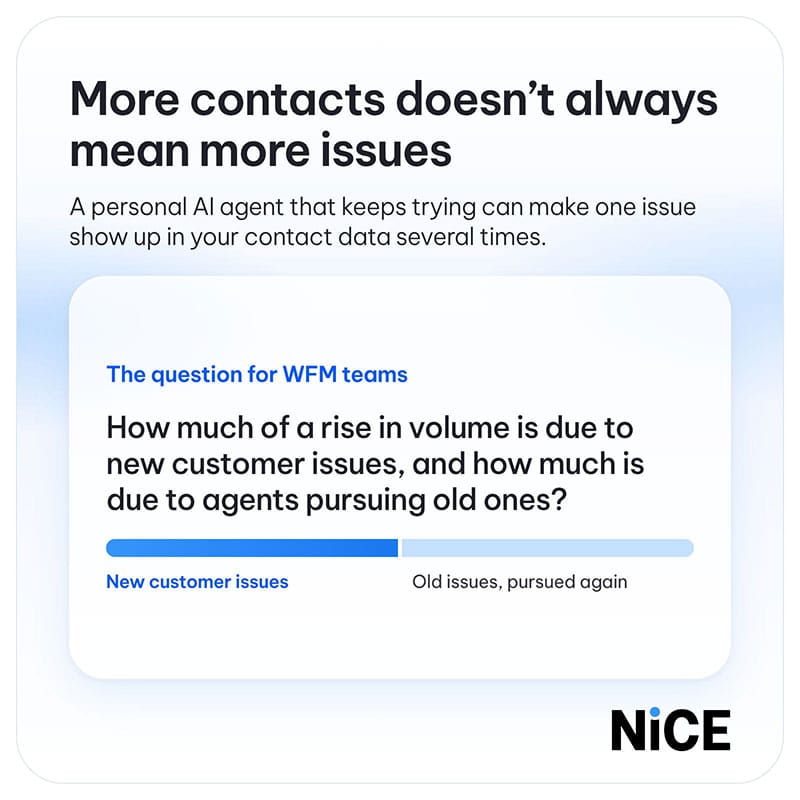
Personal AI agents could increase contact volume even if customers aren't having any more problems than before. And if a personal AI agent keeps trying when it doesn't get an answer, one issue could show up in the contact data several times. That leaves WFM teams with a harder job: figuring out how much of a rise in volume reflects new customer problems and how much comes from agents pursuing old ones.
If more requests reach the business, service-level targets may need to change. And if automated systems handle routine requests but send more complicated cases to employees, leaders will need to rethink staffing levels, required skills, and cost to serve.
Five forecasting assumptions worth revisiting
As personal AI agents become more common, five assumptions underlying WFM forecasts deserve a closer look:
- Volume: Personal AI agents might pursue requests customers would otherwise abandon, generating more contacts without necessarily increasing the work handled by employees. Compare unique requests with repeat contacts associated with the same request over a defined period to distinguish new demand from repeated attempts.
- Arrival patterns: Customers tend to contact businesses when their schedules allow, but personal AI agents can submit requests at any hour. Track the share of contacts arriving outside traditional peak periods.
- Abandonment and retries: An agent that doesn't get through can wait longer or simply try again, which means abandonment rates could fall without any improvement in wait times, even as retries push contact volume higher. Compare abandonment rates with wait times and retry frequency to determine whether lower abandonment reflects better service or greater persistence.
- Average handle time: Personal agents may arrive with information already gathered, shortening some interactions, but employees could spend more time on complicated cases if automation resolves most routine requests. Compare handle times for routine and escalated requests to assess how the mix of work is changing.
- Containment and human workload: Higher containment rates won't necessarily mean fewer employees are needed. If the requests passed to human teams become more complicated, some of the savings from automation could disappear. Monitor escalation rates from automated channels and the time employees spend on those cases to understand how much work remains after automation.
How WFM leaders can prepare
AI is already changing how contact centers plan their workforce. Recent research by CMSWire in partnership with NiCE found that 83% of respondents had adjusted staffing or forecasting assumptions based on AI insights. WFM leaders can't yet predict how much demand personal agents will generate, but they can test how different outcomes would affect staffing.
Suppose contact volume rises 15%, but automated containment improves. Would human workload actually increase? What if fewer requests reach employees, but those that do take much longer to handle? Staffing scenarios also need to reflect consumers' expectations for service. In Metrigy's 2026 Q3 AI Consumer Experience Index, 33% of consumers said they wanted the option to reach a person immediately when using service AI. Planners can use scenario testing to assess how much human capacity they'll need to maintain service levels under different conditions.
As personal-agent traffic becomes measurable, WFM teams will need forecasting tools that can adapt to changing demand. NiCE's AI Best-Pick Forecasting and DARTS forecasting engine offers modeling capabilities that include Prophet and LightGBM, which can help planners analyze emerging patterns and refine their forecasts. NiCE's True to Interval approach can also provide a clearer picture of asynchronous workload by accounting for when work actually takes place, rather than when an interaction is closed.
Forecasts still need to be checked against actual results, particularly as personal-agent traffic introduces unfamiliar patterns. A recent NiCE white paper describes how teams can test models against historical data and monitor changes in underlying patterns.
Longer-term decisions involve hiring and cost to serve. How much additional demand should a business plan for if personal agents become widely used? How many employees would it need if automation handled 70% of those requests rather than 50%? NiCE's Enhanced Strategic Planner (ESP) helps WFM leaders compare the staffing and cost implications of different scenarios, including AI agent volume vs. human agent volume, before committing to hiring plans and budgets.
Knowing who's calling is only the beginning
Trust will be critical as personal AI agents begin interacting with businesses on consumers' behalf. In Metrigy's research, 41% of consumers identified trust as the most important factor in their interactions with companies. Businesses will need to verify who personal agents represent and what they're authorized to do. NiCE is working with Meta and other partners on the Personal Agent Protocol, an emerging standard designed to support secure interactions between personal and enterprise AI agents.
In NiCE's recent customer survey, more than half of respondents cited oversight, auditability, human involvement, or unified interaction logs as factors that gave them confidence to expand automation. For personal AI agents, that oversight includes setting limits on how frequently they can make contact and determining when unresolved requests must move to an employee. Retry limits could affect contact volume, while escalation thresholds could change the amount and complexity of work reaching human teams. WFM leaders will need to understand how those policies shape demand rather than relying on historical contact patterns alone.