

This holiday season, plenty of shoppers plan to ask their personal AI agent to do the legwork. In Metrigy's fourth-quarter AI Consumer Experience Index, conducted in partnership with NiCE, half of the 1,000 U.S.-based consumers say they've used a personal AI agent to complete a task for them, and 22.7% use one regularly. Among the consumers who have used a personal AI agent, 82.7% plan to use an agent for holiday shopping.
That makes the stretch from Black Friday through returns season the first true mass test for personal AI agents, which only emerged in measurable numbers earlier this fall in products such as Meta Muse, Gemini Spark, GrokBot, and OpenAI Dots, among others. Here's how consumers plan to use them, where they draw the line, and what it means for the retailers on the other end of those conversations.
Deals first, then everything after checkout
Among personal AI agent users, finding deals, including on Black Friday and Cyber Monday, tops the list at 50.2%. Close behind are checking what's in stock nearby (48.4%) and comparing products (47.6%). These agents can now take on the time-consuming research that often comes before a purchase.
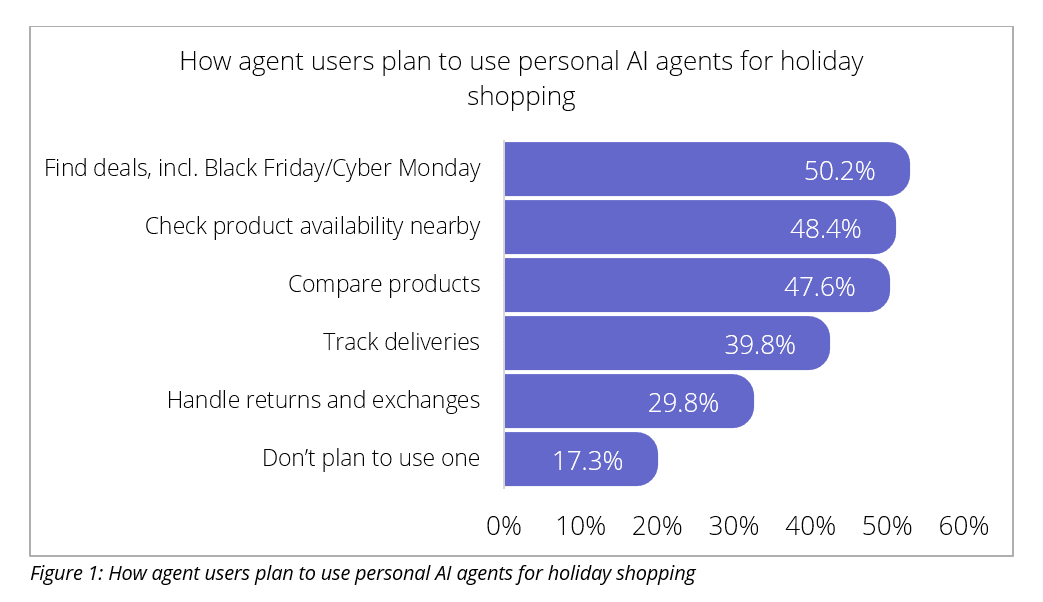
The work doesn't stop at checkout, though, as 39.8% of personal AI agent users plan to have one track deliveries, and 29.8% will use one to handle returns and exchanges. Order tracking and returns are already two of the most common reasons shoppers contact retailers after the holidays, and this year, retailers should expect some of those requests to come from personal AI agents.
Users also say their agents get the job done, with 82.4% rating the AI agent they use most often as excellent or good at completing the tasks they give it, and only 1.4% rate it poor or terrible.
Shoppers want a say before money moves
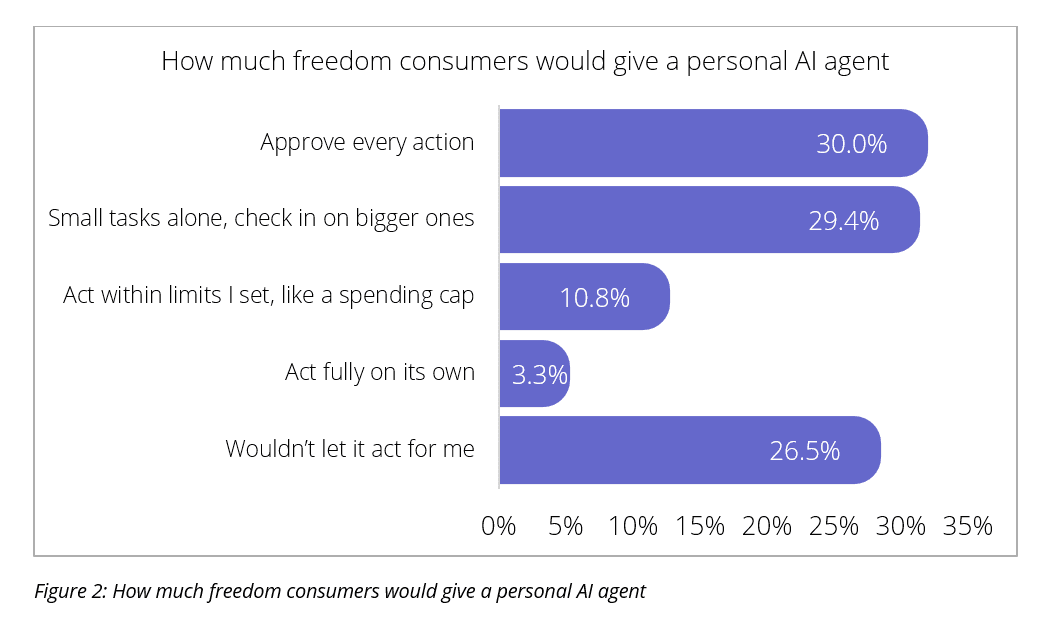
Liking personal AI agents, though, isn't the same as handing it the keys to their wallets. Only 3.3% of consumers would let AI agents act fully on their own. The most common choice is approving every action (30%), followed closely by letting the agent handle small tasks alone and check in on bigger ones (29.4%).
Personal AI agent users are already shopping this way by requiring that they approve the final step. Among them, 44.3%, have let an agent buy something after they approved it, 40.2% have had one buy within a budget they set, and 38.6% have had one build a cart for them to review. As for returns, one-third of AI agent users already have used one to handle a return, and another 51% would do so, so many may try it for the first time this holiday season.
As more consumers hand shopping tasks to personal AI agents, concerns remain about what those agents can access and do. Consumers’ top worries are that an agent has access to too much personal data (44.4%), that their payment information could be stolen (43.5%), and that it could spend money they didn’t authorize (41%). Asked what would make them trust an agent with bigger tasks like purchases, consumers point to practical safeguards like a guarantee they'll be made whole if the agent makes a mistake (35.2%), strong protection for logins and passwords (32.4%), and the ability to cancel or undo an action (31.6%). The Personal AI Protocol, now in development, will address these issues of concern and more.
Agents are heading into the service queue
Shopping is only the start, since more than half of consumers (52.7%) have used, or would use, a personal AI agent to contact a company to resolve an issue on their behalf.
Retailers that can’t work with personal AI agents risk losing customers. If a business couldn’t work with their agent, 14.9% of consumers would take their business to a competitor that can. Another 17.7% would do the task themselves but think less of the company. In total, nearly a third (32.6%) of consumers would either walk away or leave with a worse view of the retailer.
“Personal AI agents have arrived. They’re advertised on TV, and half of consumers have already used one, less than two years after the first ones launched. Smartphones took about six years to get there,” said Neeraj Verma, Vice President, Agentic AI, NiCE.
“This Black Friday, there’s no question AI agents will show up in the service queue. The real question for companies is: what are you going to do about it? Blocking every agent isn’t the answer. One-third of shoppers will think less of you or take their business somewhere else. The answer is guardrails. Identify the agent, verify the customer behind it, and decide what it can do on its own and what needs a person to approve,” he added.
What this means for retailers
The first wave of agent shopping will be mostly research and tracking, with a person approving the purchase. Retailers can prepare for that now:
- Make your data easy for agents to read. Accurate prices, local inventory and delivery status are what agents will check first.
- Build in approval. Clear confirmations, spending limits and easy cancellation match how consumers say they want to use agents.
- Get the contact center ready for agent-initiated contacts. Returns and order questions will start arriving from agents acting for customers, and those contacts need to be recognized, verified and resolved without sending the customer back to start over.
Consumers are giving personal AI agents a real tryout this holiday season, on their own terms. The retailers that work smoothly with those agents, and keep the customer in control of the money, will be the ones shoppers' agents come back to. And, it’s likely to make consumers more amenable to using business AI agents for appropriate issues, rather than requesting to talk to humans more often than is necessary.
Metrigy’s methodology
Metrigy surveyed 1,000 demographically representative U.S. consumers from November 3 to November 10, 2026, for its fourth-quarter AI Consumer Experience Index, conducted in partnership with NiCE. Holiday-shopping results and agent ratings are based on the 50% of respondents who have used a personal AI agent.