

For enterprises running AI agents at scale, autonomy and control have often pulled in opposite directions. The more an AI agent can do on its own, the harder it is to oversee.
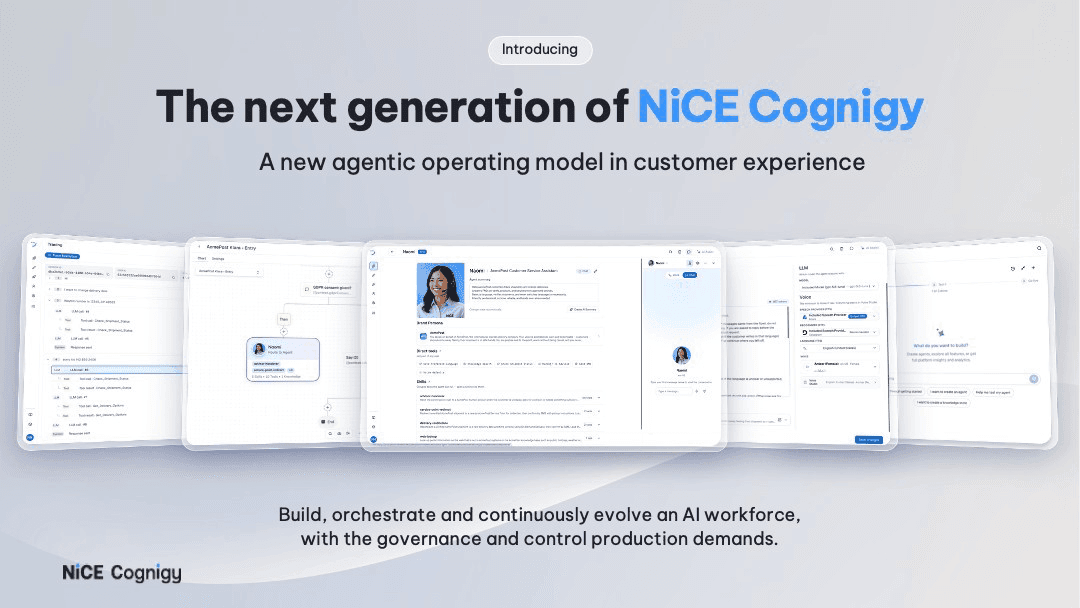
The next generation of NiCE Cognigy builds control into the platform that AI agents run on, so autonomy no longer costs oversight. A built-in agentic harness handles orchestration and governance. Tracing records every skill, tool call, and token, and multivariate testing shows which version of an AI agent performs best. A hybrid architecture adds deterministic flows wherever predictability is essential. AI agents can do more on their own, and teams can still see and direct what they do.
Next-generation AI agents also connect with external agents and systems through open standards, so enterprises can build for an open agentic ecosystem.
Watch Philipp Heltewig, Chief AI Officer at NiCE, introduce the launch, then read on for what each new capability does.
Scaling AI agents raises the bar for orchestration and governance
Enterprises scaling AI agents need to build, improve, and govern them as one process. The next generation of NiCE Cognigy is organized around that need.
Deloitte's State of AI in the Enterprise report shows why: 74% of respondents expect their companies to use AI agents at least moderately by 2027, but only 21% report a mature governance model for agentic AI. Deloitte describes mature governance as clear limits on which decisions agents make independently and which need human approval, real-time monitoring that flags anomalies, and audit trails that capture the full chain of agent actions.
Running AI agents across entire customer journeys, with the governance large organizations depend on, asks more of the teams building those agents and of the platform beneath them. AI agents need to reason and act across systems, hand complex work to specialized sub-agents, and work with agents from outside the enterprise. Teams need to reach production with confidence, and leaders need oversight they can rely on as the number of AI agents grows.
That sets four expectations for the technology behind enterprise AI agents. The sections below show how the next generation of NiCE Cognigy meets them.
- Teams get from idea to production faster. Building an AI agent should not mean assembling models, setup, and governance from scratch each time.
- Every AI agent the more decisions they make for it. The people accountable for the outcomes need to see how each one was made.
- Business leaders decide where AI agents act on their own. Regulatory and financial risk should determine which tasks AI agents handle autonomously and which follow a defined process.
- Governance holds when customers bring their own AI agents. Oversight has to work even when there is an AI agent on both sides of the conversation.
Agentic Experience Studio and AI Assist shorten path from idea to production
Agentic Experience Studio, redesigned and AI-assisted, takes teams from idea to a working AI agent faster. Teams can start right away with the default speech-to-text, text-to-speech, and LLM models included in the platform, or bring their own, so they spend their time on the AI agent, not the setup.
AI Assist works alongside the team from the first step through the full AI agent lifecycle. It guides teams through setup and best practices, then helps them build, debug, test, and improve AI agents over time, applying smart defaults with built-in governance.
Skills, governance, and connections, built into every AI agent
Next-generation AI agents use skills, tools, and personas to manage complex customer journeys and deliver an on-brand experience. A built-in agentic harness gives each AI agent the skills, governance, and connections to handle real work.
Next-generation AI agents also work with other agents. They coordinate specialized sub-agents on complex work, so a single request can draw on the right expertise at each step, and they connect with external agents and systems through open standards, including the personal AI agents customers are starting to bring along.
Trace every AI agent action, then test and ship the best version
Tracing shows each step an AI agent takes, including skills, tool calls, LLM calls, and token use.
Audit trails that capture the full chain of agent actions are among the governance capabilities Deloitte says most organizations still lack. As enterprises run more AI agents, those agents make more decisions for them, and Tracing gives the people accountable for the outcomes a way to review each one.
Multivariate testing lets teams compare multiple versions of an AI agent and ship the best one. Teams run simulations side by side, varying the snapshot, LLM, AI agent, or scenario, to see which version performs best.
Agentic at the core, hybrid by design: Leaders decide where AI agents act on their own
The next generation of NiCE Cognigy is agentic at the core and hybrid by design. It combines autonomous AI agents with the structured flows, safeguards, and governance enterprises rely on, so each organization decides which tasks AI agents handle on their own and which follow a defined process.
Deterministic flows and AI agents can work together in the same interaction. Teams can combine them or move to a fully agentic approach. Leaders gain visibility into every handoff across their hybrid workforce.
Customers draw similar lines. In Gartner's 2026 survey, 87% of customers said it is essential for companies using generative AI in customer service to offer a way to reach a human agent.
Voice-to-voice support delivers natural, real-time conversations
A classic voice agent runs speech-to-text, an LLM, and text-to-speech one after another, so it listens, thinks, and speaks in separate turns. With native voice-to-voice (also known as speech-to-speech) support, the AI agent talks and works at the same time, so conversations flow naturally without dead air.
Two models make this possible. A conversational model works with audio directly, and a delegation model handles reasoning and tool calls in the background.
What enterprise leaders can do next
Enterprises that have put an AI agent to work on a single task have taken the first step. The larger step is building many AI agents, improving them over time, and answering for what they do across entire customer journeys. Ian Jacobs, VP and Lead Analyst at Opus Research, says enterprises get the most from AI agents when "building, improving, and governing them are part of the same process."
Get a live walkthrough of the platform. Join the December 2 webinar, The next generation of NiCE Cognigy, to see how teams go from idea to a working agent faster, trace and govern an agent's actions, and decide which tasks AI agents handle on their own and which follow a defined process.
Release details on each new capability are on the launch hub.