

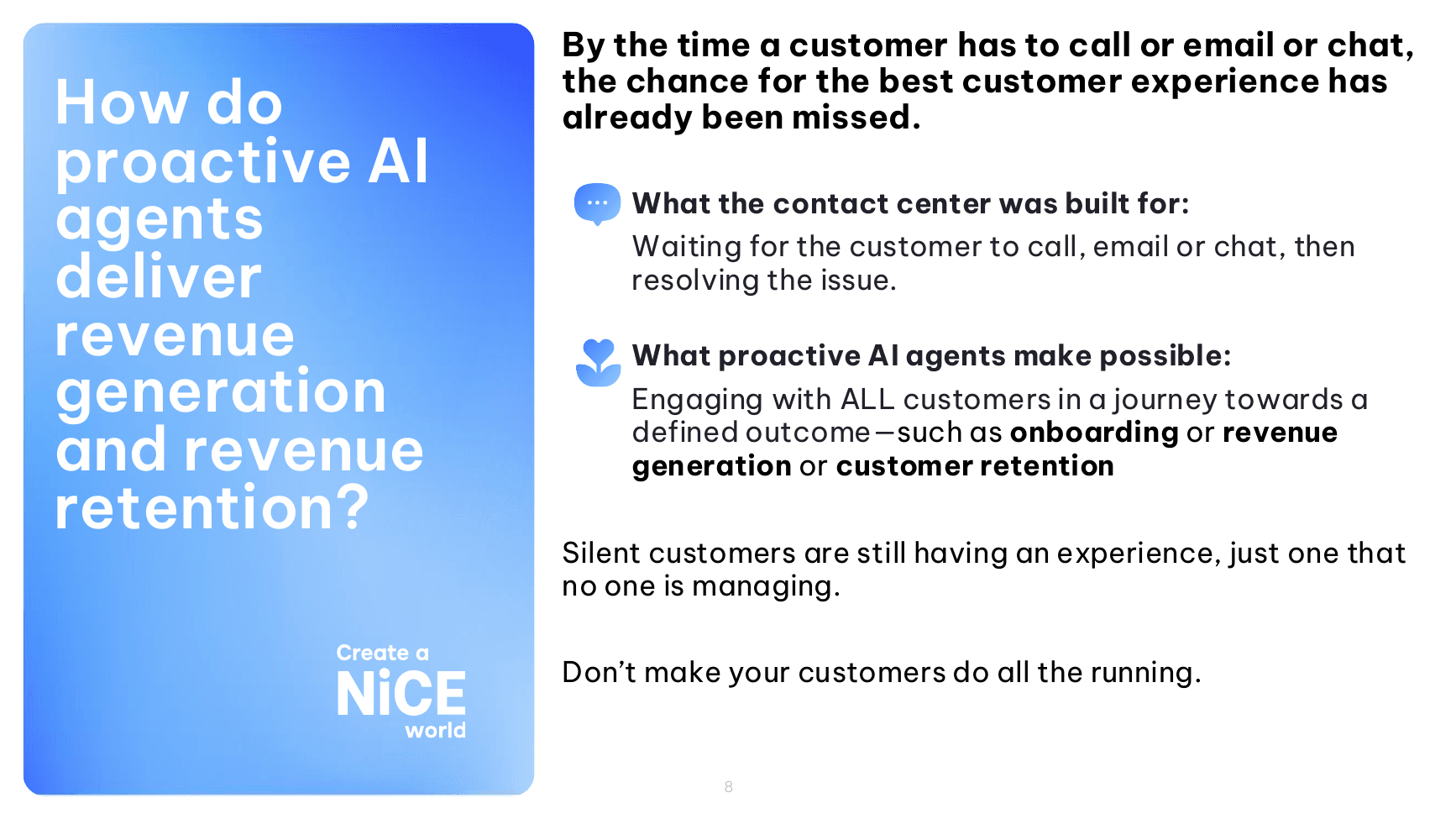
Ask most people what an AI agent does in a contact center and you’ll hear one of two answers. It helps human agents by listening to the call, suggesting answers, summarizing the conversation and drafting the follow-up. Or it handles routine contacts on its own so fewer of them reach a person. Both are worth doing, and both begin at the same moment, when the customer calls, emails, chats or logs in. The contact center was built to work that way, and it works that way whether a human or an AI picks up.
Built like that, the best you can get is a cheaper operation. By the time a customer picks up the phone, the chance at the best customer experience has already passed, because now they’re the ones doing the work.
Jim Lundy of Aragon Research and I shared insights around the power of proactive and on how to turn AI agents into revenue and retention engines in part two of our Putting Enterprise AI Agents to Work webinar series available now on demand. We spent most of the hour on one main idea. Every customer who never calls, emails or chats is still having an experience with your company. Proactive AI agents can make it better, both for them and for those customers that do call or log in.
Starting from the data instead
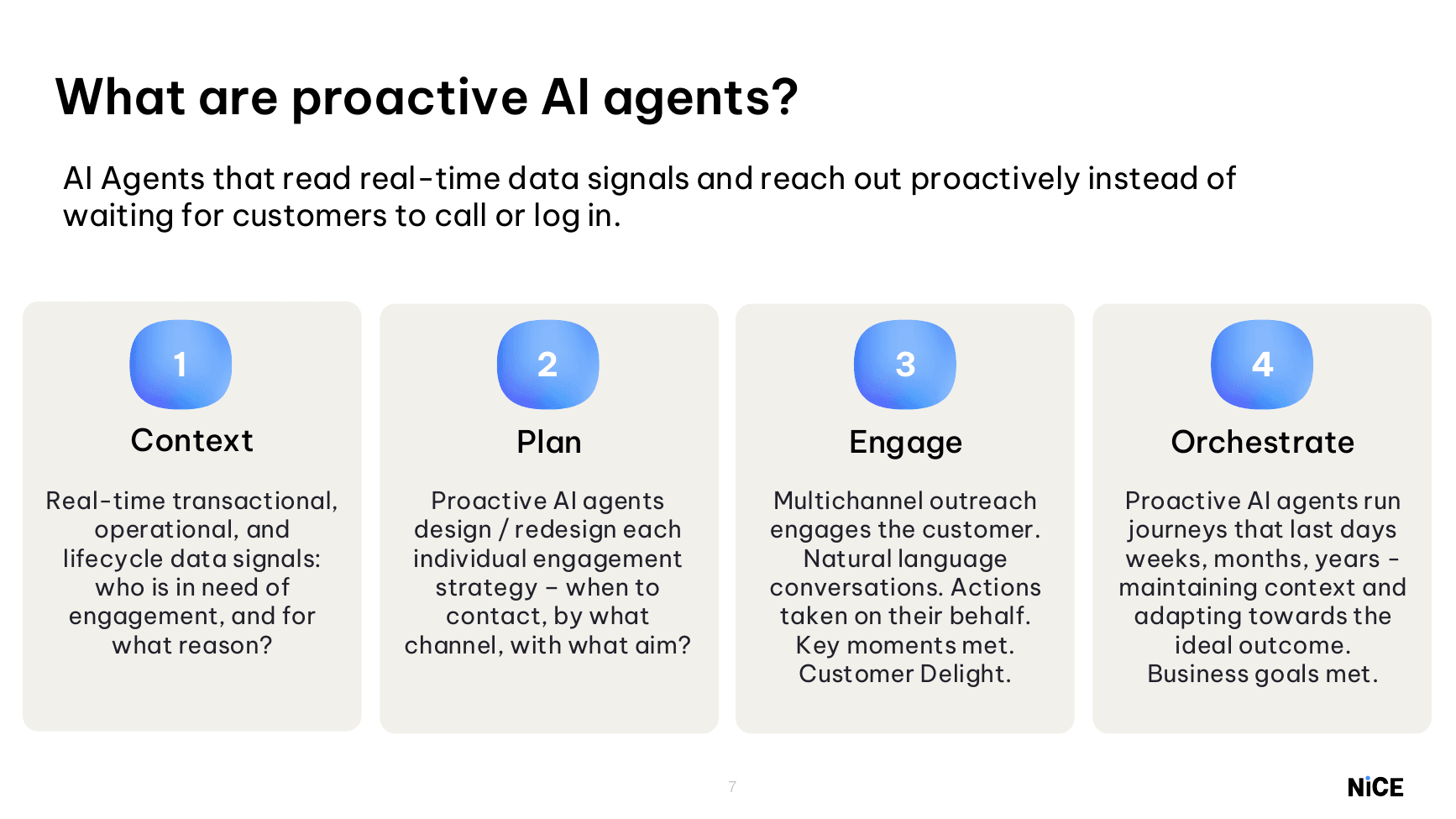
A proactive AI agent starts somewhere else. It watches transactional, operational and lifecycle data in real time to see which customers need to hear from you and why. Then it plans the engagement for each one: when, on which channel, and what it should achieve. From there it holds the conversation in natural language, takes actions on the customer’s behalf, and stays with that person for as long as the outcome takes, whether that’s days, weeks, months, or years. We break the proactive AI process into four steps: context, plan, engage, and orchestrate.
Three deployments, one pattern
Most of the session went to three live NiCE deployments, in telecom, banking and higher education, across three countries. The details differ, but each followed the same arc. A reactive process was losing customers or revenue, a proactive program replaced it, and the gain showed up in retention or revenue.
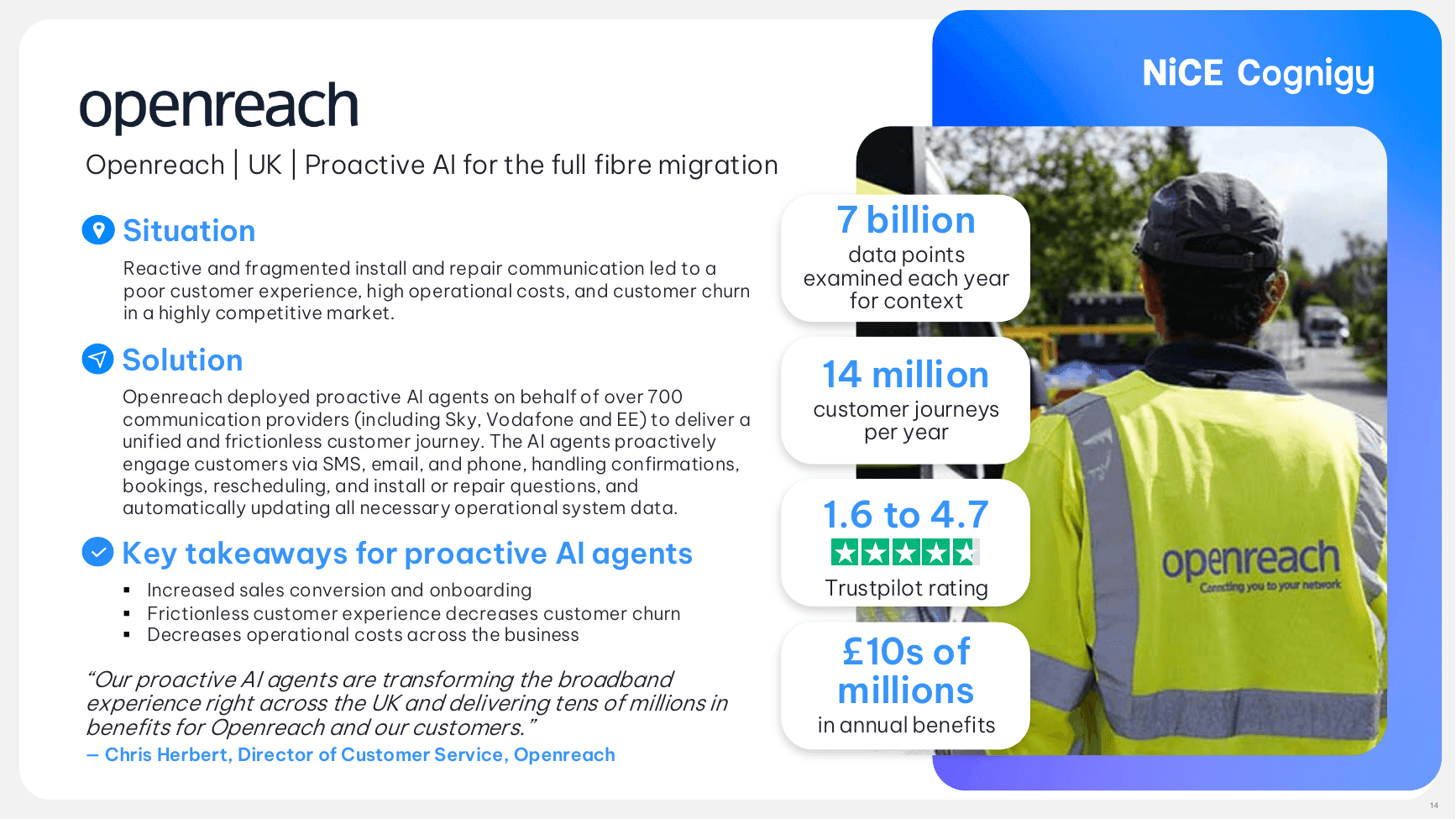
Openreach, part of BT, runs the broadband and phone network across the UK, and providers like Sky, Vodafone and EE sell service over it. Install and repair communication used to be handled separately by each of more than 700 providers. Customers got a poor experience, Openreach carried high costs, and challengers saw an opening. Now proactive AI agents handle that communication for the providers over SMS, email and phone. They confirm and reschedule appointments, answer install and repair questions, and update the operational systems as they go, so the customer sees one experience whichever provider they signed up with. The scale is large, with 7 billion data points examined a year and more than 14 million customer journeys. Trustpilot went from 1.6 to 4.7, and Openreach reports tens of millions of pounds in annual benefits across retention, sales, field operations and call center costs. Chris Herbert, Director of Customer Service at Openreach, put it this way: “Our proactive AI agents are transforming the broadband experience right across the UK and delivering tens of millions in benefits for Openreach and our customers.”
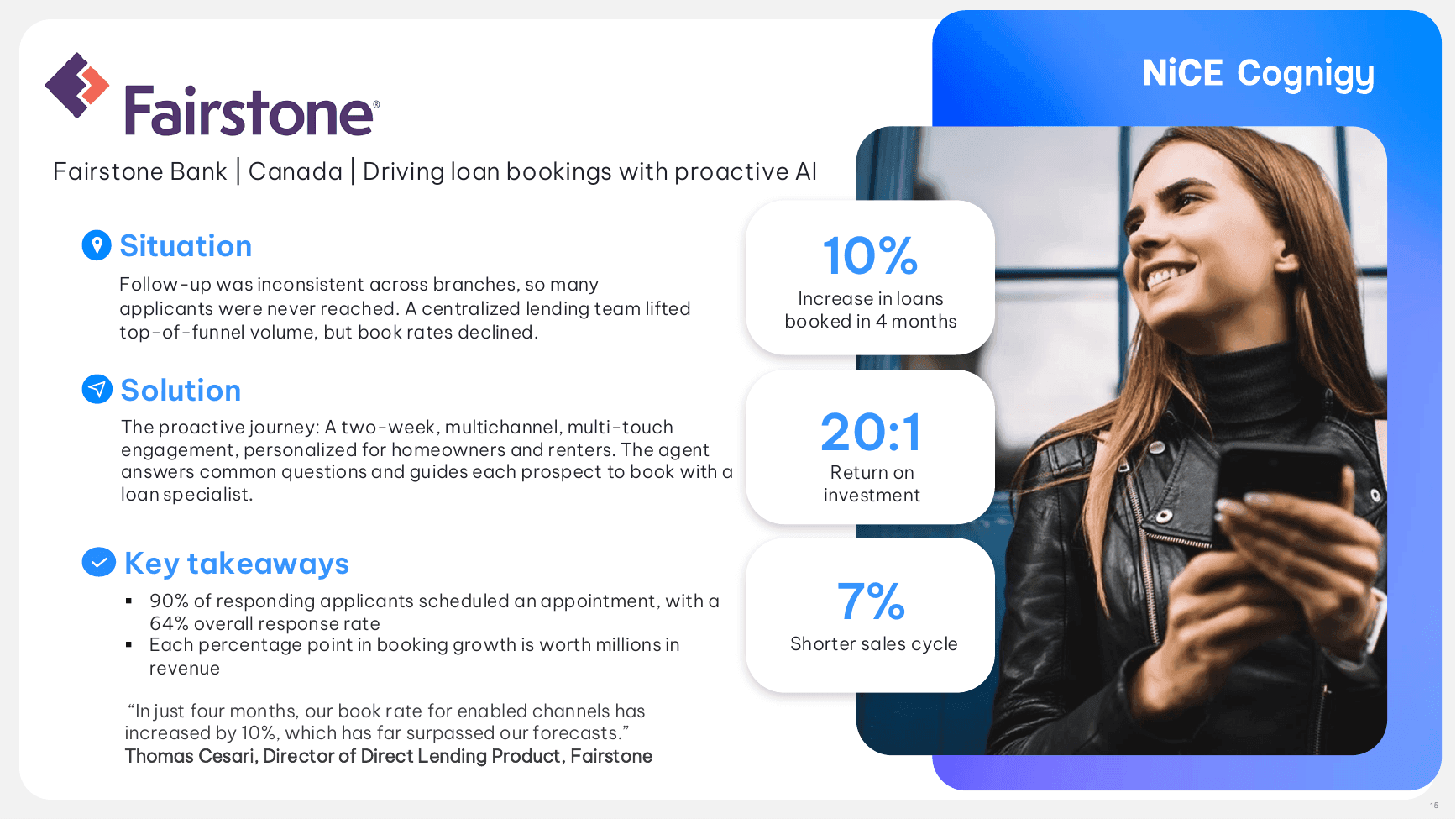
Fairstone Bank in Canada had a funnel problem. Branches followed up on loan applications inconsistently, so plenty of applicants never heard back. A centralized lending team brought in more applications, but the book rate fell, so more applicants did not mean more loans. Fairstone now runs a two-week, multichannel program for homeowners and renters in which an agent answers common questions and steers each applicant toward an appointment with a human loan specialist. Loans booked rose 10% in four months, the sales cycle is 7% shorter, and Fairstone reports a 20:1 return on investment. Ninety percent of the applicants who responded booked an appointment, and 64% responded overall. Thomas Cesari, Director of Direct Lending Product, said: “In just four months, our book rate for enabled channels has increased by 10%, which has far surpassed our forecasts.”
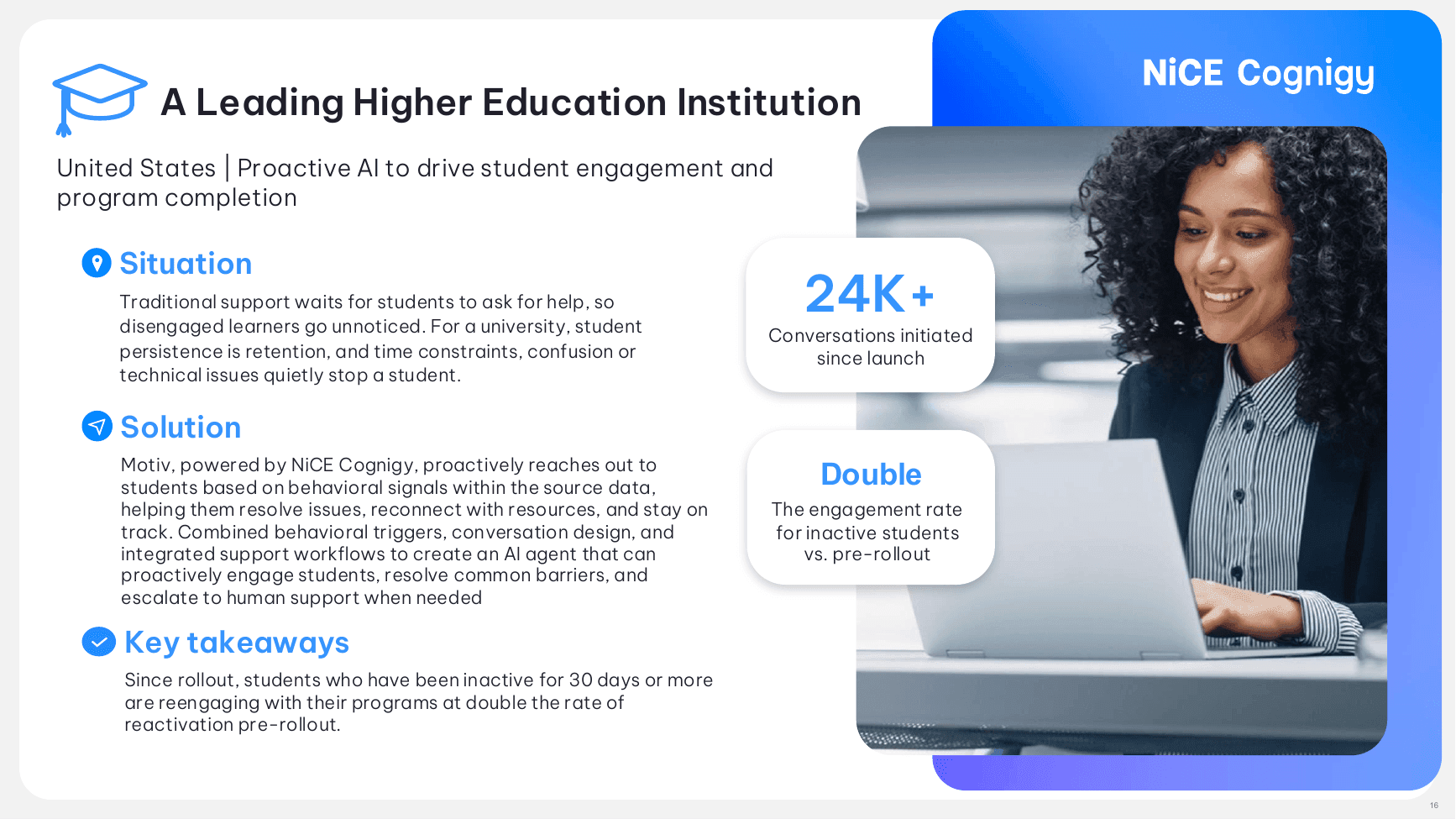
The third is a leading US online university, where keeping students enrolled is the revenue. Traditional support waits for a student to ask for help, so the ones who are slipping away go unnoticed. Motiv, powered by NiCE Cognigy, now reaches out when behavioral signals in a student’s data suggest trouble. It helps them fix a problem, find a resource or reconnect with a mentor, and it hands off to human staff when needed. Since launch it has started more than 24,000 conversations, and students inactive for 30 days or more are coming back at twice the rate they did before.
Plan from first contact to outcome
Looking across the three examples, a few things stand out. The projects started with an outcome the business already cared about, whether that was loan bookings, course completion or customer lifetime value, and the channel and tooling came afterward. Teams picked who to contact from signals in the data, such as applicants nobody had followed up with or a student’s activity dropping off, so the starting point was never an inbound call. They planned the whole program from first contact to outcome instead of one interaction at a time, and they measured success in business results. Contact center savings were real in all three, but smaller than the revenue and retention gains.
Jim asked what one thing a CX leader should do in the next 90 days. I’d open the company’s annual report and find which of three goals the business cares about most: converting more customers, earning more from each, or losing fewer of them. Then build the business case around that goal. Jim’s answer, to build revenue retention and generation playbooks, landed in the same place.
Cold sales is where I’d be careful. Consumers are tired of automated selling, the TCPA limits it, and the filters Apple and Android added recently screen out calls and texts people don’t want. Proactive selling works when the lead is warm, like someone finishing an application or an onboarding. The bigger prize is the customers you already have: fewer cancellations, smoother renewals, and more value over time from upsells and cross-sells.
What the audience asked
The questions that came in kept circling the same practical worries. The first was about channels, and whether the agents in our examples were voice agents or chatbots. Voice was part of the mix, along with SMS, RCS, WhatsApp and email. A website chatbot can’t start a conversation anyway, because it waits for the customer to show up. Messaging that doesn’t need an immediate answer usually works best, since a text can wait until the person is ready and a phone call can’t. Location matters too and varies country by country: for example, a default of WhatsApp in Germany and Brazil, SMS in the US and UK. I’d choose the program first and let the channel follow from it.
That led to the worry that proactive outreach will feel like spam. Done well, it does the opposite. Think about how many departments at a typical company email, text and call the same customer, each with its own agenda. A planned program replaces that with sophisticated and transactional engagements that arrive at the right time and give the customer something to act on, so the total amount of unnecessary noise goes down.
Two other questions were about where to begin and how to prove it worked. For the first, I suggested plotting every candidate program on a matrix of volume, complexity and value. High-volume, lower-complexity programs usually go first, and Jim’s advice to start with the repetitive work pointed the same way. For the second, set up control groups early and get finance to sign off on the numbers before rollout. Deployments move quickly, and once the results arrive everyone wants credit for them.
One attendee asked about corporate banking and reinsurance, where there are fewer clients and each relationship is closer. I was honest that this is a hard place to start with proactive AI, since you’re usually trying to reach one person inside a complicated relationship. Strong reactive support with good tools for the people serving those clients gives a faster return. That applies to proactive and reactive agents alike: they are only as good as the knowledge behind them, having the same data and knowledge serve the human agent, the reactive AI agent, and the proactive one.
Whichever of the three goals your annual report puts first, converting more customers, earning more from each, or losing fewer, the inbound queue won't move it. Instead, you need to get to all of your customer and give them the best proactive care.
If you missed the full conversation, you can watch Turning AI Agents into Revenue and Retention Engines, and see the full series, including How to Close the Decision Gap between Insight and Action, and Five Ways AI Agents are Changing the Game.