
Most CX leaders aren’t short on insight. They’re short on time. When a problem takes days or weeks to move from a dashboard to a fix, every one of those days shows up in repeat contacts, escalations, and churn risk. And with AI agents now handling part of the work, the problem is harder because it can start with an AI agent or a human agent.
That delay is what David Myron, Principal Analyst at Omdia, and I dug into in the first session of NiCE’s webinar series, Putting Enterprise AI Agents to Work. The session, How to close the decision gap between insight and action, paired David’s research on why the gap persists with a look at how agentic analytics goes beyond the dashboards and generic LLM summaries most teams use today. It doesn’t just report what happened. It recommends what to change, shows the expected ROI, and verifies the result.
The cost of a late answer
More insight has not made teams faster at acting on it. Organizations have more dashboards, more metrics, and more AI-generated insight than ever, and it can still take days or weeks to understand what changed, agree on a solution, and push the right intervention into production.
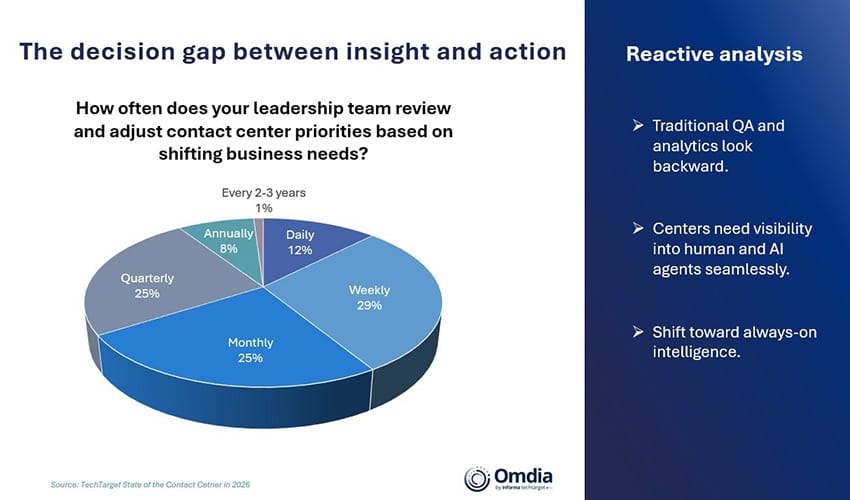
Review cadence shows how common this is. In TechTarget’s State of the Contact Center in 2026 report, 12% of leadership teams said they review and adjust contact center priorities daily and 29% said weekly. Half said monthly or quarterly. Weekly or daily looks agile on paper, but traditional QA and analytics look backward, so many centers are “steering by looking in the rearview mirror.”
Visibility is the other half of the problem. The same research found that only 19% of contact centers assess every channel they support for quality, and 35% assess fewer than half. A customer can start in a chatbot, move to WhatsApp, and finish on a phone call while the team reviews only the call.
The pressure is higher now that contact centers manage human and AI agent performance side by side, and many leaders still lack a unified view. “They look at AI metrics in one silo and human performance in another,” David said.
Why the gap persists
Most organizations have the data. What slows them down is what happens next. Here are five structural causes that stretch the time from insight to intervention:
- Fragmented evidence: voice, digital, CRM, quality, workforce, knowledge, and bot data live in separate views.
- Manual investigation: analysts reconcile exports and ask specialists to explain what changed.
- Siloed ownership: operations, product, workforce, IT, and AI teams each own a different part of the journey.
- Static playbooks: a finding may not map to a specific, approved action or an accountable owner.
- Trust gap: recommendations without evidence, confidence, and guardrails are hard to put into practice.
In a live poll of webinar attendees about what slows them down most, manual investigation led at 38%, with and fragmented evidence at 19.7%.
No single dashboard shows where a problem started. A customer could start with an AI or self-service experience, transfer to a human agent, and may then depend on a back office team to finish the request. If self-service fails on a billing intent, transfers rise, agents spend time re-asking questions, and customers contact you again. Each team’s dashboard shows a local symptom, while the cause sits somewhere across the whole journey. A failure at one handoff can surface later as a queue spike or a repeat contact. He was clear that this is an illustrative example, and it will sound familiar to anyone who runs a contact center.
From lagging signals to always-on intelligence
Service level, CSAT, complaints, and attrition are the metrics most teams watch, and they all run on a delay. By the time one moves, the issue has usually already reached customers and agents. Leading signals show up earlier: a new contact reason growing quickly, transfers clustering around one intent, AI containment falling on a topic, or a spike in knowledge searches. None of these proves a problem on its own. They tell you where to look.
That is the case for always-on intelligence: monitoring that covers human and AI agent interactions together, so one view shows how both are performing. Where traditional QA relies on sampling a small share of historical calls, always-on intelligence analyzes every interaction, human and AI, in real time. This comes with a guardrail: “Always on should not mean constant interruption,” as David said. A useful test for any alert is whether it arrives early enough for someone to prevent customer impact.
Omdia’s operating model for closing the loop has five steps: detect, explain, decide, act, and verify. Verification is what makes it a loop. “Without verification, a recommendation can be completed without producing the intended result,” he added. Not every action should be automated, either. A low-risk, reversible change may suit automation, while a change that touches customer eligibility or privacy may need human approval and testing.
How agentic analytics closes the loop
The shift from traditional analytics to agentic analytics is a shift from reporting to acting. Rules-based tools were manual to build, needed expertise, and had to be updated constantly as conversations changed, which kept programs reactive and made early detection hard. Generic LLM-based tools improved on that, but without specialized CX models they were less precise couldn’t provide actionable recommendations and couldn’t measure impact. Agentic analytics tells you what needs to change and what the ROI is for changing it. It continuously scans interactions, workflows, and outcomes for improvement opportunities, then feeds them to the AI agents and teams best positioned to act.
The result is a learning loop with five steps, and in each one something that used to be manual now runs on its own:
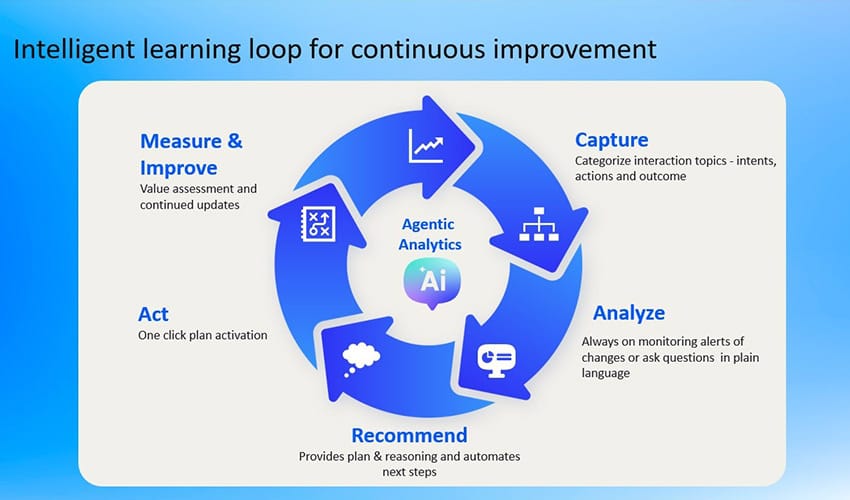
- Structure: analyzes 100% of your unstructured customer interactions across channels and sorts them into intents (why customers contact you), actions (what agents did), and outcomes (resolution and sentiment). You can tune the models to your own terminology. This replaces analyst-written rules for clustering topics and phrases, which had to be updated as conversations changed.
- Analyze: always-on monitoring alerts you to changes, or you can ask a question in plain language, like “Where are AI to human handoffs failing?” Answers include supporting transcripts, so you can check the evidence. A business user can ask directly instead of waiting on an analyst to build a report.
- Recommend: where traditional dashboards never tell you where to start, an AI daily briefing prioritizes your work by role, with evidence and expected impact behind each item. Each one is tagged by the action it calls for: investigate a signal, automate a high-volume intent, or improve a live AI agent.
- Act: carry out the recommendation in the same motion, with one-click plan activation, so the fix happens where the issue was found. You can build an AI agent, update a knowledge article, or create a coaching plan. AI agents publish directly to the NiCE Cognigy platform, where simulation lets you confirm they work as planned. Guardian AI, the oversight layer that keeps AI agents safe, secure, and on brand, scores every conversation against your guardrails you set for compliance, brand, permissions, and safety, and drafts a fix when an agent drifts.
- Measure and improve: the platform sets a baseline before anything changes, records what you did and when, and ties the impact to the action itself, calculated against that baseline in real time.
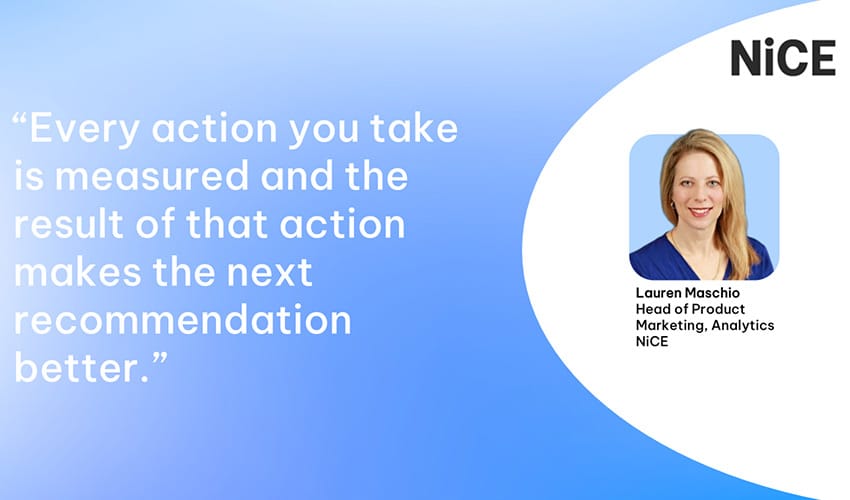
Measurement is where most AI programs stall. A Gartner report, Customer Service Leads on AI Adoption but ROI Remains Elusive, found that 42% of AI customer service use cases have an unclear ROI. Setting a baseline before anything changes lets you prove impact, whether the action is a coaching plan for a human agent or a fix for an AI agent.
One question to bring to your leadership team
Boards tend to scrutinize the risk of changing how a contact center operates. They rarely put the same rigor on the cost of staying put. That cost is real: repeat contacts and escalations that keep climbing, problem patterns that run unchecked until someone spots them in a weekly report, and analyst hours spent pulling exports instead of fixing root causes.
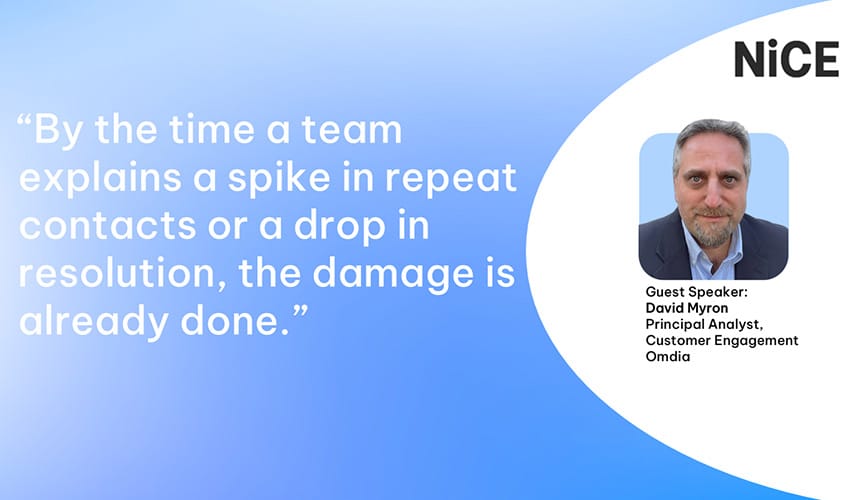
Omdia’s David Myron suggests making the status quo show its math. Before you pitch real-time AI, price the delay. Ask: what is each day of delayed insight costing our bottom line?
If the answer is “we don’t know,” that’s the first gap to close.
Watch the full session
If you want even more insights on how to turn CX insight into faster action, watch How to close the decision gap between insight and action on demand. You’ll get:
- Omdia research on how contact centers review priorities, assess quality, and where they need better metrics
- David’s detect, explain, decide, act, and verify operating model, plus the five cycle times that show whether your gap is closing
- A walk-through of agentic analytics turning an insight into an AI agent, a knowledge update, or a coaching plan
- Live Q&A on proving ROI and managing change
This was session one of Putting Enterprise AI Agents to Work. Register now for the rest of the series:
- October 27: Turning AI Agents into Revenue and Retention Engines with Aragon Research’s Jim Lundy
- October 29: Five Ways AI Agents Are Already Changing the Game with Metrigy’s Robin Gareiss