
Watch the on-demand session: The Future of Customer Service Work: How AI Agents Change the Workforce
Too many organizations are directing one customer journey from two control towers.
AI agents resolve inquiries, trigger workflows, and absorb demand that once landed on human teams. Behind the scenes, AI agents run on one set of systems, metrics, and owners while human teams run on another.
That separation widens with every inquiry an AI agent resolves. Quality standards, escalation paths, and performance visibility begin to diverge, and no single leader can see how the combined workforce is serving customers.
Successful organizations create a shared control layer. They establish clear routing and escalation rules, measure both groups against common customer outcomes, and give leaders one view of capacity, quality, and accountability across the full-service operation.
The implications extend beyond automation. Customer service leaders must now determine how work should move between AI agents and people, where human expertise creates the most value, how performance should be measured across both, and how service capacity can grow without headcount increasing at the same rate.
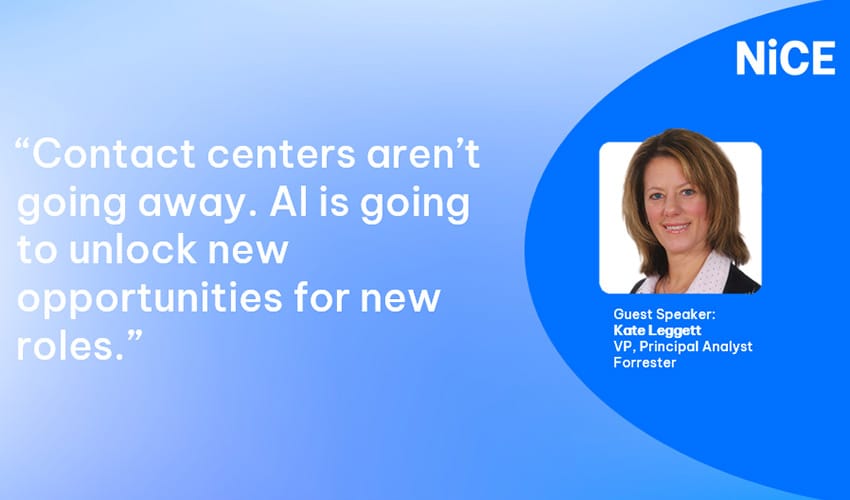
This was a central theme of our webinar, The Future of Customer Service Work: How AI Agents Change the Workforce, with insights from guest speaker Kate Leggett, VP and Principal Analyst at Forrester.
The shift leads to a different way of thinking about the workforce: When AI agents are doing the work, they need to become part of how the work is planned, measured, supervised, and improved.
That changes the role of human employees, the economics of customer service capacity, and the management systems surrounding both. And it starts with rethinking what workforce management is actually managing.
Workforce solutions are becoming a strategic layer
For years, workforce management answered predominantly human questions: How many employees will we need? When should we schedule them? What skills should they have? How are they performing? AI agents expand those questions because they change the unit of management. That shifts the focus from individual employees to a connected system of people, AI, and workflows.
Many organizations still manage those components separately. Humans sit inside workforce systems. Automation lives elsewhere. AI agents may even be owned by another function entirely. That fragmentation makes it harder to answer increasingly important questions: Where is capacity available? Why did AI escalate? Did the handoff improve or damage the experience? Does poor performance trace to a human skills issue, an AI issue, a workflow issue, or some combination of the three?
This is why workforce engagement management (WEM) is evolving from a collection of workforce capabilities into an AI-driven orchestration layer across human agents, AI agents, skills, workflows, demand, and performance. The change reaches across WEM's core domains.
Capacity planning can account for work handled by people and AI together. Quality management can expand beyond sampled human interactions toward a broader view of customer interactions. Performance management can examine outcomes across both types of agents, including what happens when responsibility changes hands.
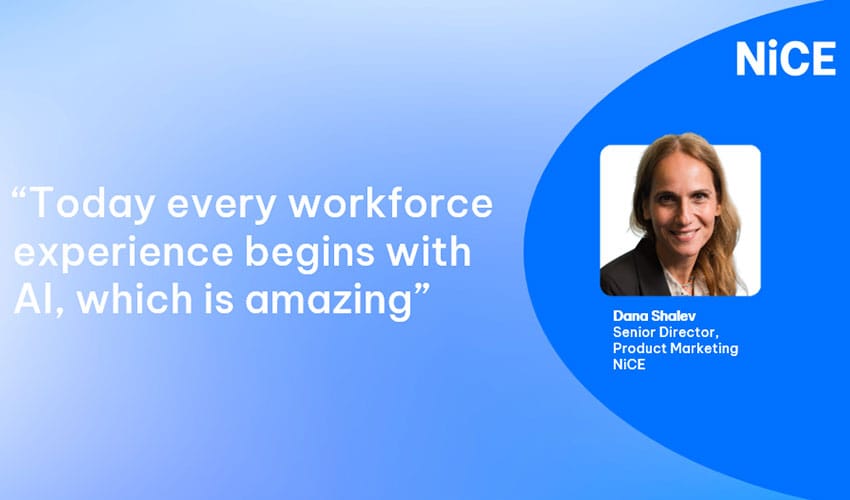
As we discussed during the webinar, workforce management is turning into a discipline for managing work, rather than specifically human labor. When AI agents contribute directly to service outcomes, leaders need a connected view of capacity and performance across both human and AI work.
Agentic workforce management extends that idea further. As AI progresses from providing assistance to identifying issues and acting on operational intelligence, WEM can become a more active optimization layer across the hybrid workforce.
AI agents leading to specialized career growth for human agents
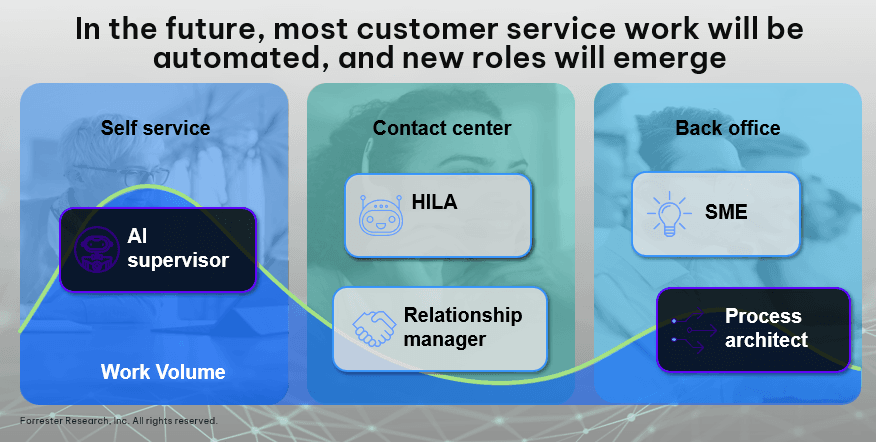
As AI absorbs straightforward work, the human role becomes more specialized. Forrester's research presented during the webinar points to emerging roles that illustrate the change. A human-in-the-loop employee can resolve exceptions when an AI agent gets stuck. Relationship managers can take on situations where emotion, negotiation, or trust matters. Subject-matter experts can handle difficult technical or policy questions. AI supervisors and process architects can oversee AI outcomes and improve how AI-driven work gets done.
The skill mix changes with those roles. Empathy and communication become more valuable when customers reach people with more complex or emotional issues. Domain expertise matters when straightforward inquiries have already been resolved. Analytical and technical skills become increasingly relevant as employees monitor AI performance, identify failure patterns, and help improve processes.
Enterprises already recognize the need to prepare people for this transition. According to the World Economic Forum's Future of Jobs Report 2025, 77% of employers plan to upskill workers in response to AI, while 50% expect to transition staff into other parts of their businesses.
AI assistance can reinforce that movement. Copilots can bring knowledge, context, recommendations, and insights directly into employees' workflows, helping people become more efficient, strategic, decisive, and proactive. Less effort spent searching for information or completing repetitive tasks creates more room for work requiring judgment.
The opportunity for CX leaders is to direct human attention toward the moments where judgment, empathy, expertise, and relationships matter most. Capturing it requires intentional workforce development because institutional knowledge does not automatically translate into AI oversight, relationship management, or specialized expertise.
Leaders need career paths that move employees toward the work the hybrid operation will require. Done well, automation becomes both a capacity strategy and a catalyst for a more specialized workforce.
The advantage of watching human and AI agent performance side by side
Organizations know how to measure human agents, and they are learning how to measure AI agents. Customers, however, experience the combination.
Imagine an AI agent handles most of an interaction efficiently, then hands the customer to an employee without enough context. The AI dashboard might show successful containment until escalation, while the employee dashboard shows longer handle time. Neither view, by itself, explains the customer's experience because a critical part of performance sits between them: the handoff.
That transition is becoming a new source of performance intelligence. In a hybrid performance model shown during our webinar, leaders can view measures such as AHT, CSAT, and abandoned interactions across AI and human agents, then examine the handoff itself: volume, handle time, CSAT, escalation frequency and reasons, fallback rate, sentiment, and intent accuracy.
The handoff is no longer invisible. It can be scored, diagnosed, and improved.
Real-time supervision extends that visibility into the interaction itself. Supervisors can monitor AI-led interactions, identify interactions at risk, flag flow problems, and intervene, when necessary, through options such as joining, taking over, or handing the interaction to a live employee.
That broader view helps supervisors distinguish between very different performance problems. A recurring issue might indicate that an employee needs coaching. It could reveal that an AI agent repeatedly fails to recognize a particular intent. Or it might show that a workflow is transferring customers without the context employees need to resolve the issue efficiently.
Shared visibility makes those distinctions easier to see and creates a feedback loop across AI performance, employee performance, customer outcomes, and workflow design. In a hybrid workforce, performance management must show how the system performs together.
The business case for a well-orchestrated hybrid workforce
For decades, customer service growth came with a stubborn equation: more customer demand meant more labor. AI changes that relationship by creating capacity across several parts of the operation at once.
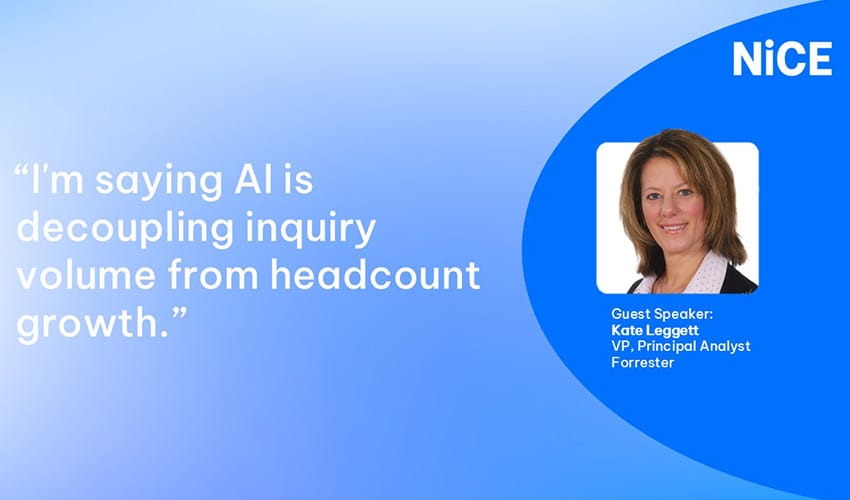
During our webinar, Kate Leggett described the shift as AI “decoupling customer service inquiry volume from headcount growth.” AI agents can resolve inquiries without human intervention. Copilots can help employees find information and make decisions faster. AI can summarize cases, classify interactions, automate administrative work, surface insights, and support routing. Employees can then concentrate more of their time on exceptions, relationships, and specialized work.
One of NiCE Cognigy’s customers, Lufthansa, demonstrates what this looks like when AI becomes operational infrastructure rather than an isolated experiment. In 2025, the airline automated 16 million conversations, achieved an 80% automation rate for refunds and rebookings, and handled peak loads of 12,000 messages per minute, with 16+ AI agents operating with real-time AI translation.
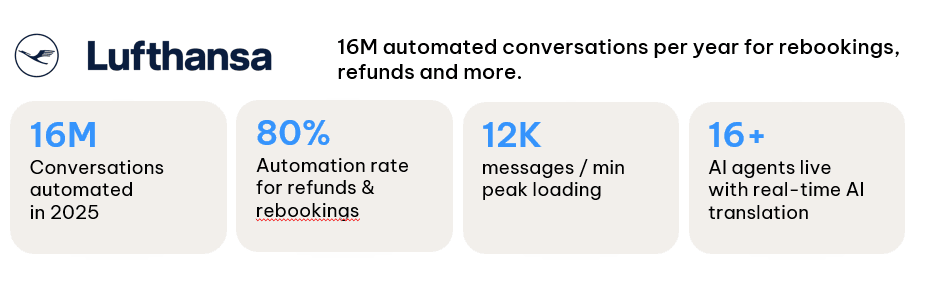
The significance of those numbers goes beyond automation volume. A service operation capable of absorbing that level of demand with AI does not plan capacity the same way as one in which virtually every incremental interaction creates incremental human workload. Seasonal peaks, business growth, and rising interaction volumes do not have to translate as directly into additional staffing.
Greater AI capacity also raises the value of coordination. As AI handles more work, employees increasingly receive the interactions AI cannot or should not resolve. Those interactions may be more complex, more emotional, or more consequential. Poor handoffs become more costly, visibility into AI performance becomes more important, and workforce skills need to evolve alongside the work.
The business advantage comes from orchestrating AI capacity with human judgment, expertise, and accountability. That is how customer service can expand its capacity without treating headcount as its primary scaling mechanism.
Turning this into a plan, not just an idea
For CX leaders, the practical question is already here: AI agents are doing work that once belonged entirely to people, so it’s critical that workforce planning accounts for their contribution.
Start by mapping the work rather than the org chart. Identify what AI can resolve from beginning to end, where it escalates, what triggers those escalations, which interactions require human judgment, and what context follows the customer when responsibility changes hands. Then determine whether leaders can see performance across that entire flow.
Next, examine the workforce implications. Which roles will become more specialized? Which employees could move toward relationship management, subject-matter expertise, human-in-the-loop oversight, AI operations, or support insights? Which skills need to be developed now to prepare for those roles?
Performance needs the same scrutiny. A hybrid workforce requires visibility into human performance, AI performance, and the connections between them. Agentic workforce management points to what comes next. By bringing together signals from performance, conversations, workflows, AI observability, and other operational context, AI can help identify root causes, find opportunities for improvement, and shape actions to improve the operation.
Manage one workforce by updating mindsets, disciplines, and technology
AI agents create capacity. People bring judgment, expertise, empathy, and accountability. Agentic AI adds another dimension: the ability to continuously optimize how that combined workforce operates. The advantage comes from managing human and AI work as one workforce, with the intelligence to keep improving both.
Read the Forrester report AI Agents Reshape The Customer Service Workforce In Dramatic Ways for a deeper dive into research on how human expertise and AI-driven work come together in an AI-first CX model.
Watch the full session on demand: The Future of Customer Service Work: How AI Agents Change the Workforce