

A human agent misses a required compliance step. An AI agent reaches a request outside its designed scope and stalls. Sentiment on a high-value channel begins to fall, but the pattern remains buried until the next review cycle.
In each case, the signals exist across interactions, workflows, and operational systems. The business risk is not only whether leaders can detect the issue. It is how quickly they can understand why it is happening, decide what matters most, and move the right response into action.
That delay — the distance between knowing and doing — raises cost, increases exposure, weakens customer retention, and makes AI ROI harder to prove. It is why analytics is moving beyond retrospective reporting toward an agentic command center for CX performance: an always-on intelligence environment that monitors both human and AI agents, explains what changed, prioritizes what to address next, and connects the finding to governed action across a unified CX AI platform.
The reporting model leaves a gap enterprises can no longer absorb
Traditional CX analytics was built for a look-back cadence. Dashboards surface problems after the fact, and an analyst then works backward to figure out why they happened.
That model depends on rule-based detection to identify known conditions. As a result, it only catches what the rules were built to catch, in the slice of conversations it happens to review. Everything outside that scope stays invisible until someone goes looking for it. As a result, the model doesn't provide the complete operational coverage needed to find a compliance failure, an emerging customer intent, or an AI agent that is beginning to drift. When the question changes from “What usually happens?” to “Where is risk forming now, and which response is most likely to improve the outcome?” delayed or partial analysis is not enough.
Hybrid human and AI agent operating environments intensify the challenge. Every AI agent introduces new signals for task completion, accuracy, escalation, tone, and governance alongside the human workforce. Voice, chat, email, messaging, and social channels add context of their own. A dashboard can show the state of those metrics, but dashboards alone do not continuously determine which change matters most, explain the evidence behind it, or connect the insight to execution.
What makes analytics agentic
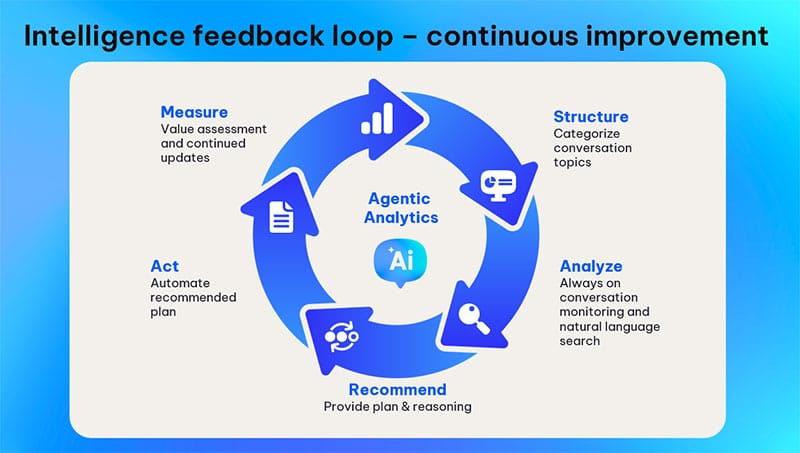
A conventional report answers a predefined question. Agentic Analytics proactively watches for material change, investigates what is driving it, recommends what should happen next, and continues measuring what happens after the response.
- Continuous observation reveals what deserves attention. Across connected voice and digital interactions, it can examine signals such as customer intent, agent actions, outcomes, sentiment, escalation, compliance indicators, knowledge gaps, and workflow performance. Rather than waiting for an analyst to specify every condition in advance, it surfaces anomalies and emerging patterns that deserve attention.
- Evidence-based reasoning explains what is driving the change. A drop in containment is not automatically treated as a problem. It may be a symptom of a missing knowledge answer, a new customer intent, or a handoff that no longer works. The command center correlates behavior with outcomes, grounds its conclusion in the interactions, and signals behind it and prioritizes the issue by business impact and risk.
- Impactful recommendations connect insight to business priorities. Recommendations are tied to defined business goals and operating guardrails, not simply to movement in a metric. Leaders can see why an issue was prioritized and which outcome the proposed response is intended to influence.
- Additional data keeps the system learning. After a governed action is initiated, such as assigning a coaching plan, proposing a knowledge update, or creating and testing a new AI agent, the same analytics environment continues monitoring the target KPI. That closes the learning loop and turns improvement into a continuous discipline rather than a one-time project.
A command center for human and AI performance
Here, “command center” does not mean another workflow console. It means an intelligence and decision environment that brings evidence, priorities, actions, and measured outcomes together.
Human and AI agents contribute to the same customer journeys and business outcomes, but they do so in different ways. Leaders therefore need a shared view of enterprise outcomes, including resolution, customer effort, satisfaction, compliance, revenue, cost, and handoff quality, alongside role-specific measures of performance. For human agents, those measures may include behaviors, coaching opportunities, and process adherence. For AI agents, they may include containment, task completion, accuracy, and escalation quality. Agentic Analytics brings these measures together in one operating view, helping leaders understand each workforce’s contribution while applying consistent governance across the operation.
That unified view allows leaders to follow a breakdown across the journey: where an AI agent misunderstood intent, where a handoff added effort, where knowledge failed, and where human intervention recovered or compounded the outcome. It replaces separate narratives for separate workforces with shared intelligence about what the customer experienced and what the business should change.
It also changes who can ask the question. Executives, operations leaders, supervisors, and quality teams should not need to enter an analyst queue to understand why repeat contact rose or where compliance risk is forming. Plain-language exploration gives each role direct access to an evidence-backed answer, while the source interactions and supporting signals remain available for validation.

From evidence to governed action
A report ends with a number. An Agentic Analytics command center continues into the decision and the response.
Its value does not come from replacing every system that carries out the work. Its value comes from becoming the intelligence and decision point that keeps those systems aligned. A detected issue can become an evidence-backed recommendation, move into the appropriate workflow, and remain connected to the metric the organization intends to improve.
That could mean routing a coaching plan to a supervisor, sending a proposed knowledge change to the right owner for approval, strengthening a monitoring rule, or initiating the creation or refinement of an AI agent. The action should follow enterprise permissions, approval policies, audit requirements, and human override controls. Speed matters, but governed speed is what makes the model scalable.
DMG Consulting describes this progression in the report, Analytics: The actionable intelligence engine of CX modernization. It states that “data becomes insight, insight becomes action, and action becomes measurable business impact.” On a unified CX AI platform, that loop can connect agentic analytics with quality, coaching, knowledge, AI-agent development, workflow execution, and governance without forcing leaders to reconcile disconnected point solutions.
What enterprise leaders should look for in an agentic analytics solution
Evaluating whether analytics can operate as an agentic command center requires more than a feature checklist. The enterprise test is whether it can improve decision quality, speed, accountability, and measurable outcomes at scale.
- Outcome-first monitoring. Continuously evaluates performance against defined business goals and proactively surfaces risks or opportunities in priority order.
- Comprehensive, transparent coverage. Analyzes all interactions across channels and proactively makes any coverage gaps visible.
- Evidence-backed reasoning. Shows the source interactions and operational signals behind an answer.
- Supports plain-language exploration. Business leaders can ask questions and get a response, making the path from observation to recommendation clear and easy to execute.
- Unified human and AI agent performance understood together on one surface. Connects both workforces to common business outcomes and governance while preserving the role-specific measures each requires.
- Role-based decision support. Gives executives, supervisors, quality leaders, managers, and analysts the information, visualizations, and actions relevant to their responsibilities.
- Governed action. Moves recommendations into connected workflows with permissions, approvals, auditability, and human override where required.
- Closed-loop measurement. Establishes the baseline, records the action, monitors the target KPI, and shows whether the result improved over time.
The outcome the C-suite expects
Metrigy reports that nearly 84% of companies believe customer interaction data should be part of executive performance dashboards. That figure rises to 96.7% in its success group. The signal is clear: interaction intelligence is no longer only an operational resource. It is becoming an enterprise performance input.
That expectation changes how analytics should be evaluated. Executives do not need more data points. They need a defensible line from operating signal to business decision, and from action to measured result.
Gartner predicts that more than 40% of agentic AI projects will be canceled by the end of 2027 because of escalating costs, unclear business value, or inadequate risk controls. The lesson is not that agentic AI cannot scale. It is that scale requires continuous visibility into value, risk, and operational performance from the start.
An Agentic Analytics command center makes that value observable. It can analyze conversations against a baseline or target KPI goal, make recommendations and execute plans, and monitor subsequent performance. It provides a disciplined evidence trail that helps leaders decide what to expand, change, or stop.
Built to keep pace with a business that keeps changing
Customer intent changes. Regulations change. Knowledge changes. The mix of human and AI agent work changes. An agentic analytics command center treats detection, diagnosis, prioritized action, and measurement as one connected cycle, so the operation can respond without rebuilding the analysis each time conditions shift.
Modernizing a single component, such as a better dashboard, a sentiment tool, or a coaching application, may improve local performance. It does not close the gap between knowing and doing when intelligence, decisions, and execution still depend on disconnected handoffs.
In a connected system, the insight does not disappear into a queue. The recommended response reaches the right owner with evidence and governance attached, and the command center continues measuring whether the target outcome moves.
That is the strategic shift: from analytics as a record of the operation to Agentic Analytics as the command center that helps the operation understand, decide, act, and improve.
Watch the on-demand webinar, Your CX Data Has Answers—Put It to Work, to see how NiCE Agentic Analytics brings human and AI performance into one view, supports plain-language exploration, generates role-relevant insights and visualizations, and recommends the next action based on the signals that matter.