


Watch the on-demand session: Why the Agentic Enterprise Needs an Orchestrated AI Strategy
Most customer experience organizations are spending more on AI this year than last. And while that might sound like progress, not all of them would say their customer experience got proportionally smarter for it. That gap isn’t a coincidence. It’s the fault line the next 18 months will run straight through, separating the organizations that orchestrate AI from the ones that just keep accumulating it.
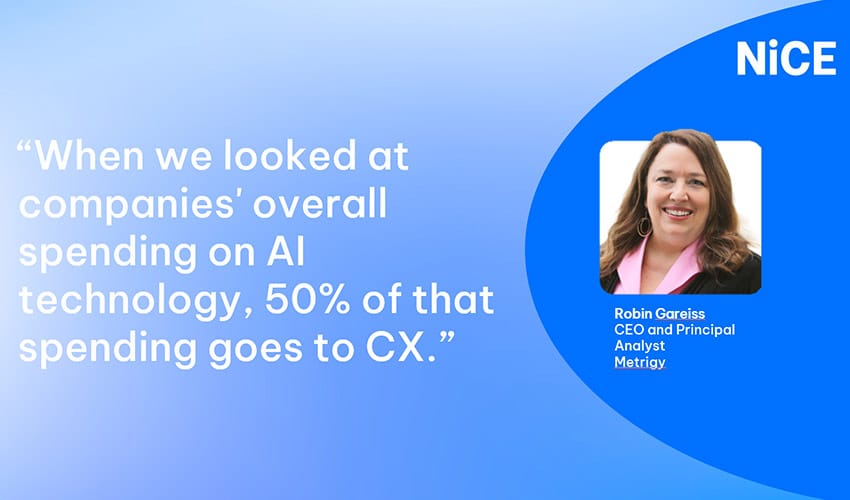
Robin Gareiss, CEO and Principal Analyst at Metrigy, put a number on it during NiCE’s webinar, Why the Agentic Enterprise Needs an Orchestrated AI Strategy. AI investment in customer experience now accounts for roughly half of all companywide AI spending. The average organization is running about 12 different vendors with AI capabilities across its CX stack, and 46% expect that number to grow further in the next year.
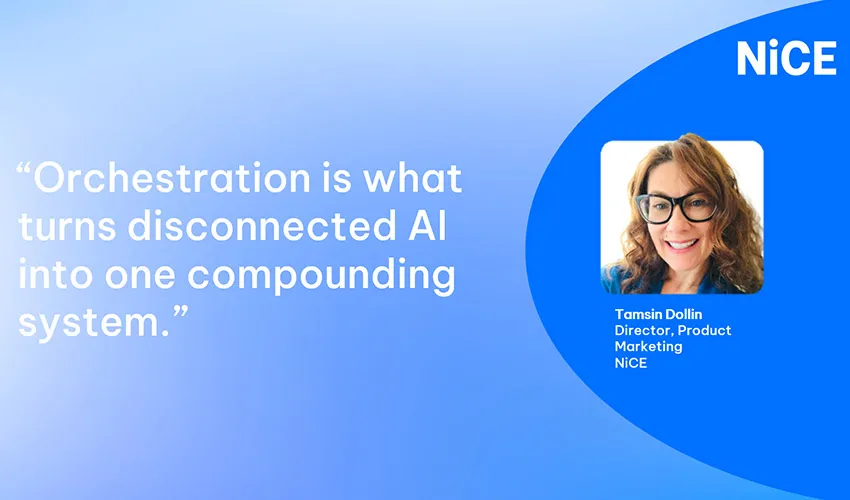
Here’s the gap that matters more than any of those totals: 62.7% of companies say AI orchestration is vital when choosing a vendor. Yet only 35% say their AI systems actually maintain full context across workflows and interactions. Everyone wants orchestration. Almost nobody has it, and that gap isn’t a temporary growing pain. It’s the direct, measurable result of treating a platform decision like a shopping list.
So, here's the question worth asking before you approve the next AI budget line: are the AI wins you have connected to anything, or are they siloed? Plenty of organizations can point to real results: a chatbot deflecting more inquiries, an assist tool shaving seconds off handle time. Far fewer can show those wins compounding into something bigger, because the systems producing them aren't talking to each other. That's the real diagnosis hiding inside the spending numbers: not that the tools don't work, but that unconnected wins can't scale and can't be measured against what orchestration would actually deliver.
Reframe: Accumulation vs. orchestration
That difference, working as one system versus tools working alone, has a name in how CX leaders talk about AI maturity: accumulating versus orchestrating.
Accumulating means collecting and deploying more: more channels, more logs, more point solutions, more data. The unit of work is a record. Success looks like completeness: everything captured, nothing missed.
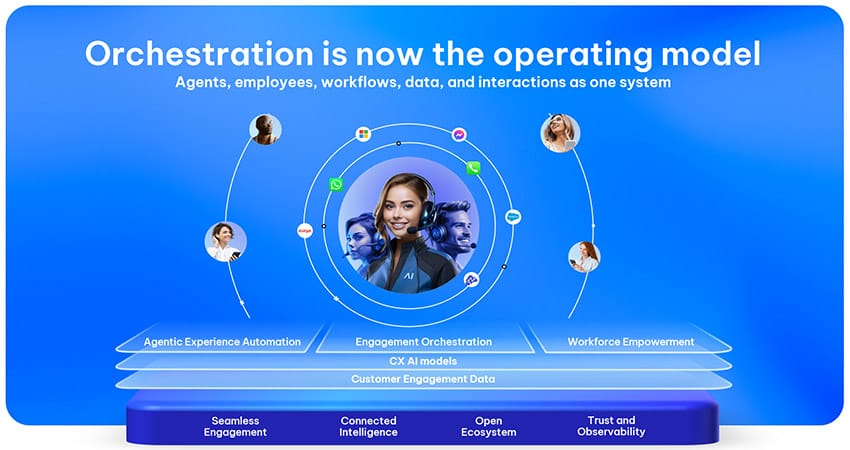
Orchestrating means using that intelligence to decide what happens next, in real time, across systems. The unit of work is a decision or a handoff. Success looks like coherence: the right action, at the right moment, through the right channel.
Simple enough, but here's the catch: accumulation feels like progress – but is it really? Every new tool solves a real, local problem, and the internal tally of "AI capabilities deployed" keeps climbing, which makes for a good slide in a board deck. But an organization can double the data it holds and still ship the exact same disconnected experience, because volume was never the constraint.
The constraint is the connective tissue: the APIs, the ownership of sequencing, the exception handling. That’s what determines what actually happens when a customer moves from one channel, one tool, or one team to the next. No individual vendor is going to sell you that. It must be a decision you make about your architecture, not a feature you add to it.
So, the real question isn't "how many tools do we have?" It's "does anything we've deployed actually know what happened five minutes ago, on a different channel, on a different system, and act on it without someone telling it to?" If the honest answer is no, adding more AI capabilities won't close that gap. It'll just make it more expensive to maintain.
Why this is urgent now
This distinction would matter in any era. It’s urgent in this one because customer expectations have already reset, and they didn’t wait for CX teams to catch up.
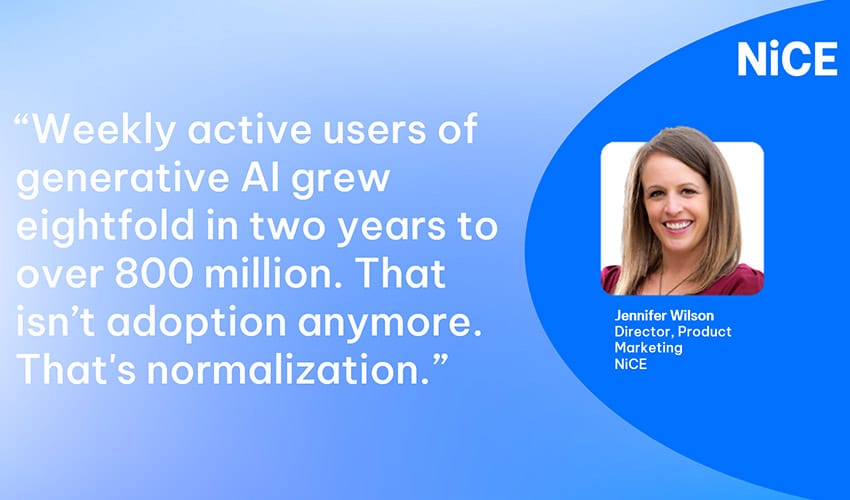
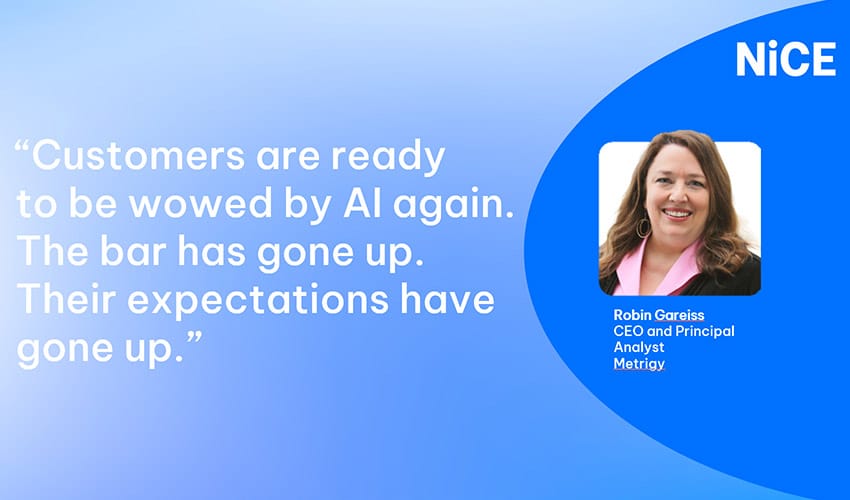
Weekly active users of generative AI tools grew roughly eightfold in two years, from about 100 million to more than 800 million. That’s not adoption. That’s normalization. Consumers now get instant answers from large language models and eerily accurate recommendations from the platforms they use daily. They’ve absorbed a new baseline for what “fast” and “personalized” mean, and they bring that baseline into every interaction, including the one with your contact center, whether you’re ready for the comparison or not.
The consequence is blunt. When customer service feels slower, less connected, or less intelligent than the AI people already use in their own lives, patience with that brand doesn’t erode. It disappears, instantly.
This is where most organizations get stuck, and it’s worth being precise about why. Customer experience is still, in practice, reactive. Context gets lost as a customer moves between channels. Customers end up effectively orchestrating their own resolution: repeating themselves, getting bounced between teams, with no one clearly owning the journey.
That isn’t a story about teams that don’t care. It’s a story about an operating model that hasn’t caught up to what customers now expect as the baseline, not the bonus.
The real cost of fragmentation
Here’s the trap a lot of organizations fall into without ever quite noticing it. A new AI tool proves real value inside its own silo: a chatbot that resolves more website inquiries, an assist tool that speeds up agent responses. But that tool remains structurally unable to preserve context, hand off a case, or feed anything it learns back into the rest of the stack. Call it AI pilot purgatory. The tool works. The system around it doesn’t, and nobody budgeted for the cost of closing that gap.
When the pilot doesn't scale past its silo, leadership usually draws the wrong conclusion that the AI wasn't ready. It was. The architecture wasn't. A pilot can prove a point on top of a silo, but it can't hand off. Context never travels, nothing it learns compounds, and the organization ends up re-litigating “is AI ready” instead of asking the harder question: what is this AI actually orchestrated on?
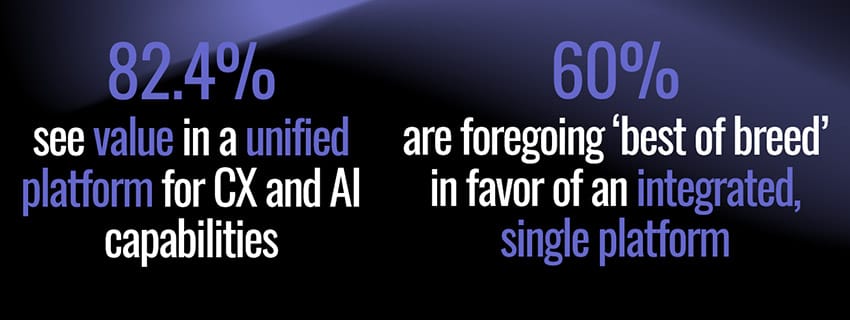
The market has already started answering that question with its wallet. Even as organizations keep adding tools, 82.4% see real value in a unified platform for CX and AI. And 60% are already deprioritizing a pure best-of-breed approach in favor of one integrated system. That’s not a future trend to watch. That’s a majority position, right now, which means “best of breed” isn’t a strategy anymore. It’s a legacy habit most of the market has already abandoned.
The good news is, none of this requires ripping out what you already run. On NiCE’s CXone platform, orchestration connects directly into the systems of record you already have: SAP, Salesforce, ServiceNow, Workday, Epic, your existing voice infrastructure, even other CCaaS tools. The fix was never a bigger stack. It’s a stack designed to work as one system instead of a dozen adjacent ones, and specifically one that doesn’t ask you to start over to get there.
The orchestration maturity framework: where do you actually stand?
This is the part worth pausing on, because it’s a framework you can apply to your own organization before you finish reading: not a maturity model to admire from a distance, but a mirror.
Stage 1: Accumulating. Multiple bots, copilots, and AI point solutions operate independently, each solving a local problem well enough to justify its own existence. Telltale sign: new AI tool requests come from individual teams, with no shared roadmap tying them together. Marketing wants a copilot, service wants a chatbot, and nobody is asking whether they should talk to each other.
Stage 2: Connecting. Tools are integrated at the data or workflow layer, but intelligence doesn’t move between them automatically. This is real progress over Stage 1, and it’s also exhausting. Telltale sign: “connecting the dots” has become someone’s full-time job, because every new integration is still a bespoke project instead of a built-in capability.
Stage 3: Orchestrating. AI agents, employees, workflows, and data operate as one coordinated system rather than a set of connected parts. Telltale sign: a decision in one channel visibly improves an outcome in another. A pattern caught in analytics changes what happens on a live call, without anyone manually wiring that specific connection.
Stage 4: Compounding. The system learns continuously, and each interaction makes the next one better without manual retraining or rework. Telltale sign: CSAT, resolution time, and cost-to-serve trend in the right direction, without the usual trade-off of adding headcount or more tools to get there.
Be honest with yourself here, because the webinar’s own live audience wasn’t where it expected to be. In an early poll, just 17% of attendees called their organization orchestrating. The majority split between accumulating tools independently and simply not being sure.
Later in the same session, after walking through this exact framework in detail, the live self-assessment shifted further toward the earliest two stages, not away from them. People who’d have called themselves “orchestrating” in a hallway conversation placed themselves at Stage 1 or 2 once the framework gave them a real yardstick.
That isn’t a discouraging result. It’s clarity. And clarity, not confidence, is the first real step toward maturity.
What compounding looks like in practice
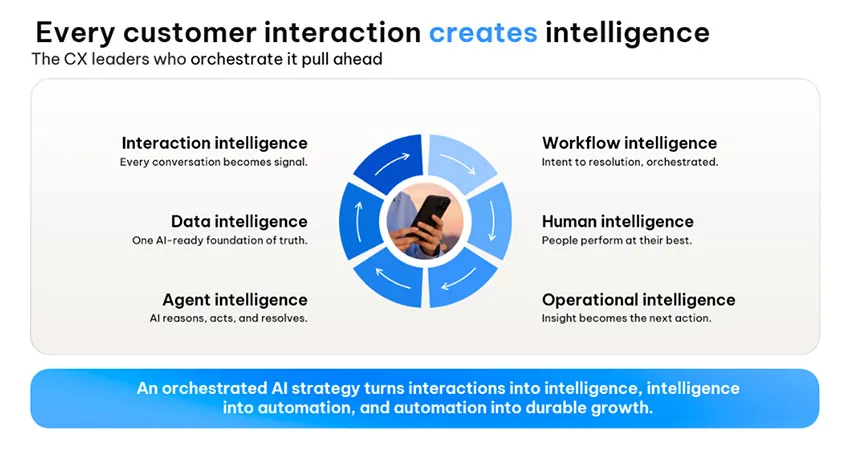
It’s easy to talk about “connected intelligence” in the abstract. On NiCE’s platform, it’s built as six specific types of intelligence generated by every customer interaction. Human and agent intelligence cover who acts. Workflow intelligence covers what’s orchestrating. Data and interaction intelligence cover what the system runs on. And operational intelligence covers what closes the loop.
The point isn't to shop for six separate products. It's that all six run on one shared layer: the Agentic Engagement Plane, which mediates and orchestrates the handoffs between them, sitting on Experience Memory, a persistent record of the journey, context, and outcome behind every case. That's what actually lets a case travel from an AI agent to a human agent without a single fact getting re-explained.
In outcome terms, the cycle looks like this: every interaction generates data. Every data point sharpens a signal. Every signal drives an action. Every action produces an outcome. And every outcome makes the next interaction smarter. That's the mechanism: not a one-time integration project, and not a system left to optimize on its own, but one engineered to make each interaction easier to get right, for the people and AI working it, without manually rebuilding the pipeline behind it.
Where organizations have actually gotten this right, the results don’t cluster by industry: they cluster by operating model.
Case in point: a financial services organization posted a 32% increase in Net Promoter Score. A government agency improved sentiment by 24%. A healthcare organization cut average handle time by 14%. A hospitality company consolidated a sprawling tech stack by 11 vendors. A retailer lifted containment and resolution rates by 15%. Five industries, five different metrics, and one shared explanation: what’s consistent isn’t the industry or the individual use case. It’s the AI operating model behind it.

Stop accumulating. Start orchestrating. Here’s your next step.
Ask yourself the question this framework forces: which stage are you actually in, not where you'd like to be, but where the telltale signs put you? Once you’ve answered that honestly, what’s the one thing keeping you there: budget, silos, technical debt, leadership buy-in, or simply not knowing where to start?
None of those is disqualifying. All of them are common. But the data behind this framework says the next 18 months will separate the organizations that answer that question from the ones that don’t. And standing still on the accumulating side of that line isn’t neutral. It’s a compounding disadvantage: the gap between the two groups doesn’t hold steady. It grows.
The full webinar goes further than this framework alone can. You’ll get Robin Gareiss’s research on exactly what separates AI leaders from laggards, a live demonstration of one customer engagement moving through all six intelligence types in real time, and the complete audience self-assessment behind the numbers above.
Watch the full Why the Agentic Enterprise Needs an Orchestrated AI Strategy webinar on demand, and find out, specifically, what’s keeping your organization trapped in the stage it’s in. Turn disconnected AI into one orchestrating, compounding solution with:
- Metrigy research on what successful leaders are doing
- A live demo of one customer engagement moving through all six intelligence types
- And audience poll results including the live "where do you actually land" self-assessment
If this session was the why, the next two webinars in The Orchestrated Intelligence Advantage executive series take it further: one into the architecture behind orchestration, and the other into what it means for your workforce. Both build directly on the framework above. Join us.