
Meta's Muse reached No. 1 among free apps in Apple's U.S. App Store just one week after launch, and within 12 days, it had been downloaded 2.8 million times across the United States and Canada.
CX leaders should read that as more than a consumer tech story. Muse and agents like it can research, fill out forms, make purchases, and book services on a person's behalf. Personal AI agents have reached mass distribution, and customer service is one of the first places they will show up.
The traffic won't wait for the protocols
It's tempting to assume agent-to-agent engagement starts once native A2A protocols mature. It will start well before then.
A personal agent doesn't need a specialized protocol to reach a business. It can navigate a website, open a chat, submit a form, send a message, or place a call. Nearly every customer-facing organization already supports those interfaces, so the first wave of agent-to-agent CX will arrive through channels enterprises run today.
Businesses are already splitting on how to respond. Amazon blocked Muse from shopping on its platform, citing transparency, security, and credential concerns. Shopify took the opposite approach, integrating Muse through Shop Pay.
Neither blocking nor welcoming is a strategy on its own. Enterprises need a controlled front door that can tell who or what is engaging, authenticate the person behind it, enforce policy, and decide what the agent is allowed to do.
Ready for the native path, too
For agents that support them, native connections are already available. NiCE Cognigy supports A2A and Model Context Protocol (MCP) today, alongside voice and digital channels and through ChatGPT Apps, so enterprises can expose the same service capabilities, knowledge, and system connections to people and personal agents alike.
With NiCE Cognigy, enterprises can also make their AI agents discoverable to personal agents. A company’s website can publish machine-readable metadata, such as an A2A Agent Card, describing the agent’s capabilities, authentication requirements, and connection endpoint. A personal agent that supports A2A discovery can then move from navigating the website to engaging the enterprise agent directly.
The technology exists. What's still maturing is broad adoption and the identity and delegated-authority standards needed for trusted use at scale.
Watch a Muse personal AI agent engage with a NiCE Cognigy enterprise AI agent through an interface customers already use.
Effort is about to stop suppressing demand
Today, customer effort quietly holds down service volume. A fee seems too small to dispute. A renewal feels too tedious to renegotiate. A delayed order isn't worth chasing, and a slow service conversation gets abandoned halfway through.
Personal agents remove that friction. They can monitor accounts, compare offers, retry failed requests, and pursue discounts, bringing the customer in only when a decision needs a human. And they'll stay in an interaction for as long as the outcome is worth it. They don’t get tired. They don’t lose patience. They can work through a service interaction for as long as the outcome justifies the effort.
Consumers appear ready to hand those jobs over. Accenture found that 74 percent of consumers would delegate routine tasks such as negotiation or complaint resolution to an AI agent when it acts within their preferences and permissions.
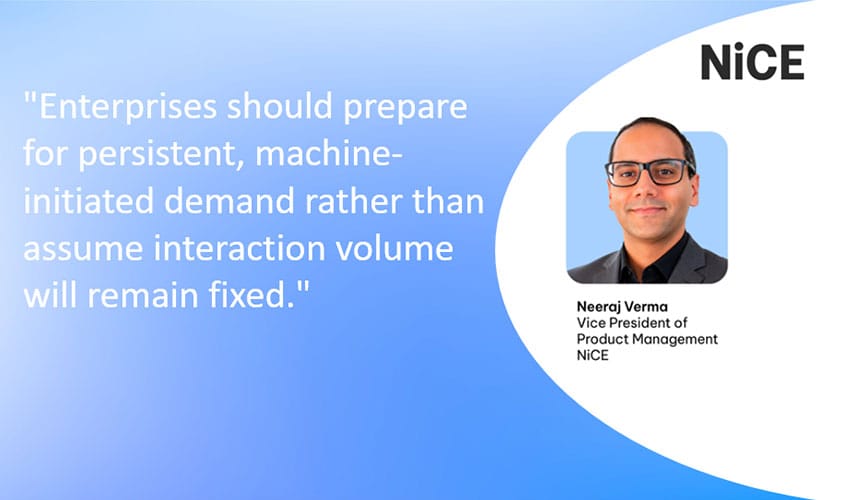
As the cost of pursuing an issue approaches zero, interactions multiply. Enterprises should prepare for persistent, machine-initiated demand rather than assume interaction volume will remain fixed. For a deeper look at why AI will increase service demand, see Why agentic AI will grow customer service demand, not shrink it.
The front door becomes the control point
Every inbound conversation, whether it comes from a person or an agent acting for one, should enter through a single AI-native front door. That front door has to understand intent, authenticate the customer, apply policy, carry context forward, and route work to the right AI agent, system, or human expert. It also has to absorb machine-generated volume without a matching increase in headcount.
That's the job NiCE built its new AI-native front door to do. NiCE Cognigy gives organizations one intelligent entry point across voice and digital, orchestrating work across AI agents, people, and enterprise systems. The NiCE Agentic Engagement Plane extends that model across the broader NiCE and enterprise ecosystem, connecting agents, systems, context, governance, and employees from intent through resolution.
Recognizing that an AI agent has arrived is the easy part. Controlling what happens next is harder, and as agent traffic grows, scale, security, and auditability determine an enterprise's ability to do that.
Trust will evolve in stages
Personal agents raise new trust questions.
Enterprises need to know who an agent represents, what it's authorized to do, and which systems and decisions it can touch. In the near term, the answer is to authenticate the principal rather than the agent. An agent entering the front door should follow the same identity and verification path as the customer it represents, with step-up or two-factor confirmation from the customer for higher-stakes actions.
Over time, native A2A protocols should support verifiable credentials that establish both the agent's identity and the authority the customer has delegated to it. Until then, approval gates, policy controls, audit trails, and clean handoffs to humans carry the load. Sounding like a customer shouldn't be enough to get treated as one.
Build the front door now
Personal AI agents won’t appear as a clean technology cutover. They will enter through familiar digital and voice interfaces first, then move toward native protocols as the ecosystem matures.
What changes immediately is the speed, persistence, and potential scale of customer demand.
Muse reaching No. 1 was a consumer signal. For CX leaders, it should be a starting signal too.