
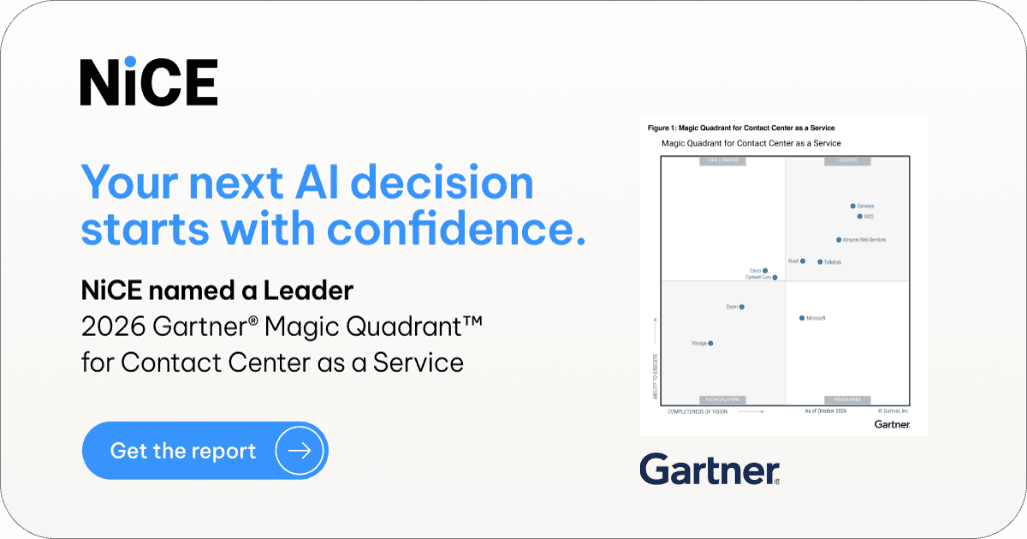
NiCE is a Leader in the 2026 Gartner® Magic Quadrant™ for Contact Center as a Service and positioned furthest for Completeness of Vision.
We take the recognition of a CCaaS Leader seriously and believe our vision earns confidence when it changes what you can resolve today and keeps improving what you can deliver tomorrow.
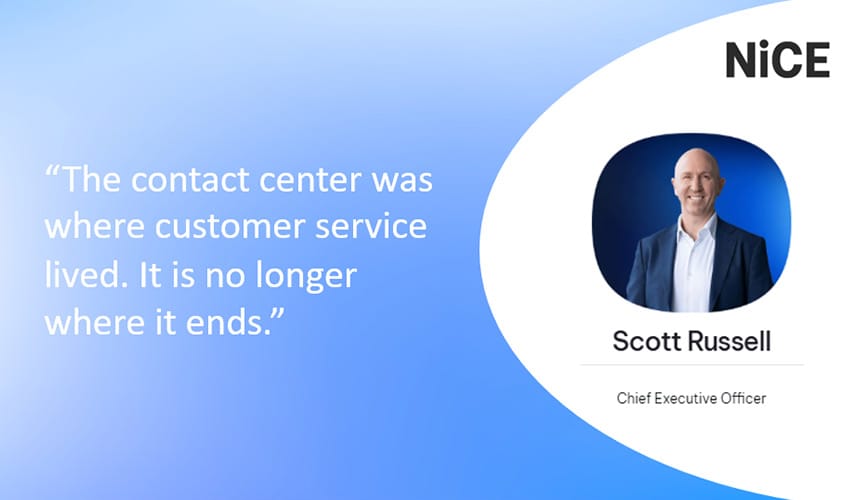
As NiCE CEO Scott Russell said, “The contact center was where customer service lived. It is no longer where it ends.”
This describes how NiCE is redefining the CCaaS era as AI agents and human agents act together to resolve customer needs across the enterprise. We believe that is the shift this report now measures.
Complete resolution across the enterprise means taking action in the systems beyond the contact center, such as scheduling, billing and field service, where the work gets done, rather than finishing the conversation and hoping the work gets done on its own. Here is how that plays out. A broadband engineer misses an appointment, the customer calls, and the call goes well. To the customer, that is one request, but the work isn't done. Internally, it may cross three teams, two systems and a partner. Each handoff creates another gap where the work can stall, even when every team meets its own service target. We believe the 2026 report measures which providers can close those gaps.
Download the report to see why Gartner® named NiCE a Leader and plan your move to CX AI with confidence.
What the report covers
The Gartner® Magic Quadrant™ positions providers on two axes, Ability to Execute and Completeness of Vision, and sorts them into four quadrants. In our reading, the 2026 criteria give more weight than before to how AI agents complete work in enterprise systems, how human and AI agents are managed together, and how real-time intelligence guides people during a conversation. The quality of conversations still matters, but it is no longer what separates providers.
AI turns your contact center into an everywhere center
Contact centers were built inside distinct walls and explicit parameters. Calls came in, agents handled them, and whatever couldn’t be finished inside the queue went to a ticket, a back office or a callback. The walls defined staffing, metrics and, until now, an entire software category.
Now, an AI agent that can read a booking, check a policy and write to a field-service system has no reason to stop at the edge of the queue. Customer needs have always been larger than the contact center. They extend past a retailer’s order flow, a bank’s onboarding journey and a telco’s install schedule. Resolving them means acting in the systems where the work happens, not only conversing in the contact center.
This is where a completed conversation differs from an end-to-end resolution.
Jeff Comstock, President, Product & Technology at NiCE, treats that as the central design problem. “The most interesting design question in customer service right now is where the system boundary sits,” he said. “For years it sat at the edge of the contact center. A customer’s need doesn’t, so the boundary has to move.”
Moving it is harder than it sounds. A rebooking agent needs more than access to the scheduling system. It needs to know which appointments can change, when a fee requires approval and what to do when the system is unavailable. Someone also must own the exceptions. Context must travel with the customer, governance must hold, and the right agent, human or AI, must be there at every step. Comstock calls that an architecture challenge as much as a product one, and it is the one NiCE is building for. “Good architecture makes the boundaries disappear for the customer,” he said.
The wall doesn’t come down because a vendor announces it has. It comes down when the customer stops noticing it was there.
Vision is what moves CX AI forward
Vision matters when it expands what you can resolve today and improves what you can deliver tomorrow. On the measure of vision, NiCE is positioned furthest, and the way to judge it is the sequence: what is in production now, what comes next, and whether the two add up to an operation that resolves more over time.
NiCE’s sequence is already in production. NiCE Cognigy AI agents take live conversations and then act in enterprise systems for end-to-end resolutions. CXone runs routing, workforce management and quality across human and AI agents through one management layer. Analytics feed what happens in service back into what gets built next, creating a continuous learning loop. Operation first, then intelligence, then one system that learns. Each stage depends on the one before it, which is why a point solution bolted onto a queue rarely gets past stage one.
Scale is the other half of the test. Running AI agents across regions, languages and regulatory regimes is an operations problem as much as a model problem, and it rewards the provider that has already done it. The report observes that “Large, multinational clients benefit from NiCE’s long-standing experience implementing and supporting CCaaS.”
When we say vision earns confidence, we mean something you can check: what is running now, and what it will let you resolve that you cannot today.
How NiCE brings CX AI to life
Four things help leaders move to CX AI with confidence. We believe the report speaks to each of them, and NiCE customers are already running each one.
AI agents that take action across the enterprise, on one CX AI platform. Conversational AI gets you in the door. Execution is what the customer came for. NiCE Cognigy AI agents resolve complex intents by acting in CRM, ERP and other enterprise systems, and orchestration inside CXone connects that execution with people, data and workflows. At Lufthansa Group, AI agents handle more than 16 million customer conversations a year. Tripadvisor took AI voice agents from concept to live calls in 2.5 months, which is roughly the time most companies spend choosing a vendor. At Openreach, AI agents rebook engineers and update operational records rather than just answering the question.
One operating model for AI and human agents. An AI agent's action and a human agent's follow-up share the same context, workflow and governance. Routing, workforce management, quality and reporting cover both kinds of agent through one set of tools. An AI agent can reduce handle time in one queue while creating more work downstream. If billing has to correct the transaction or a customer calls again, the cost has moved. Leaders need to see the full result before counting the saving.
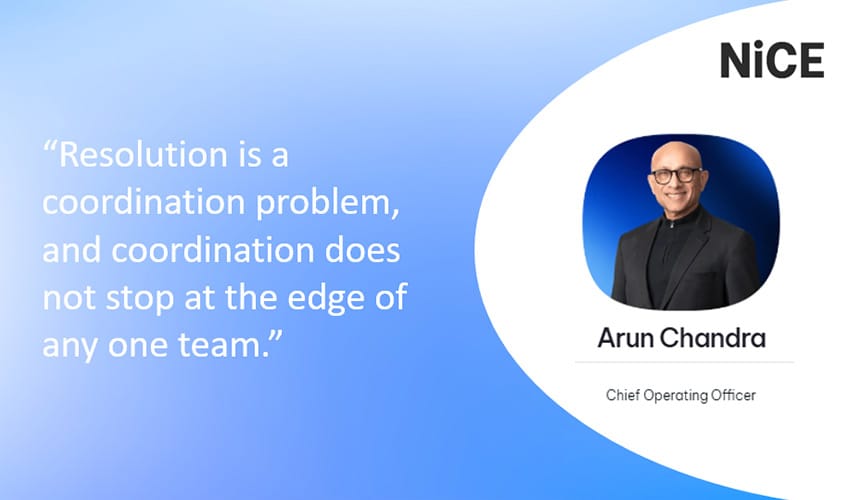
NiCE COO Arun Chandra said the measure that matters most is whether the need gets resolved. “A need rarely stays in one place,” he said. “It can move through billing, field service, the back office and a partner's system, and the right person or AI agent has to pick it up at every step with the full context in hand.” That takes routing, handoffs and context that travel with the conversation, lined up so the customer never sees the seams. AI gives operators far more to work with, and it raises the standard for what counts as finished. “Resolution is a coordination problem, and coordination does not stop at the edge of any one team,” he said.
Learning loops that make the operation better at resolving over time. Every interaction and every verified outcome, successes, failures and escalations alike, feeds improvements back into AI agent behavior, knowledge, routing, workflows and the real-time guidance human agents get mid-conversation. The exception an agent handled yesterday becomes a better rule today. The advantage compounds as the operation learns. Openreach cut missed appointments and inbound contact volume by one-third each, as the agents and the operation around them kept getting better at the job.
Proven enterprise scale across global organizations. Decades of running customer service for large, multinational enterprises provide the localized expertise and coordination that AI at scale demands. At Toyota, 95% of customers offered the AI service chose to book directly with an AI agent. At that rate, customers are showing they will choose AI when it can finish the job.
That is the CX AI era NiCE is building: one platform where AI and human agents act, learn and improve together, connected to the data and workflows behind every resolution.
CX leaders have a choice to make
We feel two questions are at the center of every platform evaluation this year. Who can run customer service as one operation, at the scale your customers expect? And who can see where that work is going? We believe the Gartner® placement speaks to both.
Running AI agents alongside a human workforce means solving two distinct problems, operation and intelligence, and joining them with a learning loop. When AI and service operations are managed separately, a pilot can succeed in one queue while disconnected systems and workflows prevent it from expanding. Solve them as one system, with shared context, connected workflows and one governance model, and service runs across every team, channel and system that touches the customer, and gets better with every resolution.
As CCaaS becomes CX AI, NiCE's position furthest for Completeness of Vision we believe gives leaders a reason to move forward with AI at enterprise scale. We believe the report shows what scale demands: one operating model, shared context and one governance model, as AI takes on more of the work.
NiCE CEO Scott Russell summed up the CCaaS transformation: “Categories change when the job changes, and the job is now resolution.”
The engineer still has to show up. The difference is that today the whole operation knows whether the engineer did.
Ask each provider to walk through a customer request that crosses departments. Where does the AI agent act? Where does a person approve the next step? If a system fails halfway through, who owns recovery, and how does the customer learn what happened?
Gartner, Magic Quadrant for Contact Center as a Service, Drew Kraus, Jason Bridge, Pri Rathnayake and Megan Fernandez, October 19, 2026.
Gartner and Magic Quadrant are trademarks of Gartner, Inc. and/or its affiliates.
Gartner does not endorse any company, vendor, product or service depicted in its publications, and does not advise technology users to select only those vendors with the highest ratings or other designation. Gartner publications consist of the opinions of Gartner’s business and technology insights organization and should not be construed as statements of fact. Gartner disclaims all warranties, expressed or implied, with respect to this publication, including any warranties of merchantability or fitness for a particular purpose.
This graphic was published by Gartner, Inc. as part of a larger research document and should be evaluated in the context of the entire document. The Gartner document is available upon request: Gartner Magic Quadrant 2026 CCaaS | NiCE.