

As organizations expand their use of AI in customer service, they need a clear way to determine which interactions are best suited for automation. The right choices can improve efficiency, strengthen customer experience (CX), and help focus investment on the opportunities with the greatest potential value.
The challenge is identifying which interactions offer the strongest combination of automation potential, customer value, and business impact. That starts with an analysis that includes understanding customer intents from historical conversations and the agent-led actions that resolve them.
Traditionally, organizations have relied on people reviewing samples of conversations or working from assumptions about the different ways an intent might be expressed. This approach can miss important interactions, resolution paths, and variations. Analyzing conversations at scale provides a broader evidence base for evaluating potential use cases and understanding how interactions are resolved.
General-purpose large language models (LLMs) can help summarize and categorize conversations, but service organizations need CX-specific context and consistency to evaluate resolution paths, business impact, and automation potential.
As organizations expand their use of generative and agentic AI, selecting opportunities with clear business and customer value becomes increasingly important. Gartner predicts that more than 40% of agentic AI projects will be canceled by the end of 2027 because of escalating costs, unclear business value, or inadequate risk controls. Gartner recommends pursuing agentic AI where it can deliver clear value or ROI.
Agentic analytics can put this approach into practice by analyzing interaction data to identify strong automation candidates, quantify their potential value, and connect those insights to action. The strongest approaches also provide the evidence behind each recommendation and continuously monitor interactions for new opportunities and performance changes.
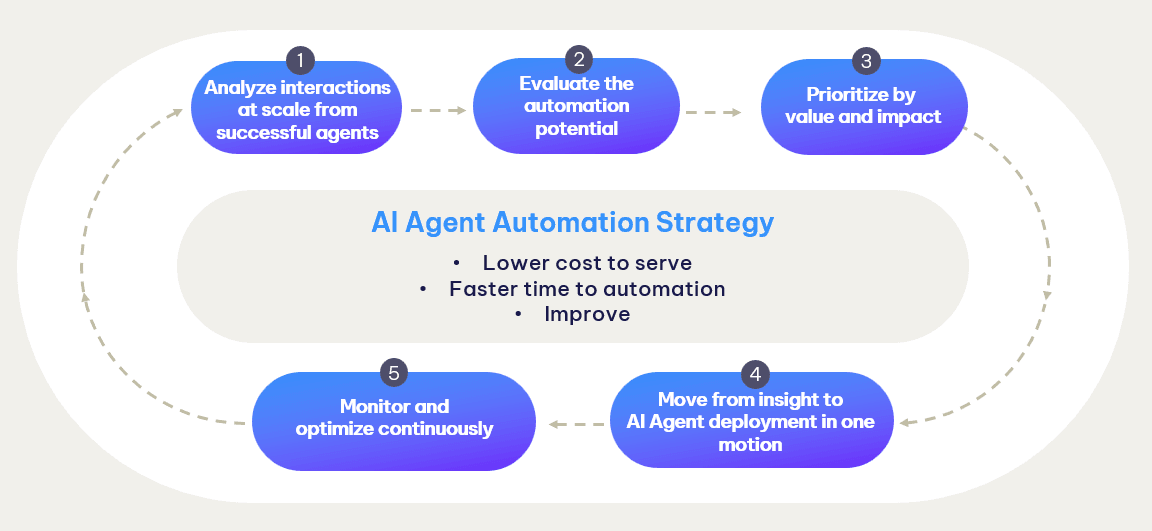
An effective AI agent automation strategy brings together five essential criteria: evidence from real interactions, comprehensive analysis of the automation potential, value-based prioritization, an automated path from insight to deployment, and continuous monitoring.

Why automation strategy matters now
Advances in AI agents and analytics are creating new opportunities to improve efficiency, lower cost-to-serve, and deliver more consistent customer experiences. As agentic AI evolves, AI agents are becoming more capable of reasoning, adapting, and taking action across systems to resolve increasingly complex customer needs.
- Lower cost-to-serve. Automating the right conversations, not simply the most frequent ones, can improve containment while maintaining a strong customer experience.
- Faster time to automation. By connecting analysis directly to agent design and deployment, agentic analytics can significantly reduce the time between identifying an opportunity and putting automation into production.
- Improved customer experience. Well-designed AI agents can improve first-contact resolution while providing the 24/7 availability and consistent service customers increasingly expect. Gartner has projected that by 2029, agentic AI will autonomously resolve 80% of common customer service issues without human intervention, reducing operational costs by approximately 30%.
The potential becomes clearer at scale. Henkel Consumer Brands now operates 25 AI agents across 11 countries and seven channels, serving more than 3 million users and handling over 5 million consumer interactions annually. More than 10 Henkel brands use these AI agents to deliver consistent, multilingual service, while AI agent analytics has accelerated consumer research by 68%.
As these capabilities continue to develop, organizations need a disciplined way to identify, evaluate, and prioritize the automation opportunities most likely to deliver meaningful customer and business value.
1. Ground the strategy in real interactions from successful agents
A strong automation strategy brings together three things: an intent taxonomy informed by agent-led conversations, a business assessment of potential outcomes, and supporting evidence such as transcripts.
Successfully resolved interactions can reveal which questions were asked, which systems were used, which actions were taken, and how different variations were handled. They provide practical evidence of how customer needs are resolved within an organization's policies, systems, and operating environment.
This evidence becomes increasingly valuable as AI agents must accomplish the same customer outcome: recognizing intent, determining the appropriate actions, accessing the right systems, and navigating variations along the way.
By analyzing successful interactions at scale, teams can understand the combination of intent, action, and outcome that contributes to an effective experience, including variations that smaller samples can miss. These patterns can inform AI agent workflows that reflect real customer language, proven service behaviors, established processes, and important exceptions.
2. Evaluate the automation potential
No one signal can determine whether an interaction is suitable for automation. Volume shows how often an issue occurs, not how difficult it is to resolve. Duration may suggest complexity, but it does not explain whether the time was spent talking, waiting, or navigating systems. Resolution data shows whether a need was addressed, but not necessarily the quality of the experience.
An effective assessment combines multiple signals, such as intent volume, resolution rate, customer sentiment, duration, silence, and business outcomes.
Together, these signals can produce an automation score that helps distinguish repeatable interactions well suited to self-service from those requiring judgment, complex exceptions, or human assistance.
This is where agentic analytics becomes central to an automation strategy, turning individual conversations into comparable opportunities that can be evaluated consistently and at scale.
3. Prioritize according to business and customer value
The easiest interaction to automate is not always the most valuable one. Organizations need a consistent way to compare opportunities based on potential impact, effort, and customer experience implications.
A useful prioritization framework combines the automation score with other factors such as the projected ROI and expected customer and business impact. All ROI assumptions should remain visible and adjustable because organizational costs, volumes, and priorities vary.
Two interactions may have similar automation potential yet deliver very different returns. A high-volume interaction with a low handling cost may create less value than a moderately frequent interaction associated with repeat contacts, high customer effort, or expensive downstream work.
Prioritization should therefore consider both technical suitability and the expected impact on customers and the business. This helps organizations direct resources toward opportunities most likely to produce meaningful outcomes.

4. Create an automated path from insight to deployment
Identifying a high-value automation opportunity is only half the work. Many organizations still rely on a handoff between the team that identifies the opportunity and the team that builds the AI agent to act on it. That transition can introduce additional effort, delay, and loss of context.
An automated path from insight to deployment closes that gap. Once an opportunity is identified and prioritized, the same analysis that surfaced it can help determine how the AI agent should recognize the intent, which actions it should take, and which systems it needs to access, carrying evidence from actual interactions directly into the agent's design.
This does not remove governance from the process. Recommendations should include the reasoning and supporting evidence behind them so teams can review, test, and iterate an AI agent before it goes live.
What changes is the reduced time required to move from identifying an opportunity to putting it into production.
5. Monitor continuously to find what changes next
An automation strategy is not a one-time decision. Customer needs shift, new products and policies introduce new reasons for contacting an organization, and AI agents themselves change the mix of conversations that remain for human agents to handle.
Continuous monitoring keeps the strategy current. With always-on conversational analysis, organizations can assess how deployed AI agents are performing, identify where resolution paths are breaking down, and recognize emerging patterns that may represent new automation opportunities.
Monitoring can also reveal when an existing automation needs adjustment as customer behavior, business processes, or service requirements change.
This turns automation from a project with a fixed endpoint into an ongoing capability that continuously identifies the next opportunity as the business and its customers evolve.
Make every AI agent a strategic decision
AI agents are expanding the opportunities for customer service automation. Agentic analytics gives organizations a more disciplined way to evaluate those opportunities by analyzing customer intents and agent actions, identifying resolution patterns from successful human agent conversation, quantifying potential business impact, and continuously monitoring performance.
Organizations that use evidence from real customer interactions can make more informed choices about where automation adds value, where human assistance strengthens the experience, and how the two can work together across the customer journey.
Before selecting the next use case, evaluate whether your approach can identify, quantify, implement, and continuously monitor automation opportunities.
These five criteria provide a practical foundation for building an automation strategy that improves customer experience while delivering measurable business value.