

AI Agent Observability vs Monitoring: Key Differences

On this page
Last updated: November 20, 2026
AI agent monitoring tracks known production signals such as uptime, latency, error rates, tool failures, and outcome thresholds. AI agent observability provides the deeper traces, context, session evidence, and behavioral data needed to understand why those signals changed. Monitoring detects that something is wrong; observability helps explain what happened and how to improve it.
AI agent observability vs. monitoring at a glance
What is AI agent monitoring?
AI agent monitoring continuously watches predefined signals that indicate whether an agent is operating within expected boundaries. It is well suited to detecting latency spikes, tool failures, outages, error-rate increases, abnormal escalation, or changes in task completion.
Monitoring works best when teams already know which conditions matter and can define thresholds or baselines that should trigger attention.
What is AI agent observability?
AI agent observability is the broader discipline of making agent behavior understandable through telemetry, tracing, analytics, session review, and contextual evidence. It is designed to investigate both known problems and unexpected behavior that was not captured by a predefined alert.
Observability is especially important for autonomous agents because failures may emerge from the interaction between models, retrieval, tools, workflows, policies, and subagents rather than a single component error.
Why monitoring alone is not enough for AI agents
An agent can be available, fast, and error-free at the infrastructure level while making poor decisions. It may retrieve the wrong context, select an inappropriate tool, repeat a loop, escalate unnecessarily, or complete a workflow in a way that creates a bad customer outcome.
Monitoring may reveal a symptom such as a higher escalation rate. Observability provides the session and trace evidence needed to determine whether the cause is knowledge, a tool, a policy, a version change, or the agent's decision path.
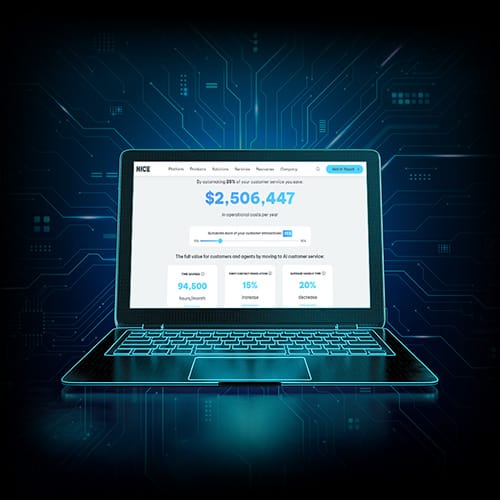
Discover the full value of AI in CX
Understand the benefits and cost savings you can achieve by embracing AI, from automation to augmentation.
When to use monitoring and when to use observability
Use monitoring continuously to watch production health and outcome thresholds. Use observability whenever teams need to understand unexpected behavior, investigate a trend, validate a change, improve agent quality, review an incident, or compare agent versions.
In practice, the two should be integrated. An alert should lead directly to affected sessions and traces, and an observability investigation should lead to better monitoring rules where a repeatable failure pattern is discovered.
Next step
Use monitoring to detect problems quickly and observability to understand, fix, and prevent them.
Explore the AI Agent Observability pillar
Frequently asked questions

Ready to experience the power of one platform?
Let us show you how NiCE can unify, automate and elevate your entire customer experience - with AI at the core and outcomes at the forefront.