

AI Agent Analytics for Performance and Business Impact

Last updated: November 20, 2026
AI agent analytics turns production agent data into measurable trends, segments, and business insights. It helps teams understand adoption, effectiveness, resolution, escalation, customer feedback, task completion, quality, cost, and other outcomes across thousands or millions of sessions rather than reviewing interactions one at a time.
What is AI agent analytics?
AI agent analytics is the aggregated analysis of agent activity and outcomes across production interactions. While session replay examines one interaction in depth, analytics reveals patterns across many sessions: which intents are growing, which workflows fail most often, where escalations occur, and whether an agent version is improving or regressing.
For enterprises, analytics should combine technical, behavioral, customer, and financial signals. That creates a more complete picture of agent effectiveness than a dashboard limited to message counts or API usage.
What should AI agent analytics measure?
Adoption metrics show where agents are being used and by whom. Outcome metrics measure task completion, resolution, escalation, abandonment, conversion, or other goals. Quality metrics assess answer relevance, groundedness, policy adherence, tool selection, and customer feedback. Efficiency measures may include latency, cost, turns per session, or tool-call frequency.
The right mix depends on the agent's job. A customer-service agent may prioritize resolution and escalation quality. A workflow agent may prioritize successful completion and exception handling. A sales agent may focus on qualified actions and downstream conversion.
From dashboard to diagnosis
Analytics becomes far more useful when it is connected to the underlying interactions. If a dashboard shows that escalation increased for a particular intent, a user should be able to open representative sessions, inspect traces, and see whether the issue came from knowledge, a tool integration, routing logic, policy constraints, or customer behavior.
This connection prevents teams from optimizing based on aggregate numbers alone. It also supports faster validation after configuration changes.
Segmenting AI agent performance
Segment analytics by the dimensions most likely to explain behavior: intent, channel, customer segment, language, geography, model, agent version, workflow, tool, knowledge source, time period, and outcome. Comparing segments can expose a failure that affects only one product line or integration.
Version comparison is especially valuable. Teams should be able to determine whether a prompt, policy, knowledge, model, or workflow change improved the intended metric without creating regressions elsewhere.
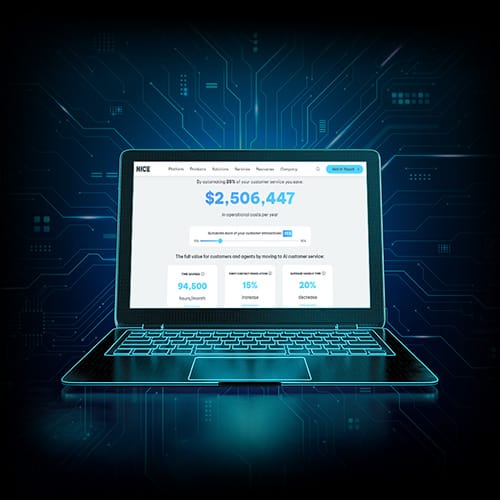
Discover the full value of AI in CX
Understand the benefits and cost savings you can achieve by embracing AI, from automation to augmentation.
AI agent analytics for CX leaders
CX leaders need analytics that translates automation into customer and operational outcomes. That includes the share of interactions resolved autonomously, the reasons customers are escalated, where customers repeat themselves, the quality of handoffs, the relationship between agent behavior and customer feedback, and the cost of automated service relative to the value delivered.
These measures help leaders decide where to expand automation, where to constrain it, and which improvement work should be prioritized.
Next step
Measure whether AI agents are creating better outcomes, not simply more automation.
Explore the AI Agent Observability pillar
Frequently asked questions

Ready to experience the power of one platform?
Let us show you how NiCE can unify, automate and elevate your entire customer experience - with AI at the core and outcomes at the forefront.