

AI Agent Monitoring for Production Reliability

Last updated: November 20, 2026
AI agent monitoring continuously tracks the health and performance of production AI agents. It watches signals such as availability, latency, errors, tool failures, session outcomes, throughput, and escalation patterns so teams can detect problems quickly and know when an agent requires investigation, rollback, or intervention.
What is AI agent monitoring?
AI agent monitoring is the continuous measurement of production signals that indicate whether an agent is available, responsive, stable, and achieving expected outcomes. It gives operations teams an early-warning system for problems that could affect customers or downstream workflows.
Monitoring can include infrastructure and model signals, but it should also reflect the agent's actual job. A service agent may be technically available while resolution rates fall sharply because a tool integration changed or a knowledge source became stale. Outcome-aware monitoring helps expose that difference.
What should you monitor for AI agents?
Technical health signals commonly include latency, timeout rate, model errors, API failures, tool-call failures, retry rate, queue delays, and resource consumption. Agent behavior signals may include session completion, escalation, abandonment, loop detection, fallback use, failed actions, and abnormal tool sequences.
Business and CX signals may include resolution, containment, task completion, customer feedback, repeat contact, conversion, cost per interaction, or other metrics tied to the agent's purpose. Monitoring is most useful when thresholds are tied to real operating expectations rather than generic system averages.
AI agent monitoring vs. AI agent observability
Monitoring answers questions such as: Is the agent up? Is latency rising? Are tool errors increasing? Did the failure rate cross a threshold? Observability goes further by helping teams investigate why. It provides the traces, session evidence, context, and behavioral detail needed to explain a signal.
The two disciplines should work together. Monitoring identifies where attention is needed. Observability supplies the evidence needed to diagnose and improve the system.
How to design useful alerts
Alert on conditions that require action. A single failed session may not matter, while a sustained increase in tool failures, escalations, or latency may indicate a systemic issue. Use baselines, segmentation, and severity levels so teams can distinguish a localized anomaly from a production incident.
Alerts should include enough context to accelerate investigation: affected agent or version, channel, intent, tool, time window, failure type, and links to representative sessions or traces. That reduces the time between detection and diagnosis.
Monitoring AI agents in customer service
Customer-facing agents require a broader view than infrastructure health. Operations teams should monitor resolution, escalation, handoff quality, abandonment, response time, policy exceptions, repeated customer effort, and tool-action success. Changes in these measures can signal an experience problem even when no technical error is present.
Segment performance by intent, channel, language, customer type, agent version, and workflow. Aggregate averages can hide localized failures that affect only one product, queue, or customer journey.
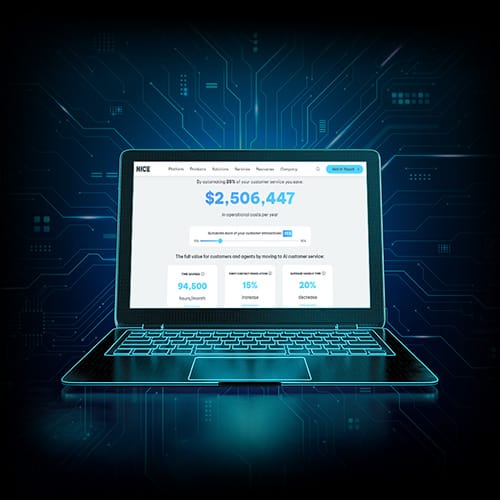
Discover the full value of AI in CX
Understand the benefits and cost savings you can achieve by embracing AI, from automation to augmentation.
Next step
Monitor the production signals that matter most, then use deeper observability to understand and improve the agent behavior behind them.
Explore the AI Agent Observability pillar
Frequently asked questions

Ready to experience the power of one platform?
Let us show you how NiCE can unify, automate and elevate your entire customer experience - with AI at the core and outcomes at the forefront.