

AI Agent Observability for Reliable, High-Performing AI

On this page
- What is AI agent observability?
- Why autonomous AI needs a different observability model
- Core components of an AI agent observability stack
- What should AI agent observability measure?
- AI agent observability for customer service
- How to evaluate AI agent observability software
- Next step
- Explore the AI Agent Observability pillar
- Frequently asked questions
- What is AI agent observability?
- Why autonomous AI needs a different observability model
- Core components of an AI agent observability stack
- What should AI agent observability measure?
- AI agent observability for customer service
- How to evaluate AI agent observability software
- Next step
- Explore the AI Agent Observability pillar
Last updated: November 20, 2026
AI agent observability is the practice of collecting and analyzing the signals generated by autonomous AI agents so teams can understand what agents did, why they did it, whether the outcome was correct, and where performance can improve. It combines monitoring, tracing, analytics, session review, quality signals, and incident investigation for production AI.
What is AI agent observability?
AI agent observability is a production discipline for understanding the behavior and performance of autonomous or semi-autonomous AI agents. It captures telemetry from agent sessions and turns that data into evidence teams can use to monitor health, investigate decisions, measure outcomes, and improve future performance.
Traditional application monitoring usually tells teams whether a system is available, fast, or producing errors. Agents introduce another layer of complexity because they can interpret intent, retrieve information, select tools, call APIs, hand work to subagents, and change their plan based on what happens during a session. A technically successful request can still produce a poor customer outcome. Observability helps reveal that gap.
A mature observability program therefore looks at the full path from customer request to agent decision to action to outcome. It should make it possible to move from a high-level performance trend into the underlying session evidence without stitching together multiple systems manually.
Why autonomous AI needs a different observability model
Agentic systems are less deterministic than traditional software. Two similar customer requests may take different paths depending on retrieved context, available tools, prior conversation state, policy rules, or subagent selection. That makes simple error logs insufficient for explaining many failures.
Teams need visibility into the agent's execution path: which intent was inferred, what knowledge was retrieved, which action or tool was selected, whether that tool succeeded, how long each step took, and why the session resolved, escalated, timed out, or failed. This is especially important when agents are allowed to update records, trigger workflows, issue refunds, change appointments, or take other consequential actions.
Core components of an AI agent observability stack
A complete observability stack normally combines several layers. Monitoring tracks health, availability, latency, errors, throughput, and other operational signals. Tracing reconstructs the path through models, tools, retrieval, workflows, and subagents. Analytics aggregates sessions into trends, segments, and business outcomes. Session replay lets teams inspect individual interactions in detail. Incident response turns observability signals into a repeatable process for detection, diagnosis, containment, recovery, and prevention.
These layers should connect. A spike in escalations should lead to the affected sessions. A failed session should expose the relevant trace. A trace should show the tool calls and retrieved context that influenced the decision. That connected workflow is what makes observability actionable rather than just another dashboard.
What should AI agent observability measure?
Start with outcomes. Measure whether the agent completed the intended task, resolved the customer's need, escalated appropriately, or abandoned the workflow. Add quality signals such as groundedness, policy adherence, answer relevance, tool selection accuracy, and customer feedback where available.
Then connect those outcomes to operational measures such as latency, error rate, retry rate, tool failures, token consumption, model usage, session duration, and subagent handoffs. The right metric set depends on the agent's job. A service agent should not be judged by the same measures as a sales research agent or an internal workflow agent.
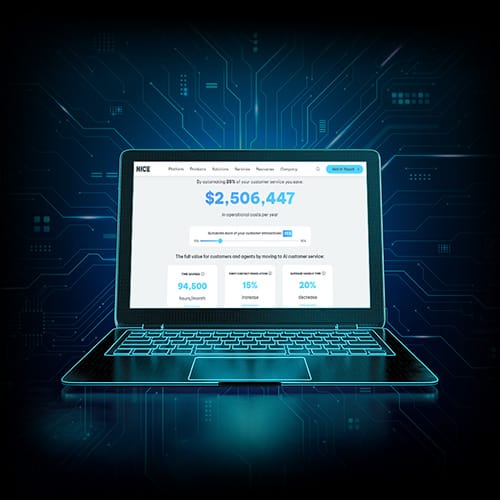
Discover the full value of AI in CX
Understand the benefits and cost savings you can achieve by embracing AI, from automation to augmentation.
AI agent observability for customer service
In customer service, observability should make automated interactions as inspectable as human-assisted interactions. Leaders need to know which intents are being resolved, which ones trigger handoffs, where customers repeat themselves, when an agent selects the wrong action, and which knowledge gaps cause weak answers.
That data can support quality teams, AI trainers, operations leaders, knowledge managers, product teams, and engineering. It also creates a practical improvement loop: identify a pattern, inspect the sessions, determine the cause, update knowledge or configuration, validate the change, and monitor the resulting performance.
How to evaluate AI agent observability software
Evaluate how quickly a user can move from an aggregate metric to the exact sessions and traces behind it. Look for session-level inspection, tool-call visibility, error context, configurable scoring, filtering and segmentation, trend analysis, alerting, and the ability to compare agent versions or configuration changes.
Enterprise teams should also evaluate access controls, retention, auditability, data export, integration with existing observability and analytics systems, support for multiple agent frameworks, and whether the platform can connect technical telemetry to business outcomes. The goal is not simply to collect more logs. It is to make agent behavior understandable enough to operate and improve at scale.
Next step
Build an operational feedback loop for AI agents that makes performance visible, diagnosable, and continuously improvable.
Explore the AI Agent Observability pillar
Frequently asked questions

Ready to experience the power of one platform?
Let us show you how NiCE can unify, automate and elevate your entire customer experience - with AI at the core and outcomes at the forefront.