

Conversational AI Analytics: Every Conversation Is Evidence

- The Loop: Four Verbs, One Cadence
- Intent Discovery: The Roadmap Writes Itself
- Production Quality: Caught by Dashboards, Not Customers
- The Voice-of-Customer Dividend
- Standing Up the Practice
- Analytics Across the Estate: One Scoreboard, Every Generation
- Conclusion
- Continue Exploring the Conversational AI Platform
A conversational AI estate produces its own improvement instructions daily — every misunderstanding a labeled defect, every escalation a boundary reading, every abandoned journey a friction map — and most programs file those instructions unread. The difference between estates that plateau and estates that compound is rarely the model; it's whether anyone runs the loop that turns conversation data into change. This page is that loop, in operating detail: capture, discover, diagnose, act; the intent-discovery practice that writes the roadmap from evidence; the production quality monitoring that catches drift before customers do; and the voice-of-customer dividend that makes the analytics function pay twice. Definitions stay with their owner — KPIs for agentic AI in CX defines what resolution and containment mean — and the commercial machinery lives with NiCE's Interaction Analytics; this page is the practice that puts both to work.
The Loop: Four Verbs, One Cadence
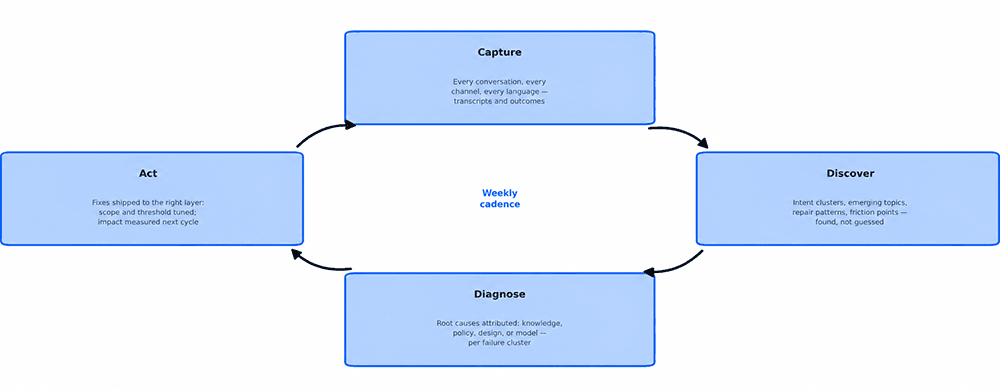
The Conversational Analytics Loop
Every conversation is evidence — the loop turns it into improvement
The anti-pattern: a separate bot per language — thirty forks of logic, drifting apart with every policy change
Centralize the meaning; localize the words
Figure 1. The conversational analytics loop. NiCE analytics practice model.
Capture is a completeness discipline: every conversation — automated, escalated, abandoned — across every channel and language, with outcomes attached, because a corpus with gaps analyzes the estate you wish you had. Consent, retention, and privacy rules apply from the first byte; analytics inherits the platform's governance, not an exemption from it. Discover lets the corpus speak: clustering utterances into candidate intents and themes, surfacing what's rising, what's failing, what's new — the machinery of the next section. Diagnose attributes each failure cluster to its root layer — the four-way sort this library uses everywhere: *knowledge* (the answer was wrong or missing), *policy* (the rule was ambiguous or absent), *design* (the conversation lost people), or *model* (understanding genuinely failed) — because fixes shipped to the wrong layer are effort spent making the wrong thing better. Act closes the loop: fixes routed to their owners, scope and thresholds tuned through the governed change process, and every action tagged so next week's cycle measures its impact. The cadence matters as much as the verbs: weekly, evidence-first, with decision rights in the room — the operating rhythm the training lifecycle formalizes for tuning.
Intent Discovery: The Roadmap Writes Itself
Intent Discovery: Mining What Customers Actually Ask
The backlog writes itself when the conversations are allowed to speak
- All conversations
The full corpus — automated, escalated, and abandoned — across channels - Cluster
Unsupervised grouping of utterances into candidate intents and themes - Quantify
Volume, outcome, and cost per cluster — what’s big, what’s broken, what’s new - Route
New automation candidates, design fixes, knowledge gaps, and product feedback — each to its owner
Discovery beats assumption: the intents customers bring are reliably different from the intents committees predict
The gap between the two is where roadmaps go wrong — and where analytics pays for itself first.
From corpus to routed insight. NiCE discovery model.
The single highest-yield analytics practice is letting demand speak before committees do. Cluster the corpus — including what customers asked that nothing handled — quantify each cluster by volume, outcome, and cost, and the estate's true backlog appears: the automation candidates ranked by demand (feeding the strategy quadrant with evidence), the intents whose failure clusters need design or knowledge work, the emerging topics that didn't exist last quarter (a new product's questions, a policy change's confusion, a competitor move's ripple), and the phrasings the understanding layer keeps missing. Discovery beats assumption reliably enough to be a rule: the intents customers actually bring differ from the intents planning sessions predict, and the delta is where roadmaps go quietly wrong. Modern platforms increasingly automate the front half of this — NiCE's data-to-agent direction turns interaction analysis directly into ready-to-deploy automation candidates with projected impact — which moves the human work up a level: judging the candidates, not excavating them.
Production Quality: Caught by Dashboards, Not Customers
Monitoring Conversation Quality in Production
Five signals watched continuously — so drift is caught by dashboards, not by customers
- Resolution & completion
Intents finished end to end, verified against systems — the headline, per intent and per language - Repair & escalation rates
Rising clarification loops or escalations on a stable intent — the earliest drift alarm - Accuracy audits
Sampled answers checked against source knowledge — fluency hides errors; audits find them - Sentiment & effort
Customer frustration signals and journey effort, trended — experience decay precedes metric decay - Guardrail & policy hits
Out-of-scope attempts, blocked actions, disclosure events — the safety telemetry, reviewed not archived
Five production quality signals. NiCE quality monitoring framework.
Quality monitoring is the loop's always-on half — five signals watched continuously so that drift announces itself in telemetry rather than in complaints. Resolution and completion, verified against systems, segmented per intent and per language (the multilingual discipline forbids blended averages). Repair and escalation rates, whose movement on a stable intent is the earliest drift alarm available — a knowledge update gone stale, an upstream change, a new phrasing pattern. Accuracy audits on sampled answers against source knowledge, because the generative era's fluency hides errors that stilted bots wore openly — the verification shift conversation design flags. Sentiment and effort trends, since experience decay precedes metric decay by weeks. And guardrail and policy hits — out-of-scope attempts, blocked actions, disclosure events — reviewed as safety telemetry, not archived as noise. Wire alerting to movement, not just thresholds: the estate's most dangerous failures are gradual.
The Voice-of-Customer Dividend
The same corpus that improves the AI is the business's richest listening post, and treating it as such makes the analytics function pay twice. Conversations carry, unprompted and at census scale, what surveys sample and focus groups approximate: which product confusions recur, which policies generate friction, which competitor comparisons customers volunteer, which words customers actually use for what the roadmap calls something else. Routing discipline turns this from anecdote to asset: product feedback clustered and quantified to product owners; policy friction to policy owners with the transcripts attached; journey pain to experience owners — through the voice-of-the-customer machinery the platform already runs for human interactions. One boundary keeps the dividend honest: insight extraction respects the same privacy, consent, and purpose limits as everything else; a listening post that customers would be surprised to learn about is a liability, not an asset.
Standing Up the Practice
- Instrument before launch, not after. Per-intent, per-channel, per-language segmentation retrofitted is months of blind flying — the implementation path wires measurement at step five for this reason.
- Staff the loop, not just the launch. The weekly cycle needs named owners with decision rights — analytics that reports without power to change anything is decoration.
- Route by root cause, always. The knowledge/policy/design/model sort is the practice's spine; skipping it ships fixes to the wrong layer.
- Keep humans reading transcripts. Sampled, native-language transcript reading catches what aggregates can't — the practice's irreplaceable manual core.
- Publish the loop's wins. Fixed clusters, recovered intents, drift caught early — visible impact is what keeps the cadence funded.
Analytics Across the Estate: One Scoreboard, Every Generation
Two scope rules turn a good analytics practice into an estate-wide one. First, measure every generation on the same scoreboard: legacy bots, modern conversational AI, and human-handled conversations all report the same resolution-first metrics, because mixed estates are the norm and migration decisions — which intents to upgrade, which bots to retire — deserve comparable evidence, exactly as the upgrade path prescribes. Second, segment everything by the axes that hide problems: per intent, per channel, per language, per customer segment — blended averages are where estates go to feel healthy while a market, a channel, or an intent quietly fails. The practice's maturity test is a simple question asked of any number on the dashboard: *can we say which conversations, which root cause, and which owner?* When the answer is yes at every altitude — estate, pillar, intent, conversation — the analytics function has become what it should be: not a reporting layer bolted onto the estate, but the estate's nervous system, sensing everywhere and routing every signal to a hand that can act on it.
And a caution to close on, because analytics functions drift toward it: resist the dashboard-as-destination failure, where measurement becomes its own product and the loop's fourth verb quietly atrophies. The weekly cycle exists to change the estate — a fix shipped, a threshold tuned, a wave re-sequenced — and any metric that has never altered a decision is a candidate for deletion, not decoration. The healthiest analytics practices are measured the way they measure everything else: by outcomes, against a baseline, with the strategy's named owners accountable for acting on what the conversations keep saying. A quarterly audit of the loop itself keeps it honest: which discoveries became fixes, which fixes moved their metric, and which reports nobody read — pruned without sentiment. Analytics earns its budget the same way the estate does: by what it completes, not by what it displays.

Discover the full value of AI in CX
Understand the benefits and cost savings you can achieve by embracing AI, from automation to augmentation.
Conclusion
Capture everything, let the corpus speak, diagnose to the right layer, and act on a cadence with decision rights — the loop that separates compounding estates from plateaued ones. And read the dividend: the same conversations improving your AI are telling you, at census scale, what your customers actually think. NiCE's analytics machinery was built to run both halves; the practice on this page is how teams put it to work.
Continue Exploring the Conversational AI Platform
- Conversational AI Platform hub — The complete guide to conversational AI platforms.
- Conversational AI strategy — The measurement layer this practice powers.
- Conversation orchestration and context — The journeys whose telemetry the loop reads.
- Multilingual conversational AI — The per-language segmentation discipline.
Frequently Asked Questions About Conversational AI Analytics

Ready to experience the power of one platform?
Let us show you how NiCE can unify, automate and elevate your entire customer experience - with AI at the core and outcomes at the forefront.