

Multilingual Conversational AI: One Brain, Many Languages

- The Architecture Rule: Centralize Meaning, Localize Words
- The Rollout Rule: Tier the Ambition
- Voice: Where Language Gets Physical
- The Quality Rule: Honest in Every Language
- Getting the Language Program Started
- The Multilingual Payoff, Counted Honestly
- Conclusion
- Continue Exploring the Conversational AI Platform
Every global operation eventually meets the same ugly math: customers converse in thirty languages, specialists staff eight of them well, and the gap is covered by hold music, translation vendors, and apologetic English. Multilingual conversational AI exists to break that math — instant support in the customer's own language is one of the technology's most concrete promises, and one of NiCE's most prominent platform claims. But the promise is routinely fumbled in the architecture: “add a language” becomes “clone a bot,” and two years later thirty forks of conversation logic are drifting apart with every policy change. This guide is the anti-fumble: the one-brain architecture, the tiered rollout that sequences ambition honestly, the voice-specific considerations, and the per-language quality discipline that keeps the estate honest in the languages leadership doesn't read.
The Architecture Rule: Centralize Meaning, Localize Words
Multilingual Conversational AI: One Brain, Many Languages
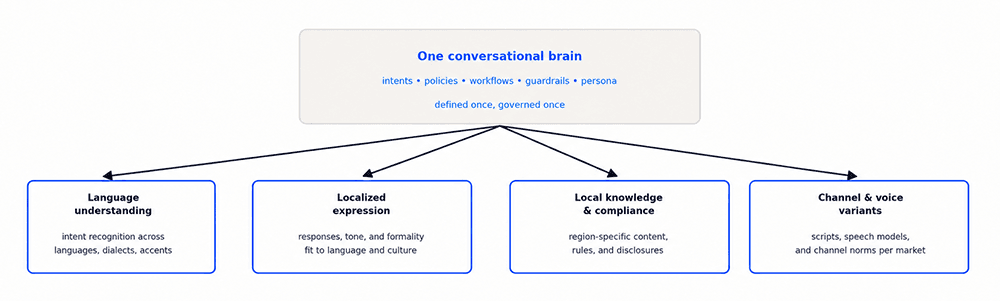
Centralized understanding and policy, localized expression — not thirty separate bots
The anti-pattern: a separate bot per language — thirty forks of logic, drifting apart with every policy change
Centralize the meaning; localize the words
Figure 1. One brain, many languages. NiCE multilingual architecture model.
The load-bearing decision is what gets defined once versus per language. Once, at the brain: intents (a refund request is a refund request in any language), policies and workflows (the refund rules don't change with the alphabet), guardrails and escalation standards, and the persona's substance — the traits and boundaries specified in conversation design. Per language, at the edge: understanding tuned to the language's phrasings, dialects, and accents; expression — responses whose tone, formality, and idiom actually fit the culture, because translated-sounding service reads as second-class service; local knowledge and compliance — the region's content, rules, and required disclosures; and channel and voice variants, since messaging norms and speech models differ by market. The payoff structure is the same one every shared-foundation argument in this library makes: a policy change lands once and every language inherits it; an intent improved at the brain improves in thirty markets; and governance — the enterprise requirements of security, audit, and control — applies uniformly instead of thirty times. The per-bot alternative isn't just expensive; it's ungovernable, and its drift is invisible until a market's customers are being told last year's policy in this year's words.
The Rollout Rule: Tier the Ambition
Sequencing the Language Rollout
Not every language needs every capability on day one — tier deliberately
- Tier 1 — Full service
Complete scope: understanding, action, voice and digital, local knowledge, human escalation in-language
Your largest customer languages - Tier 2 — Core service
High-volume intents automated in-language; long-tail requests translated or routed to Tier 1 flows
Significant but smaller markets - Tier 3 — Assisted
Understanding plus translation-assisted responses; human escalation with language routing
Emerging or low-volume languages
Promotion between tiers is an evidence decision: volume, resolution quality, and market priority — reviewed on a cadence.
Three-tier language rollout. NiCE rollout framework.
“Which languages?” is the wrong first question; “which languages at which depth?” is the right one. Tier 1 — full service for the largest customer languages: complete scope, voice and digital, local knowledge, human escalation in-language. Tier 2 — core service for significant markets: the high-volume intents automated natively in-language, the long tail translation-assisted or routed through Tier 1 flows. Tier 3 — assisted for emerging and low-volume languages: understanding plus translation-assisted response, with human escalation routed by language skill. The tiers convert an impossible promise (“every language, fully, now”) into an honest sequence, and promotion between tiers becomes an evidence decision — volume, resolution quality, market priority — reviewed on the same cadence as the rest of the strategy's measurement layer. Two sequencing notes from practice: prioritize by *conversation* volume rather than market revenue (the languages customers contact you in are not always the markets you sell most in), and treat Tier 3 as a demand sensor — rising volume and decent assisted-resolution in a language is the business case for its promotion, written by customers themselves.
Voice: Where Language Gets Physical
Digital text is language's easy mode; voice is where multilingual gets physical. Accents and dialects stress recognition models unevenly — the understanding that scores well in a language's standard register may stumble on its regional varieties, which is a testing dimension, not a footnote. Speech synthesis carries the persona's warmth or destroys it per language; a voice that sounds native in one market and robotic in another is delivering two different brands. Code-switching — customers mixing languages mid-sentence, ubiquitous in many markets — separates genuinely multilingual understanding from language-siloed deployments. And the escalation path must be language-aware end to end: an in-language conversation that escalates to an agent without that language, context notwithstanding, has broken its promise at the worst moment. The full voice methodology belongs to the voice AI discipline; the multilingual addendum is simply that every one of its tests must be run *per language*, at the tier that language is promised.
The Quality Rule: Honest in Every Language
Keeping Quality Honest Across Languages
Multilingual estates fail quietly in the languages leadership doesn't read — unless the loop prevents it
- Measure per language
Resolution, escalation, and satisfaction reported by language — never blended into one flattering average - Review with native speakers
Transcript review by people who read the language and the culture — idiom failures don't show in dashboards - Watch the gap
The spread between best- and worst-performing languages is the metric — a widening gap is a quiet crisis - Fix at the brain
Root causes fixed in shared intents and policy where possible — so every language inherits the repair
The per-language quality loop. NiCE quality framework.
Multilingual estates fail quietly, in the languages leadership doesn't read — a blended global resolution average can hold steady while one market's experience collapses. The countermeasures are procedural. Measure per language: resolution, escalation, repair rates, and satisfaction reported by language, with the analytics practice segmenting everything it tracks. Review with native speakers: transcript review by people who read the language *and* the culture, because idiom failures, tone misfires, and formality errors are invisible in dashboards and glaring to customers. Watch the gap: the spread between the best- and worst-performing languages is itself a headline metric — a widening gap is a quiet crisis with a market's name on it. Fix at the brain: when the diagnosis is shared (a policy ambiguity, a broken workflow), repair it centrally so every language inherits the fix; when it's local (an idiom, a mistranslated disclosure), fix it at the edge and add the case to that language's test suite. The loop's staffing corollary: every Tier 1 and Tier 2 language needs a named human reviewer with real hours — a multilingual estate reviewed only in headquarters' language is unreviewed.
Getting the Language Program Started
- Audit the demand first. Contact analytics by language — including the conversations currently forced into your default language — is the tier map's raw material.
- Stand up the brain before the second language. The one-brain architecture is cheapest to adopt at language two and painful to retrofit at language twelve.
- Launch each language contained. The six-step deployment discipline applies per language: scoped intents, native-speaker testing, contained rollout, evidence-gated expansion.
- Wire per-language measurement from day one. Retrofitted segmentation means months of blind flying in exactly the markets you know least.
- Publish the tier map internally. Markets deserve to know their language's tier and its promotion criteria — ambiguity breeds either false expectations or shadow bots.
The Multilingual Payoff, Counted Honestly
The business case writes itself once the architecture is right, and it's worth stating in the strategy's own terms. Resolution reach: every language promoted a tier converts a population from hold-music-and-apology to first-contact resolution — measured per language against that language's own baseline, never against the global average. Capacity arithmetic: language-skilled specialists are among the scarcest agents in any operation; every in-language intent the platform absorbs returns exactly those scarce hours to the conversations that genuinely need them, and language-aware routing concentrates the remaining specialist time where it counts. Consistency: one brain means one policy, one persona, and one compliance posture in every market — the governance dividend that per-market bots structurally cannot deliver. And expansion economics: with the brain in place, entering a new market's language is a localization project, not a platform project — weeks of edge work instead of quarters of duplication — which changes what market entry costs and therefore what markets are worth entering. Model the arithmetic against your own contact volumes with the AI value calculator; multilingual estates are where the shared-foundation math is usually most dramatic.
A closing note on the people the math tends to forget: multilingual automation done well is also a workforce story. Language-skilled agents stop being a triage bottleneck for routine lookups and become what their skill actually is — the escalation tier for the conversations where culture, nuance, and judgment matter — and the per-language transcript review gives them a second role as the estate's quality conscience in their language. Programs that frame the language rollout to these teams as an upgrade to their work, and staff the reviewer hours to prove it, launch into cooperation instead of quiet resistance.

Discover the full value of AI in CX
Understand the benefits and cost savings you can achieve by embracing AI, from automation to augmentation.
Conclusion
Centralize the meaning, localize the words, tier the promise, and measure every language like it's the only one — that's multilingual conversational AI that scales past the second market without forking into chaos. NiCE's platform was built for the one-brain architecture, which is why adding your thirtieth language should feel like configuration, not another project.
Explore AI Agents for Self-Service
Continue Exploring the Conversational AI Platform
- Conversational AI Platform hub — The complete guide to conversational AI platforms.
- Conversational AI strategy — Where the language tiers sit in the five layers.
- Conversation orchestration and context — The spine that carries journeys across languages too.
- Conversational AI analytics — The per-language measurement machinery.
- Enterprise conversational AI — The governance regime multilingual estates inherit.
Frequently Asked Questions About Multilingual Conversational AI

Ready to experience the power of one platform?
Let us show you how NiCE can unify, automate and elevate your entire customer experience - with AI at the core and outcomes at the forefront.