

Conversation Orchestration and Context: How One Conversation Stays One Conversation

- The Context Spine: What Travels With the Customer
- Orchestration: Five Jobs on Every Turn
- Continuity, Worked: One Journey, Three Channels
- What Orchestration Demands of the Platform
- Evaluating Orchestration: Four Live Tests
- Orchestration and the Human Workforce: One Fabric, Not Two
- Conclusion
- Continue Exploring the Conversational AI Platform
Ask people what they hate about automated service and the answers converge on one experience: starting over. Repeating the story to the bot, again to the app, again to the human; re-uploading, re-verifying, re-explaining. The absence being felt has a name — context — and the capability that prevents it has one too: orchestration. Together they are the least glamorous and most decisive layer of a conversational AI platform, the machinery behind the hub's One Conversation principle: a unified journey across channels and touchpoints, however many turns, topics, and handoffs it takes. This page opens that machinery — the context spine, the five jobs orchestration performs on every turn, and cross-channel continuity as a worked example. The *craft* of what conversations say lives with conversation design; this is the layer that makes the craft executable.
The Context Spine: What Travels With the Customer
The Context Spine: One Conversation Across Every Channel
Identity, history, and state travel with the customer — the platform’s defining promise
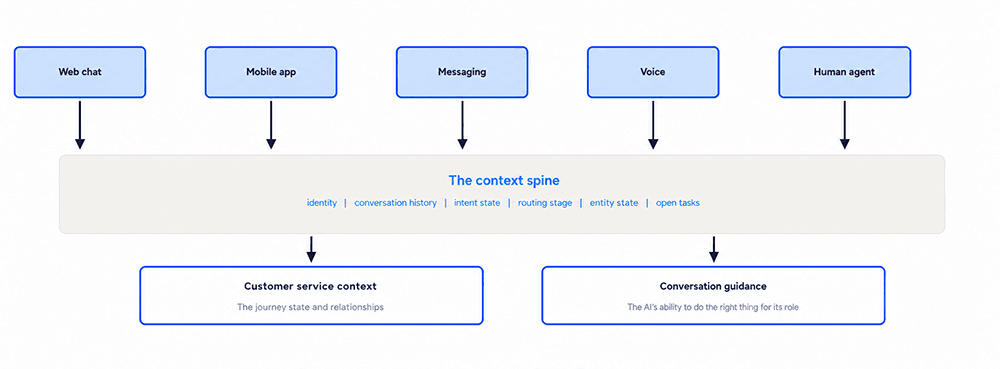
Figure 1. The context spine across channels and handoffs. NiCE context architecture model.
The spine is a working inventory of what must never be re-asked: identity — who this is, verified once per journey, not per channel; history — what's been said and done, in this conversation and relevantly before it; intent state — the goal in progress and what's been established toward it; journey stage — where the customer stands in a longer arc (the claim filed last week, the onboarding in week two); entitlements — what this customer's status makes possible; and open work — the order in flight, the case pending, the callback promised. Two properties make a spine real rather than aspirational. It is shared, not copied: every channel and every agent — AI or human — reads and writes the same object, so there is nothing to synchronize and nothing to contradict; the fragmented alternative, a memory per bot per channel, is where the fresh-interrogation experience comes from. And it is governed: context carries personal data, so access follows the same identity, permission, and audit rules as everything else on the platform, per the security-and-governance regime — continuity must never be purchased with privacy.
Orchestration: Five Jobs on Every Turn
Inside Goal-Driven Dialogue: What Orchestration Actually Does
Five jobs the orchestration layer performs on every turn of every conversation
- Track the goal
Holds what the customer is trying to accomplish — across turns, topics, and interruptions. - Manage the state
Knows what's been established, what's missing, and what's next — no re-asking, no amnesia. - Choose the move
Answer, clarify, act, confirm, or escalate — selected per turn against policy and confidence. - Execute the work
Calls the workflows and systems that complete the request — conversation as interface to action. - Handle the detour
Topic shifts, corrections, and side questions absorbed — then the goal resumes where it paused.
If the spine is memory, orchestration is judgment about what to do with it — five jobs, performed on every turn. Track the goal: the customer came to accomplish something, and the orchestrator holds that something steady across turns, topic shifts, and interruptions; conversations without a tracked goal are the ones that drift into loops. Manage the state: what's established, what's missing, what's next — the discipline that eliminates re-asking and makes progress visible. Choose the move: answer, clarify, act, confirm, or escalate, selected per turn against policy and confidence — the same confidence-and-consequence routing the threshold discipline governs in back-stage automation, here running inside the dialogue itself. Execute the work: the move that separates platforms from bots — calling the workflows and systems that actually complete the request, conversation as the interface to action rather than a pointer to it. Handle the detour: real customers interrupt themselves — a side question mid-booking, a correction three turns late — and the orchestrator absorbs the digression, resolves or parks it, and resumes the goal where it paused. That last job is the one scripted trees can't fake: a designed path has no concept of *returning* to itself.
Continuity, Worked: One Journey, Three Channels
One Journey, Three Channels, Zero Restarts
A worked example of cross-channel continuity — the experience the spine exists to produce
- Evening, web chat
Customer starts a claim: uploads two photos; has to leave mid-conversation. - Morning, mobile app
“Picking up your claim from last night” — one question remains; answered in a minute. - Lunchtime, voice call
A complication needs a human: the agent answers already reading the full history. - Same call, resolution
Approved on the line; confirmation sent in-channel; the journey closed where it started.
Count what the customer never did: repeat the story, re-upload the photos, re-verify identity, start over
Continuity is invisible when it works — and unforgettable when it doesn’t.
The worked example above is deliberately mundane — a claim, three channels, one complication — because continuity's value is mundane: it's the friction that *doesn't* happen. Evening web chat starts the claim; the customer leaves mid-flow, and nothing is lost, because the intent state parked itself. Morning app resumes with the one missing item — asked once, in one line, because the state knew exactly what remained. The lunchtime complication escalates to a human who answers already reading the history — the handoff discipline's context-first rule, executed by the spine rather than by heroics. And resolution closes the journey where it stands, with confirmation flowing back through the customer's channel of the moment. Count what the customer never did — repeated, re-uploaded, re-verified, restarted — and you have the business case for the whole layer, measured in the effort and repeat-contact metrics that experience programs track.
What Orchestration Demands of the Platform
Capability this decisive has infrastructure prerequisites, worth naming because they're where evaluations should probe. State at scale: tens of thousands of concurrent conversations, each with live goal-and-state tracking, surviving channel switches and long pauses. Connected execution: the workflows and systems the orchestrator calls must be governed connectors, not hopeful integrations — the depth belongs to the integration discipline. Unified routing: when the move is escalate, the conversation, its context, and its priority must flow into the same routing fabric humans work in — one queue logic for the whole operation, which is the commercial territory of the platform's orchestration products. Design-time expressiveness: conversation designers must be able to declare goals, states, and moves on the platform canvas without hand-coding a state machine per intent. And observability: every turn's move-choice logged and reconstructable — the conversational instance of the run-is-the-audit-unit principle from platform architecture.
Evaluating Orchestration: Four Live Tests
- The detour test. Mid-task, ask an unrelated question, then say 'anyway, where were we?' — resumption without re-asking is the pass.
- The channel-hop test. Start a journey in chat, continue it by voice (or vice versa) — the second channel must open mid-journey, not at the beginning.
- The pause test. Abandon a conversation mid-flow and return hours later — parked state and a one-line resume beat a restart.
- The escalation test. Force a handoff and read what the human actually receives — full transcript, intent state, and open work, or a name and a prayer.
Run all four against any platform claiming One-Conversation capability; the demos are cheap to stage and impossible to fake with a scripted tree. Where they pass, the rest of this pillar's promises — strategy targets, multilingual reach, analytics depth — have the machinery they assume.
Orchestration and the Human Workforce: One Fabric, Not Two
A final architectural point that operations leaders feel daily: orchestration cannot stop at the automation boundary. In estates where the AI layer and the human contact center run separate brains, the seam becomes the experience — escalations arrive as cold transfers, priorities conflict, and two versions of the customer's story compete. The alternative is one fabric: the same context spine and routing logic serving AI agents, human agents, and the copilot tooling that assists humans mid-conversation, so an escalation is a move within one system rather than a leap between two. The operational dividends compound quietly — supervisors see whole journeys instead of fragments, workforce planning reads true demand instead of post-deflection residue, and the analytics practice measures one estate on one scoreboard. When evaluating, extend the four tests across the boundary: run the escalation test all the way into the agent desktop and back, because a journey that survives channels but dies at the human handoff has failed exactly where stakes are highest.
One design corollary follows for the humans in that fabric: context must arrive *usable*, not merely complete. An agent handed forty raw turns mid-call has technically received the context and practically received a homework assignment; the platform's job is the working summary — goal, what's established, what's open, why it escalated — with the full transcript behind it for depth. The same applies in reverse: what the human resolves writes back to the spine, so the next conversation, automated or not, starts from the truth. Context is a loop, not a baton.

Discover the full value of AI in CX
Understand the benefits and cost savings you can achieve by embracing AI, from automation to augmentation.
Conclusion
Memory plus judgment: a spine that carries the journey and an orchestrator that advances it, turn by turn, channel by channel, handoff by handoff. That's the machinery beneath every One-Conversation promise — and the four live tests will tell you in an afternoon whether a platform has it. NiCE built its platform to pass them; bring your hardest journey and see.
Continue Exploring the Conversational AI Platform
- Conversational AI Platform hub — The complete guide to conversational AI platforms.
- Chatbot vs. conversational AI — The comparison this machinery decides.
- Conversational AI strategy — The continuity requirement as a strategy layer.
- Conversational AI analytics — Measuring the journeys orchestration produces.
- AI-to-human handoff in autonomous service — The escalation discipline the spine executes.
Frequently Asked Questions About Conversation Orchestration and Context

Ready to experience the power of one platform?
Let us show you how NiCE can unify, automate and elevate your entire customer experience - with AI at the core and outcomes at the forefront.