

How AI Automation Platforms Work: The Operating Layer, the Run, and the Loop

- Zoom Level One: The Operating Layer
- The Three Inputs, Honestly Described
- Zoom Level Two: Anatomy of One Run
- Zoom Level Three: The Design-Build-Operate Loop
- What This Architecture Buys You
- How to Inspect a Platform's Machinery
- Six Services, Six Failure Modes
- Conclusion
- Continue Exploring the AI Automation Platform
Platform diagrams in vendor decks tend to show boxes labeled “AI” connected to boxes labeled “value.” This page opens the boxes. It explains how an AI automation platform actually works at three zoom levels: the operating layer — the shared services every automation runs through; the run — what happens in the seconds between a trigger and a verified outcome; and the loop — how the estate designs, builds, and operates its way to compounding improvement. It is the mechanism companion to this pillar's spectrum guide: that page tells you what the levels are; this one shows the machinery that hosts them all. Integration specifics — connector types, APIs, event-driven patterns — belong to the verified sibling AI automation integration and are linked rather than restated.
Zoom Level One: The Operating Layer
One layer connecting data, systems, and Al models - operated through a design-build-run loop.
- Enterprise data
- Interactions
- Records
- Knowledge
- Outcomes
- Business systems
- CRM
- ERP
- Billing
- Ticketing
- Custom applications
- AI models
- Language
- Reasoning
- Classification
- Fit-for-purpose models
- The automation operating layer
- Orchestration and state management
- Connectors and APIs
- Identity and permissions
- Guardrails and thresholds
- Logging and auditing
- Monitoring and recovery
- Every automation—from task automation to agentic automation—runs through these shared services.
- Automated outcomes
- Tasks completed
- Processes executed
- Goals achieved
- Outcomes verified
- Human checkpoints
- Approvals
- Exceptions
- Reviews by design
Strip any serious automation platform to its skeleton and you find one layer doing six jobs for every automation on it. Orchestration and state: something must know where each of a million concurrent runs stands, what happens next, and what to do when a step stalls — orchestration is the platform's nervous system. Connectors and APIs: governed, maintained bridges into CRM, ERP, billing, ticketing, and custom systems, so automations act on reality rather than copies of it; depth on this lives in AI automation integration. Identity and permissions: every automation is an identity with least-privilege grants — the scheduling automation cannot read payment history, structurally. Guardrails and thresholds: scope limits, value ceilings, and confidence rules enforced by the layer, not promised by the automation. Logging and audit: every decision and action written durably as it happens. Monitoring and recovery: anomaly detection, alerting, pause, and rollback across the fleet. The strategic point hiding in the plumbing: *the layer is the product.* Individual automations are replaceable; the shared services are what compound — which is why platform evaluations should probe the layer, not the demos, a discipline the contact center platform pillar turns into proof tests.
The Three Inputs, Honestly Described
Enterprise data is both fuel and teacher: interaction history and outcome data tell the platform what to automate and how well automations perform — the data-to-automation discovery NiCE has productized, analyzing interaction patterns to surface candidates with projected impact before anything is built. Business systems are where automation becomes real; the platform's connector fabric determines whether an automation can complete work or merely describe it. AI models are deliberately plural: modern platforms run a multi-model approach, matching each automation's language, reasoning, or classification needs to the model that fits its accuracy, latency, and cost profile — a configuration decision, not a religion. None of the three is optional, and the weakest of the three caps the estate: brilliant models over stale data and thin connectors produce confident, unexecutable answers.
Zoom Level Two: Anatomy of One Run
What happens between a trigger and a verified outcome.
- Trigger: Event, schedule, or request starts the run.
- Context: Identity, records, and policy are assembled from connected systems.
- Decide: Rules or AI reasoning choose the action within guardrails.
- Act: Systems are updated through governed connectors, with checkpoints where designed.
- Verify and log: The outcome is checked, the audit trail is written, and metrics and learning are updated.
The run is the audit unit: Every run—millions per day at scale—is individually reconstructable, including what triggered it, what it saw, what it decided, what it did, and how it ended.
Whether the automation is a level 1 task or a level 4 agent, its run has the same skeleton. A trigger fires — an event from a system, a schedule, a customer request, another automation. Context assembles: the run authenticates as its identity, pulls the records its permissions allow, and loads the policy it reasons over. A decision happens — a rule evaluates or a model reasons — inside guardrails the layer enforces regardless of what the decision logic wants. Action executes through governed connectors, pausing at human checkpoints where the design placed them (the patterns in human-in-the-loop AI automation). Finally verification and logging: the outcome is checked against the goal, the audit trail closes, and the run's telemetry joins the estate's metrics. The design consequence worth underlining: the run is the audit unit. At enterprise scale — millions of runs a day — reconstructability cannot be an investigation; it must be a property, and it is the operating layer that makes it one.
Zoom Level Three: The Design-Build-Operate Loop
Automation is not a project phase; it is a loop the platform runs continuously.
- Design: Find candidates in your data, then model the flow, policies, and checkpoints on a visual canvas.
- Build: Assemble the automation using connectors and AI skills—no-code where possible and pro-code where needed.
- Operate: Monitor every run, catch errors, tune thresholds, and expand the scope through evidence gates.
- Evidence flows back: Operating data feeds the next design cycle, showing what to automate next, where thresholds bind, and which exceptions to absorb.
The platform is not a factory that ships automations; it is a loop that improves an estate. Design starts in evidence: interaction and exception data surface the candidates, and a visual canvas models the flow, policy, and checkpoints — increasingly drafted by AI from a described goal. Build assembles from the platform's parts — connectors, AI skills, patterns — through the no-code-to-pro-code range covered in no-code AI automation. Operate is where most of the lifecycle lives: monitoring every run, catching drift and errors, tuning thresholds, and expanding or restricting scope through evidence gates. The loop's closing arc is the compounding mechanism: operating data — which exceptions recur, where checkpoints always approve, which intents cluster — becomes the next cycle's design input. Estates that run the loop report the platform signature: each new automation ships faster than the last, because it inherits everything the loop has already built and learned.
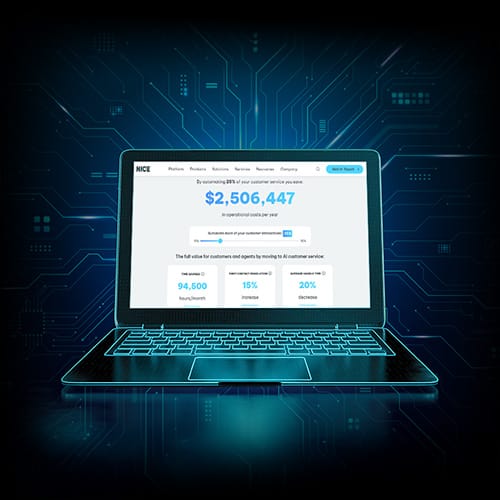
Discover the full value of AI in CX
Understand the benefits and cost savings you can achieve by embracing AI, from automation to augmentation.
What This Architecture Buys You
- Uniform governance at any scale. One identity model, one audit spine, one kill-switch discipline across a thousand automations — because all of them run through the same layer; the full control regime is detailed in enterprise AI agent governance and security.
- Spectrum mobility. Moving work up the spectrum reuses the same connectors, identities, and guardrails — a configuration change, not a re-platforming.
- Observability as a property. Fleet dashboards, anomaly detection, and root-cause reconstruction come from the layer's telemetry, not from per-automation instrumentation heroics.
- Resilient integration. Connector maintenance, API changes, and event-driven patterns are absorbed once at the layer — the resilience case the integration sibling makes in depth.
- Honest economics. Cost per verified outcome is measurable because verification and logging are built into every run; model your baseline with the AI value calculator.
How to Inspect a Platform's Machinery
Reading architecture slides is not inspection. Four requests separate operating layers from painted ones: “Show me one run, end to end” — pick a live automation and walk its most recent run from trigger to audit trail, in the tooling, not in a diagram. “Break something” — disable a dependency and watch detection, alerting, and recovery happen (or not). “Change a threshold” — watch how a guardrail moves: through governed configuration with change history, or through a developer editing code. “Add me a connector” — ask what connecting one of your real systems involves, who maintains it afterwards, and what permissions it is born with. Platforms with a genuine operating layer answer all four in minutes, live; the pattern of hesitation is itself the finding.
Six Services, Six Failure Modes
Another way to test architecture understanding — yours or a vendor's — is to name what breaks when each shared service is weak, because every failure mode is a production story someone has lived. Weak orchestration shows up as stuck runs and zombie processes: work that neither completes nor fails, discovered by the customer who never got the confirmation. Weak connectors produce the describe-don't-do estate — automations that draft perfect actions into systems they cannot actually update, leaving humans as the API. Weak identity is the shared-service-account anti-pattern: when everything acts as one over-privileged user, audit trails say 'the robot did it' and least-privilege is fiction. Weak guardrails mean limits that live in prompts and promises rather than enforcement — discovered the day an automation does exactly what it was asked instead of what was meant. Weak logging converts every incident into archaeology: reconstruction from fragments, timelines from guesswork, and regulators unimpressed. Weak monitoring means the customer is the alerting system — drift and failure surface through complaints rather than dashboards. The diagnostic value runs both directions: if any of these stories sounds like your current estate, the figure at the top of this page shows exactly which service to strengthen; and if a vendor cannot tell you crisply how their platform prevents each story, the proof-test discipline exists precisely to make them show rather than tell.
Conclusion
Understand the layer and the rest of the platform conversation clarifies: the run explains the governance, the loop explains the compounding, and the shared services explain why the second hundred automations cost less than the first ten. Inspect machinery, not slides — NiCE builds its automation platform to survive exactly that inspection.
Continue Exploring the AI Automation Platform
- AI Automation Platform hub — The complete guide to the AI automation platform.
- The AI automation spectrum — The four levels this machinery hosts.
- AI automation integration — Connector, API, and event-architecture depth.
- No-code AI automation — The build experience on top of the layer.
- Human-in-the-loop AI automation — Designing the checkpoints the run anatomy includes.
Frequently Asked Questions About How AI Automation Platforms Work

Ready to experience the power of one platform?
Let us show you how NiCE can unify, automate and elevate your entire customer experience - with AI at the core and outcomes at the forefront.