

Conversational AI Strategy: Five Decisions, In Order

- The Conversational AI Strategy Stack
- Layer 1 — Outcomes: What Is the Program Buying?
- Layer 2 — Use Cases: Prioritize by Value and Readiness
- Layer 3 — Channels and Languages: Meet, Don't Summon
- Layer 4 — Operating Model: The People Layer Strategies Skip
- Layer 5 — Measurement: The Honesty Layer
- The Strategy on One Page
- Three Strategy Anti-Patterns
- Sequencing the First Year
- Conclusion
- Continue Exploring the Conversational AI Platform
Most conversational AI programs don't fail at the technology; they fail at the sentence before the technology — the one that was supposed to say what the program is *for*. The tell is a strategy that opens mid-stack: “we need a bot on WhatsApp,” “we should use generative AI,” “our competitor launched a virtual agent.” Channels and tools are layers three and four of a strategy; started there, the program inherits nobody's outcomes and can't measure success because none was defined. This guide is the whole stack, in order: outcomes, use cases, channels and languages, operating model, measurement. It extends the hub's own starting advice — clear goals and practical use cases before automating anything — into a working method, and it deliberately hands its neighbors their pieces: the use-case *inventory* to the sibling use-cases survey, enterprise requirements to enterprise conversational AI, and execution mechanics to the implementation owners linked throughout.
The Conversational AI Strategy Stack
Five decisions, in order — each layer inherits the one above
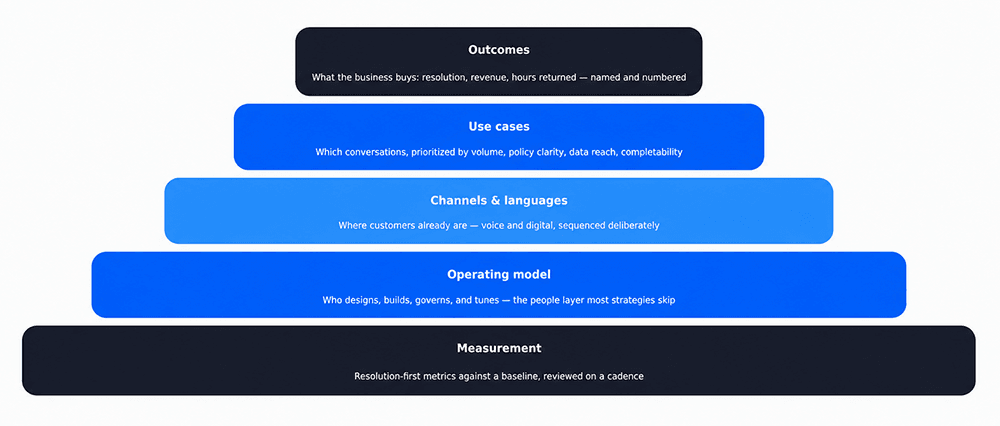
Strategies that start at layer three (“we need a bot on WhatsApp”) inherit nobody’s outcomes and measure nothing.
Figure 1. The five-layer strategy stack. NiCE strategy framework.
Layer 1 — Outcomes: What Is the Program Buying?
A conversational AI strategy exists to buy business outcomes, and the first layer names them with numbers attached. The honest menu is short: resolution — customer and employee requests completed without human effort, at equal or better experience; revenue — conversations that capture, qualify, and convert, per the sales playbook; capacity — expert hours returned to judgment work as automation absorbs repetition; and experience — effort down, availability up, journeys that don't restart. Pick the two that matter most, baseline them today, and target them explicitly — “reduce repeat contacts on billing intents by a third within a year” is a strategy sentence; “deploy AI to delight customers” is a poster. Model the economics honestly at this layer with the AI value calculator, against your own volumes, before any vendor math arrives.
Layer 2 — Use Cases: Prioritize by Value and Readiness
Prioritizing Conversational AI Use Cases
Two questions rank the backlog: how much value, how ready to automate?
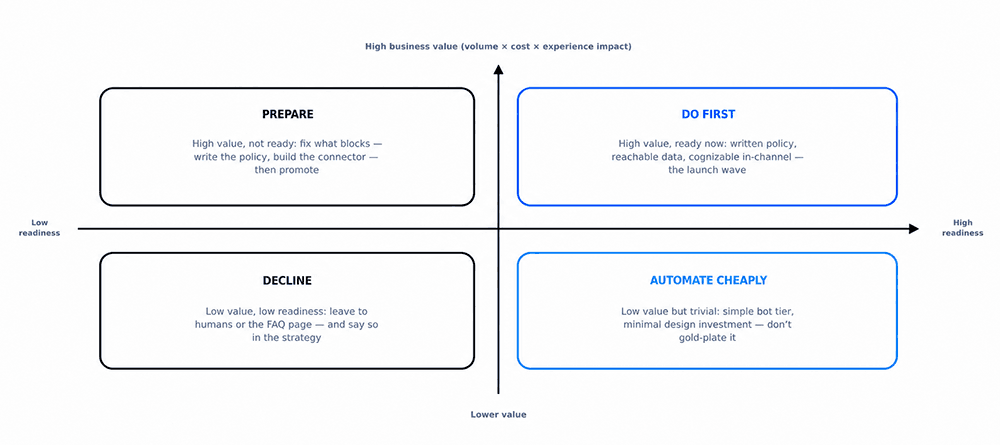
Figure 2. The prioritization quadrant. NiCE prioritization framework.
With outcomes named, the conversation inventory can be ranked instead of debated. Source the candidates from evidence — contact analytics, transcripts, the sibling use-case survey as the checklist of the possible — then score two axes: value (volume × cost × experience impact, weighted toward the layer-1 outcomes) and readiness (the recurring four gates: written policy, reachable data, in-channel completability, meaningful volume). The quadrant does the sequencing: high-value-ready cases form the launch wave; high-value-unready cases get their blockers fixed — write the policy, build the connector — and promote on evidence; trivially ready low-value cases run on the cheap tier without gold-plating; and the low-low corner is *declined out loud*, which is the quadrant's most underrated act: a strategy that says what it won't automate is one the organization can actually trust. Two portfolio rules keep the layer honest: prioritize by demand evidence rather than committee intuition (the analytics practice keeps this current), and re-score quarterly, because readiness moves.
Layer 3 — Channels and Languages: Meet, Don't Summon
The channel plan has one governing verb: *meet*. Deploy where your customers already converse — the contact data says where — rather than summoning them to a new destination; sequence voice deliberately (highest volume and stakes for many operations, deepest design demands, owned methodologically by the voice discipline); and treat cross-channel continuity as a strategy requirement, not a feature hope — one context spine, so journeys hop channels without restarting, per orchestration and context. Languages get the same deliberateness: tier them by market and volume rather than promising everything everywhere, with the full method in multilingual conversational AI. The layer's classic failure is additive sprawl — a new bot per channel per market — which the platform architecture exists to prevent: one brain, many surfaces.
Layer 4 — Operating Model: The People Layer Strategies Skip
The Operating Model: Who Runs the Conversations
Conversational AI is an operated capability — four standing roles, whatever the org chart calls them
- Experience owner
- Owns outcomes and scope per conversation domain
- Decides what the AI owns and what stays human
- Reads the weekly evidence
- Design & build
- Conversation design and persona stewardship
- Flows, integrations, and grounding built and tuned
- No-code + pro-code mix
- Governance
- Policies, guardrails, and escalation standards
- Language and brand-risk review; compliance liaison
- Threshold change control
- Operations & analytics
- Transcript review and intent discovery
- Drift and quality monitoring
- The improvement backlog, evidence-ranked
Four standing roles of the operating model. NiCE operating model framework.
Conversational AI is an operated capability, and the strategy must fund the operation: an experience owner per conversation domain who owns outcomes and scope; design and build capacity — conversation design, persona stewardship, integration work, the no-code-plus-pro-code mix the building model describes; governance — guardrails, escalation standards, brand and compliance review, threshold change control; and operations and analytics — the transcript review, drift monitoring, and evidence-ranked improvement backlog that layer 5 depends on. Small organizations double-hat; the roles must exist regardless, because every one of them corresponds to a failure mode when absent: no owner → scope drift; no design stewardship → persona rot; no governance → the incident that ends executive patience; no operations → the silent degradation that ends customer patience. Enterprises scaling past a few domains should graduate this layer to the full program discipline.
Layer 5 — Measurement: The Honesty Layer
The measurement layer keeps every layer above it honest, and its rules are inherited from this whole content library: measure resolution, not deflection — requests completed and verified, not conversations merely absorbed; measure against the layer-1 baseline, so success claims are falsifiable; measure per intent, per channel, per language, never blended into flattering averages (the multilingual version of this discipline is its own section); pair every efficiency number with an experience number; and review on a cadence with decision rights — the quarterly re-scoring of layer 2, the threshold and scope adjustments of layer 4, all driven by the same evidence stream the analytics loop produces. Metric *definitions* stay with their owner — KPIs for agentic AI in CX — so the whole estate counts the same things the same way.
The Strategy on One Page
- Outcomes: the two business results this program buys, baselined and numbered.
- Use cases: the ranked quadrant — launch wave, preparation list, cheap tier, and the declined column, all written down.
- Channels & languages: where you'll meet customers, in what order, on one context spine.
- Operating model: the four roles, named to humans, with the operate budget funded alongside the build budget.
- Measurement: resolution-first metrics, per segment, against baseline, reviewed on a cadence with decision rights.
If the strategy can't be written on that one page, it isn't finished; if it can, everything downstream — platform evaluation, vendor conversations, the first deployment's scope — inherits its clarity. The evaluation method itself has its owner in how to choose an AI contact center platform; this strategy is what makes that evaluation answerable.
Three Strategy Anti-Patterns
- The technology-first strategy. Opens with a tool ('we need generative AI') and retrofits purposes; recognizable by outcomes written after the vendor shortlist.
- The pilot plateau. One successful proof-of-concept, celebrated and never scaled, because layers 4 and 5 were never funded — the pilot proved the technology and starved the operation.
- The big-bang promise. Every channel, every language, every intent in one program year; reliably delivers a fraction of everything and the whole of nothing. The quadrant and the tiers exist precisely to replace it with sequenced, evidenced expansion.
Sequencing the First Year
The five layers compress into a workable first-year shape. First quarter: layers one and two — outcomes baselined, the quadrant scored from real contact evidence, the declined column written and socialized; platform evaluation runs in parallel against the strategy, not ahead of it. Second quarter: the launch wave ships contained — a handful of do-first intents on the primary channel, each through the six-step deployment discipline, with layer-5 instrumentation live from the first conversation. Third quarter: the evidence compounds — wave two promotes from the preparation list as blockers clear, the second channel joins on the same context spine, and the operating model's weekly rhythm becomes routine rather than ceremony. Fourth quarter: the strategy reviews itself — outcomes against baseline, the quadrant re-scored, language tiers assessed for promotion, and the next year's waves written from what the analytics loop discovered rather than what the first plan assumed. The shape matters more than the calendar: evidence before expansion, operations funded from day one, and no layer skipped because a vendor demo was exciting.

Discover the full value of AI in CX
Understand the benefits and cost savings you can achieve by embracing AI, from automation to augmentation.
Conclusion
Five decisions, in order, on one page: what the program buys, which conversations, where, run by whom, measured how. Everything else — platforms, vendors, launch plans — inherits that clarity or suffers its absence. NiCE's platform is built for organizations that arrive with the page filled in, and its people are glad to help you fill it.
Explore the NiCE CX AI Platform
Continue Exploring the Conversational AI Platform
- Conversational AI Platform hub — The complete guide to conversational AI platforms.
- Conversational AI use cases — The inventory layer 2 prioritizes.
- Chatbot vs. conversational AI — The category decision beneath the strategy.
- Multilingual conversational AI — Layer 3's language tiers, in full.
- Conversational AI analytics — The evidence stream layer 5 runs on.
Frequently Asked Questions About Conversational AI Strategy

Ready to experience the power of one platform?
Let us show you how NiCE can unify, automate and elevate your entire customer experience - with AI at the core and outcomes at the forefront.