

From Chatbot to AI Agent: The Upgrade Path for Your Bot Estate
- From Chatbot to AI Agent: The Upgrade Path
- Stage 1 — Audit: Meet Your Estate Honestly
- Stage 2 — Rescope: Keep, Upgrade, Merge, or Retire
- Stage 3 — Re-Platform: Land Once, Migrate Once
- Stage 4 — Upgrade in Waves: Intents, Not Bots
- Coexistence: The Customer Must Never See the Org Chart
- Stage 5 — Retire and Redirect: End Cleanly
- The Upgrade Owner's Checklist
- What Carries Over — and What Shouldn't
- Conclusion
- Continue Exploring AI Chatbots for Business
Most enterprises don't face a chatbot decision; they face a chatbot inheritance: the 2019 FAQ bot on the website, the IVR deflection flow nobody owns, the departmental pilot that never grew — each built on different tooling, holding different knowledge, disappointing customers in different ways. Meanwhile the capability frontier has moved: modern AI agents complete multi-step work that legacy bots could only deflect. What distinguishes the two generations is the settled subject of AI agents vs. chatbots for customer service — this page deliberately doesn't re-litigate it. This page is about the *path*: how an organization with a real, messy bot estate gets from here to there without a big bang, without stranding what works, and without customers ever seeing the org chart mid-migration.
From Chatbot to AI Agent: The Upgrade Path
Five stages from a legacy bot estate to governed agentic capability — without a big bang
- Audit
Inventory every bot: intents, volumes, outcomes, owners, dead ends. - HR & Rescope
Decide per bot: keep, upgrade, merge, or retire — on evidence, not age. - Re-platform
Land the target platform; migrate knowledge, intents, and integrations once. - Upgrade in waves
Move intents to agentic resolution where the gates pass; keep simple bots simple. - Retire & redirect
Sunset superseded bots; redirect their entry points; keep the analytics lineage.
The upgrade is measured one way: intents completed end to end that yesterday's bot could only deflect
Capability definitions belong to the comparison owner — this path is about getting there.
Stage 1 — Audit: Meet Your Estate Honestly
You cannot migrate what you haven't mapped. For every bot in the building — website, app, IVR, messaging, internal — capture five facts: the intents it claims versus the intents customers actually bring it (transcripts, not documentation); the volumes by intent; the outcomes — resolved, deflected, abandoned, escalated, measured by the resolution-first standard rather than the containment theater the last decade tolerated; the owner — and note how often the honest answer is “nobody since the reorg”; and the dead ends — the loops, the wrong answers, the escalations that arrive cold. The audit's byproduct is usually the migration's best fuel: a ranked list of the intents customers keep asking bots to do that no bot can currently finish. Those are your agentic candidates, pre-validated by demand.
Stage 2 — Rescope: Keep, Upgrade, Merge, or Retire
The Bot-Estate Audit: Keep, Upgrade, Merge, or Retire
Two questions sort the whole estate: does it deliver value, and does its work need more capability?
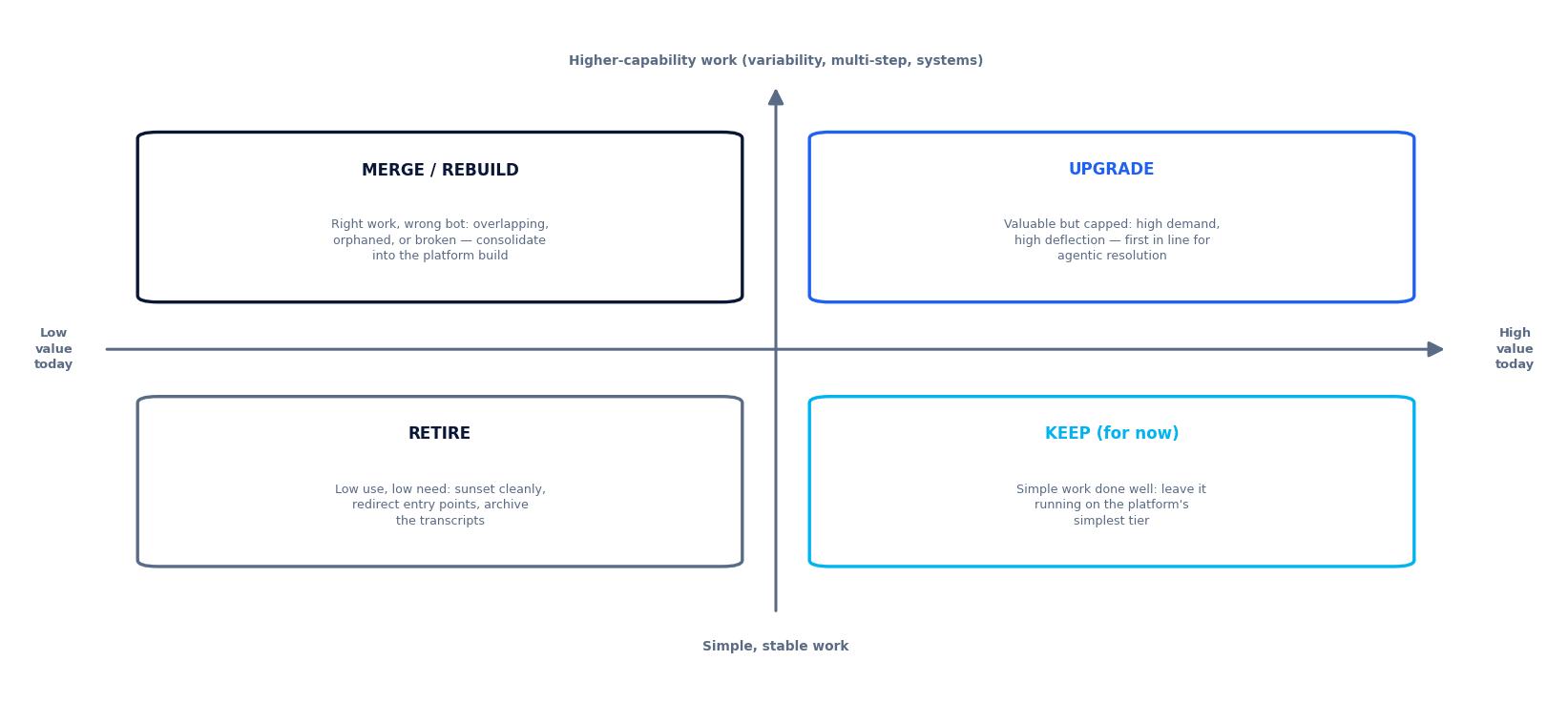
The estate audit quadrant. NiCE estate triage framework.
Two questions sort the whole estate: does this bot deliver value today, and does its work need more capability than it has? Upgrade the valuable-but-capped — high demand, high deflection, intents that fail only at completion; they head the agentic queue. Merge or rebuild the right-work-wrong-bot cases — overlapping bots answering the same intents differently, orphaned flows, brittle builds — consolidating their intents into the platform build rather than porting their defects. Retire the low-use, low-need stragglers cleanly (stage 5 covers how). Keep, for now the simple work done well: the store-hours bot that answers store hours perfectly should not be re-engineered out of fashion — it runs on the platform's simplest tier until evidence says otherwise, the level-matching discipline of the automation spectrum applied to conversations. Rescope on evidence, not age: the newest pilot may deserve retirement and the oldest FAQ bot may deserve tenure.
Stage 3 — Re-Platform: Land Once, Migrate Once
The estate's chronic disease is fragmentation — knowledge, context, and governance scattered across generations of tooling — and the cure is a single landing zone before the capability work begins: one platform hosting both generations, so the simple keepers and the new agents share knowledge, context, quality standards, and governance from day one. Selection has its owners — the vendor guide for the chatbot market view and how to choose an AI contact center platform for the full evaluation method — but the migration-specific requirements are three: the platform must run the whole capability range (so keepers stay cheap while upgrades go deep); it must carry one context and knowledge spine across all of it; and it must import your assets — intents, entities, flows, transcripts — rather than demanding you retype your history. Migrate the foundations once: knowledge consolidated and de-contradicted (the audit will have found the contradictions), integrations rebuilt as governed connectors, and the analytics baseline carried over so before-and-after is provable.
Stage 4 — Upgrade in Waves: Intents, Not Bots
The unit of upgrade is the intent, not the bot. Wave by wave, move intents from answer-and-deflect to agentic completion where the readiness gates pass — the same four gates every deployment in this library runs: volume, written policy, data reach, verifiable completion. Each upgraded intent launches contained, measured against its own audited baseline, with escalation designed per the handoff discipline and improvement run per the training lifecycle. Sequence by the audit's demand list: the intents customers most often asked bots to finish are the waves that pay fastest and prove most. And resist the completeness itch: intents that pass no gate stay at the level they've earned — a migration that upgrades everything upgrades nothing well.
Coexistence: The Customer Must Never See the Org Chart
Coexistence: Running Old Bots and New Agents During the Transition
The customer must never see the org chart — three rules keep the estate coherent mid-migration
- One front door
A single entry experience routes each intent to whichever generation handles it best — customers never choose between bots. - One context spine
Conversations crossing generations carry identity and history — the legacy bot's transcript reaches the new agent, and vice versa. - One scoreboard
Old and new measured on the same resolution-first metrics, so migration decisions — and bragging rights — rest on comparable evidence.
Transitions measured in quarters are normal; transitions where customers feel the seams are design failures.
Three coexistence rules for the transition. NiCE coexistence framework.
Real migrations run mixed estates for quarters, and the design goal is that only the operations team knows it. One front door: a single entry experience routes each intent to whichever generation handles it best — customers state their need; the routing does the archaeology. One context spine: identity and history travel across generations in both directions, so an escalation from a legacy flow reaches the agent (human or AI) with the same completeness as one from the newest deployment. One scoreboard: both generations measured on identical resolution-first metrics, so wave decisions rest on comparable evidence — and so the new agents must actually beat the old bots' numbers, not just their aesthetics. Coexistence run this way converts the migration from a leap into a gradient.
Stage 5 — Retire and Redirect: End Cleanly
Superseded bots deserve deliberate deaths: entry points redirected (the web widget, the IVR branch, the deep links in old emails), transcripts and analytics archived with lineage so year-over-year measurement survives, knowledge merged rather than duplicated, credentials and connectors revoked, and the owner's name struck from an on-call rotation somewhere. The estate's headcount should fall as its capability rises; a migration that only ever adds bots has merely modernized the sprawl. Close each retirement with the number that justifies the whole path: the intents this bot could only deflect, now completed end to end by its successor — the metric the entire upgrade is accountable to, validated against your baseline with the AI value calculator.
The Upgrade Owner's Checklist
- Audit from transcripts, not documentation — the estate's real intents and outcomes live in what customers actually typed.
- Triage every bot into the quadrant — and defend the keepers as firmly as the upgrades.
- Land the platform before the capability work — one knowledge spine, one context object, one governance plane, assets imported.
- Upgrade intents, not bots, through the four gates — each wave contained, baselined, and measured on completion.
- Run coexistence on the three rules — one front door, one context spine, one scoreboard.
- Retire loudly — publish each sunset's before-and-after; the retirements are the migration's proof.
What Carries Over — and What Shouldn't
Migration anxiety usually centers on sunk cost, so it helps to be precise about which assets genuinely transfer. Carries over: the intent taxonomy and its volumes (your demand map is platform-independent and hard-won); the transcripts (training and testing gold, and the audit's evidence base); the knowledge content, once de-contradicted; the integration *requirements* (what systems must be touched, even where connectors get rebuilt governed); the persona and tone decisions, per the conversation design assets; and the escalation pathways your human team already trusts. Should not carry over: the accumulated flow spaghetti (migrating a decade of patches ports the defects); the deflection-era metrics and their targets (the new scoreboard is resolution-first, and old bonuses tied to containment actively fight the migration); orphaned intents nobody can explain; and the shared service accounts and scraping hacks the governed platform exists to retire. The rescope quadrant makes these calls bot by bot, but the principle is portable: migrate the evidence and the decisions, rebuild the machinery. Teams that internalize this stop experiencing the upgrade as abandoning their investment and start experiencing it as finally cashing it in.

Discover the full value of AI in CX
Understand the benefits and cost savings you can achieve by embracing AI, from automation to augmentation.
Conclusion
Inherit the estate, audit it honestly, and walk the five stages: triage, land once, upgrade by intent, coexist invisibly, retire loudly. The prize is concrete — the requests your customers kept asking bots to finish, finally finished. NiCE's platform was built to host the whole journey: your simplest keeper and your most ambitious agent, on one foundation, from the first audit to the last retirement.
Explore Agentic Experience Automation
Continue Exploring AI Chatbots for Business
- AI Chatbot Business hub — The complete guide to AI chatbots for business.
- AI agents vs. chatbots for customer service — The capability comparison that motivates the path.
- AI chatbot vendors — The market view for the re-platform stage.
- How to implement an AI chatbot for business — The per-deployment discipline each wave runs.
- Chatbot conversation design — Carrying the design assets across the upgrade.
Frequently Asked Questions About From Chatbot to AI Agent: The Upgrade Path

Ready to experience the power of one platform?
Let us show you how NiCE can unify, automate and elevate your entire customer experience - with AI at the core and outcomes at the forefront.