
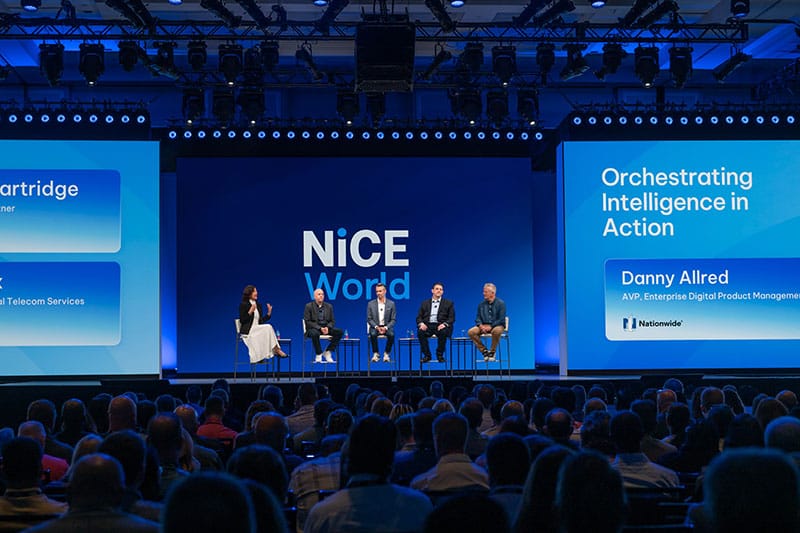
Four enterprise leaders took the main stage at NiCE World 2026 to talk about orchestrating intelligence, and why the milestone that matters is what happens after launch day.
Every enterprise now has an AI pilot underway somewhere in the business. What boards are asking for is proof that the pilot changes what customers experience and what the business earns. Customers, meanwhile, have stopped waiting to be impressed: one 2025 industry analysis says 68% expect a brand to solve a problem before they call, and say they'll switch when that doesn't happen.
That's the tension sitting on every CX, CIO, and CCO desk right now: customers who expect a brand to already know what they need, and customers who remain skeptical of the systems trying to do that.
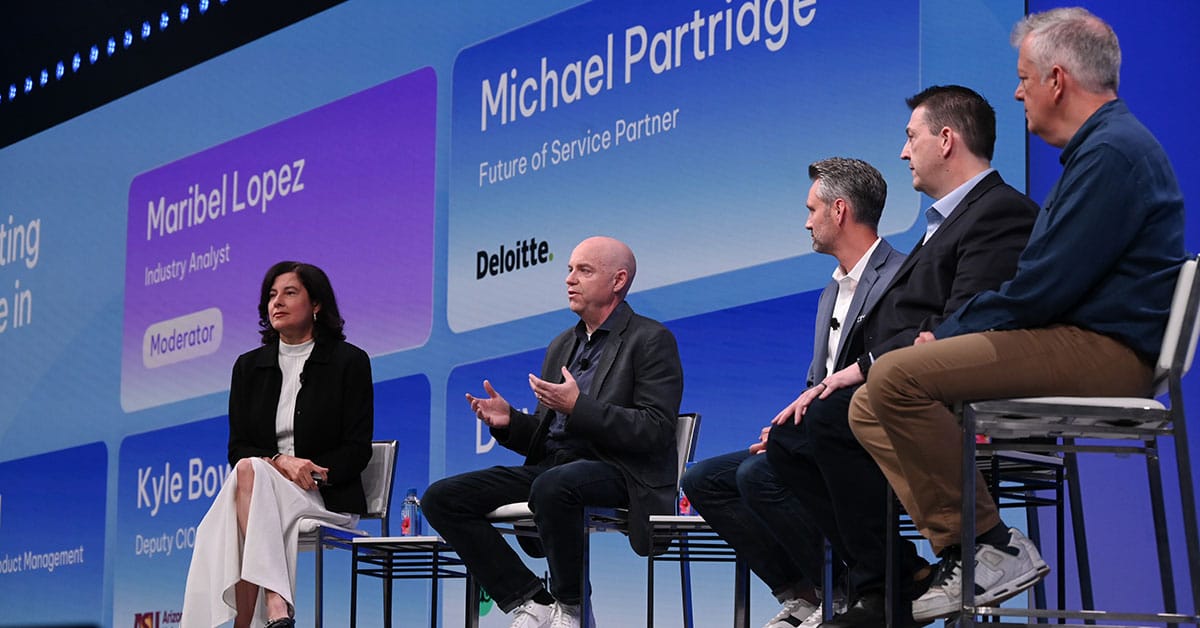
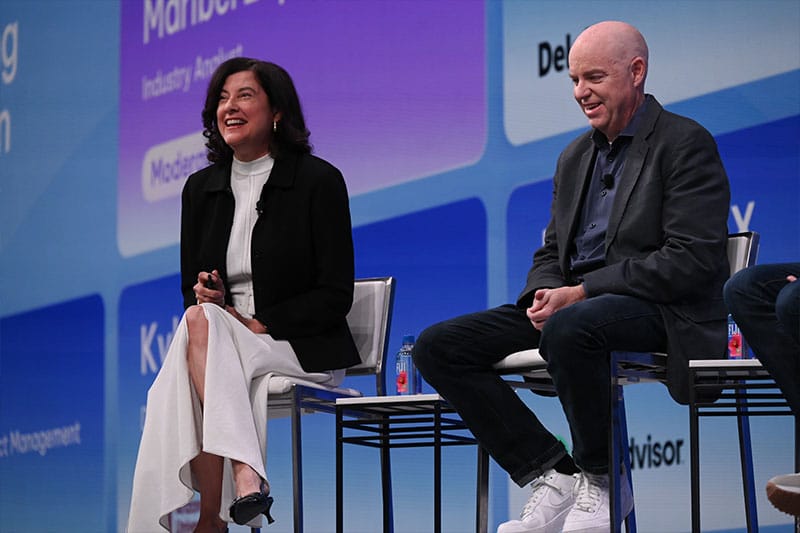
That was the backdrop for a panel at NiCE World 2026 moderated by Maribel Lopez, founder of Lopez Research and a longtime industry analyst covering enterprise AI. Lopez opened by reframing what the conversation was about.
“We're not just talking about the tools, not just the automation, but the human intelligence, the artificial intelligence, the customer intelligence, and the operational intelligence all coming together and all working as one," Lopez said, introducing Dave Fox of Tripadvisor, Danny Allred of Nationwide, Kyle Bowen of Arizona State University, and Michael Partridge of Deloitte.
Lopez's first question to the panel was the familiar one: when did AI move from pilot to production? The four leaders described what happens to a business after that milestone when orchestrated intelligence stops being a project and starts changing what the contact center is for. It’s as NiCE CEO Scott Russell said in his NiCE World keynote, the front line becomes a growth line.
“We also heard a lot more from NiCE about what it looks like when humans and AI are generally working together and genuinely making the right decisions for our customers,” Lopez said. “I want to spend some time talking to the panelists, not just about the technology. I want to talk to them a little bit about what this does to their organizations, not just metrics, but how people work, what they focus on, what can become possible that hasn’t happened before.”
When intelligence acts first
Kyle Bowen's team at Arizona State University offered clear evidence of what happens when intelligence acts before a customer. In this case, a student never has to pick up the phone. ASU's experience center fields more than 1 million contacts a year, historically measured purely by call volume. Bowen's team changed what they measure.
“Using AI, looking across our data sets, we can begin to predict when students are going to have a challenge, because we can largely see it before they can," Bowen said. “What this does is change the place where our experience center sits inside the organization and makes it so that we can work proactively to resolve some of these issues before they emerge.”
The results: 85% of students who were contacted proactively took action on that outreach, fewer than 1% of those contacts generated an inbound call, and the calls that did come in ran about half as long, because students arrived already informed. That single shift shows up as lower cost to serve, higher satisfaction, and fewer students left to solve a problem alone.
From serving demand to creating capacity
Danny Allred’s team at Nationwide created capacity that didn't exist before. Nationwide built an AI agent specifically to reach customers and prospects human team couldn't get to.
“The metric that ends the debate is being able to show that we can achieve outcomes that are above and beyond our current human capacity, so we can get opportunities that just don't exist today,” Allred said. Every prospect conversation Nationwide’s team had trouble scheduling is now a conversation the company is having.
Just as Scott Russell’s NiCE World keynote addressed, organizations can reframe AI in the contact center as a growth function.
For example, there was a related pivot at Tripadvisor where AI took over routine intent capture ahead of the company's peak summer travel season so agents could focus on higher-value work.
“We do take out complexity from anything we decided to do and build on what we'd already spent a lot of time putting together: a platform that helps us have those interactions in one place,” Fox said. “Then we could identify the right use cases, which we could automate or augment.”
Today’s business case now includes which conversations a company can afford to have that it couldn't before, and what those conversations are worth in retained accounts, new business, and expanded relationships.
Trust as a precondition for speed
None of that added capacity matters if customers don't appreciate it.
Early in its rollout, a prospect told Nationwide he was unhappy an AI agent had called him.
“We learned that we had to be radically transparent about the use of AI, and when a human was going to come in and assist them,” Allred said.
After Nationwide rebuilt disclosure into every call, negative feedback about the AI agent dropped to zero. Allred described a customer who later spent 5 minutes talking with the AI agent unprompted.
“That's not possible today with existing technology,” Allred said. “That's the customer experience that's extraordinary care beyond what our humans are able to do today.”
Michael Partridge, who works with regulated industries at Deloitte, pointed out that this kind of trust is a precondition for speed, not an obstacle to it.
"The question is, can you use it, should you use it, can you use it right now — it's fundamentally a question of trust," Partridge said, describing how organizations decide which data and use cases are ready for AI.
He added that treating governance as friction only creates additional obstacles: “There is a tendency out there to look at that as a barrier or something to be worked around, but think about the implications of not doing that right from the start, and then getting in trouble later. You're not back at square one, you're behind the starting line.”
For a C-suite leader deciding how fast to move, governance should be viewed as the discipline that lets a rollout survive contact with real customers.
Prepare for momentum that starts after CX AI launch day
Every leader on stage described launch as the point where the real work started. Tripadvisor's voice AI assistant is now outperforming human agents on intent capture and customer sentiment.
Fox called sustaining that performance an open-ended job.
“It's a job which is really like painting the Golden Gate Bridge,” he said. “You never stop, you're constantly learning, iterating, and bringing on new things, and the process is endless. The opportunities are really cool, and it's going to be fun doing it.”
Allred described what that ongoing work requires organizationally.
“This is not a web or mobile app that you set, you monitor, and you can almost forget it,” he said. “You have to have a team that is dedicated and monitoring and looking at these experiences on a regular basis and changing those prompts and changing the experience as consumers are interacting with it.”
That is what orchestrating intelligence looks like in practice: customer intelligence surfaces what someone is trying to do, operational data shows where a journey is breaking down, AI acts on the routine parts of that signal, and a human team continuously adjusts the logic behind it. Each of those four pieces depends on running continuously, as a loop rather than a one-time deployment.
One platform running underneath every CX interaction
None of the leaders described their results as the output of a single tool. Fox credited Tripadvisor's speed (45 days from kickoff to a live voice AI assistant) to a CX AI platform the company had to bring every customer interaction into one place, which let his team identify which conversations could be automated, which needed a person, and hand off context between the two instead of losing it. Tripadvisor has the kind of shared CX architecture that makes journey visibility and closed-loop insight possible across channels, rather than trapped inside a single bot.
Partridge made the organizational version of the same point.
“The biggest key to success is definitely commitment,” Partridge said. “Organizations have to be committed to making changes to the way that they work.”
A CX AI platform can carry human intelligence, artificial intelligence, customer intelligence, and operational intelligence into one workflow. Whether an organization works differently once that workflow exists is a separate decision, and Partridge argued it's the one that determines whether any of it pays off.
Lopez closed the insightful NiCE World main stage panel by naming what separated these four organizations from everyone still tracking pilot metrics.
“The companies are winning,” she said. “They're not just companies that have deployed the most tools. They’re the ones who've made it all work together: the tools, the data, the people, the platform.”
A CX growth line is ready for those who move on it
The four organizations on the NiCE World stage didn’t just win by simply celebrating a deployment. They won by building a system that keeps learning from every interaction and keeps getting more valuable to the business running it, turning what the industry has measured for two decades as a cost center into the growth line Scott Russell described at NiCE World 2026. Read more NiCE customer success stories.
If your contact center still reports up as a cost to contain, a competitor is already turning theirs into a growth line.