

Enterprise adoption of AI is rapidly increasing. Across industries, customer support leaders are seeking ways to move from experimenting with AI to integrating it into real operations. The business and technology insights company Gartner® expects that “33% of enterprise software applications will include agentic AI by 2028, up from less than 1% in 2024.[1]
There appears to be a broad, strategic shift from curiosity to core strategy. AI should be everywhere by now. But in reality, something isn’t working.
Alongside projections of growing adoption, “Over 40% of agentic AI projects will be canceled by the end of 2027, due to escalating costs, unclear business value or inadequate risk controls, according to Gartner, Inc.”[2]
MIT research shows that 95% of generative AI pilots fail, never making it to production. The key reason is the lack of learning, integration barriers, and workflow misalignments.
In other words, technology is not really the one to blame here. The tools are powerful. The data exists. Even the funding is often there.
Instead, AI fails when it’s introduced as a standalone capability rather than embedded into how work actually happens. To understand why, let’s examine a domain that has become a proving ground for operational AI: outbound call centers.
Here are five recurring reasons that AI projects fail, and what organizations can learn from outreach models to get it right.
1. When AI lives outside the work, adoption stalls
One of the most common reasons organizations struggle with AI initiatives is deceptively simple: AI lives outside the flow of work. It’s a separate interface. A dashboard. A side panel. An additional tool to proactively consult. The burden falls on humans – and in busy environments, that rarely happens.
This disconnect shows up everywhere. In healthcare, AI models flag patients at risk of missing follow-ups or developing complications, but clinicians must leave their electronic health record to review alerts. During a packed shift, those insights often go unseen. In retail, AI predicts churn or recommends offers, but frontline employees don’t see those insights during the customer interactions that could benefit from them. In manufacturing, predictive maintenance models exist, but they’re not integrated into daily work orders, so teams still respond reactively.
In contrast, AI tools for proactive customer outreach succeed where others falter because AI is integral to the work itself.
AI is embedded in campaigns, queues, tasks, and conversations, not parked in a separate system. Whether a sales rep is following up with a lead, a lender is nudging an applicant to complete documentation, or a collections team is coordinating payment reminders, AI shows up exactly when and where execution happens.
Training and mandates can force adoption, but they don’t create momentum. Momentum comes from eliminating friction. Our recent blog highlights this clearly, demonstrating how agentic AI drives adaptive responses to customer needs in real-time conversations.

2. Automation without context creates friction, not value
Another major reason AI initiatives fail is over-automation without enough context. At scale, automation can quickly become harmful if it ignores where customers are in their journey, what they’ve already experienced, or what they actually need next.
This mistake appears across nearly every industry. In banking and lending, for example, applicants receive automated reminders even after they’ve already submitted the required documents, creating confusion and eroding trust. In e-commerce, customers are retargeted with ads for products they already purchased or returned. In B2B sales, prospects continue receiving automated communications that don’t reflect recent meetings, objections, or readiness signals.
In all these cases, the automation is functioning as designed, but it lacks situational awareness.
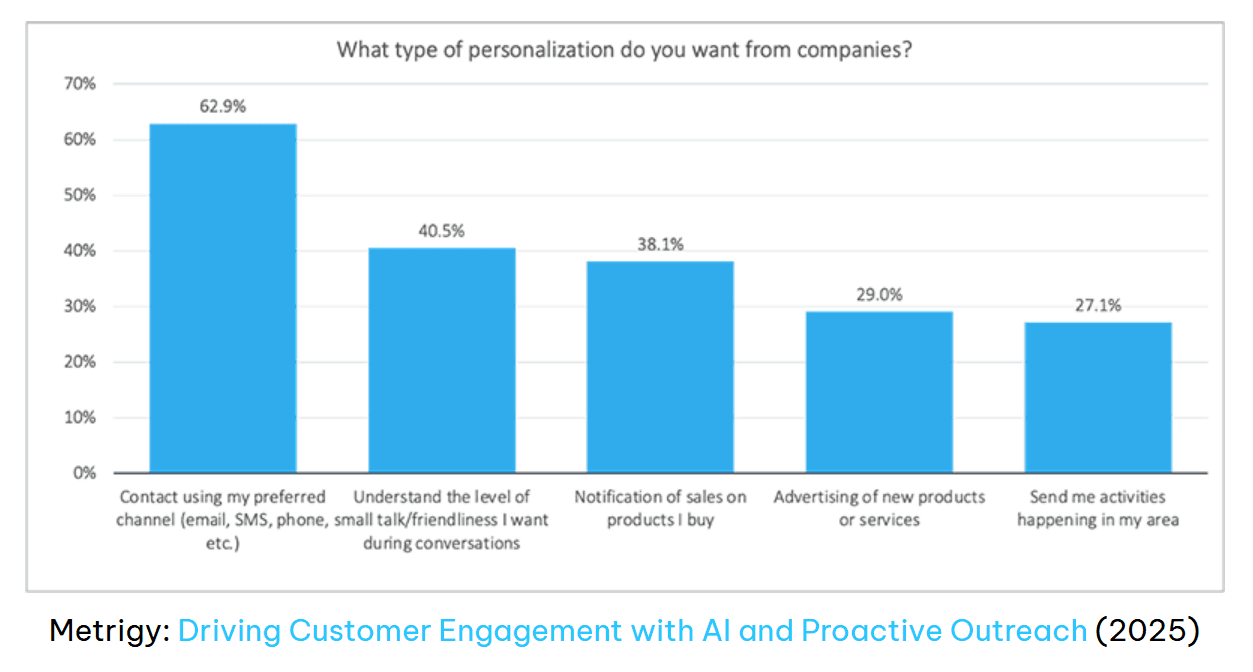
Outreach models, in contrast, are built around where a customer is on their journey, what’s already happened, and what outcome is required next. Customer preferences – including timing, channel of choice, prior interactions, consent, and intent – influence the next action.
Outreach, when done well, feels helpful instead of intrusive, even when it’s automated. Reaching for that goal has made customer outreach one of the earliest real-world applications of agentic AI. Functioning as much more than a chatbot, it is capable of deciding what to do, when to do it, and when to hold back.
As Metrigy research clearly indicates, consumers tend to value outbound calling when it provides them real value and is done on their terms.
3. When compliance is an afterthought, AI never scales
In regulated industries, AI often hits a wall called risk. Leaders worry about regulatory violations, consent management, over-contacting customers, auditability, and reputational damage. As a result, many AI initiatives remain stuck in perpetual pilot mode — tested but never trusted enough to scale.
In healthcare, patient engagement tools are constrained by privacy and data governance requirements. In utilities and telecom, over-communication leads to complaints, churn, or regulatory scrutiny. In public sector organizations, AI engagement stalls due to transparency and accountability concerns.
When compliance is treated as a manual checkpoint or a post-processing task, AI becomes risky. Teams slow down. Legal reviews pile up. Innovation stalls.
In customer outreach, compliance isn’t bolted on; it’s built into the flow. Consent enforcement, frequency controls, channel eligibility, and audit trails are handled automatically, in real time, as part of execution.
This is one of the most overlooked lessons in AI adoption: risk-aware design doesn’t slow innovation. It enables it. When teams trust the system to protect them, not impede them, they move faster.
4. AI fails without limits
Another common failure point is AI systems that can’t step aside. Automation is powerful for routine actions, but it can quickly degrade experiences when human judgment is required and AI continues anyway.
This happens more frequently than you might think. Such as when customer support bots persist with scripted responses even as frustration escalates. Healthcare triage systems miss emotional or complex cues that require clinician involvement. Sales automation continues after a prospect signals readiness for a live conversation.
In each such scenario, the issue isn’t automation itself. It’s the absence of intelligent escalation.
Outreach models handle this better because human-in-the-loop isn’t an exception. It’s a design principle. AI handles routine tasks, surfaces signals, and recommends next steps. Humans step in when nuance, empathy, or judgment matter most.
Rather than replacing people, proactive AI outreach empowers them. It accelerates the work that can be automated and gets out of the way when human involvement leads to better outcomes.
5. When AI isn’t tied to outcomes, trust erodes
AI projects fail not because they perform poorly, but because they can’t prove their value. Too often, AI success is measured by activity metrics - number of automated actions, model accuracy, or tool usage.
But businesses don’t win on activity. They win on results.
This gap shows up when marketing teams deploy AI content tools, but pipeline impact remains unclear. Sales organizations may increase touches through automation, but conversion rates stagnate. Healthcare providers introduce engagement tools, but the adherence rate doesn’t increase. Collections teams increase contact volume, but recovery rates don’t improve.
Without a clear connection to business outcomes, AI initiatives become vulnerable during budget reviews.
Outreach, on the other hand, is inherently outcome-driven. Its success is measured by completed applications, reduced abandonment, accelerated deal cycles, improved recovery, and fewer complaints. Because outreach sits at the intersection of customer action and business value, it forces AI to prove itself where it matters most.

The AI blueprint: 6 practical steps
Proactive outreach offers a blueprint in which AI is operational, trusted, and measurable. That combination ensures that advanced solutions like agentic AI can move from promise to production.
Now you may be wondering: where do I start?
Most teams rush to deploy new technology before they truly understand where value will come from. The most successful outbound call center organizations take a different approach: they slow down at the start so they can move faster – and more profitably – later.
- Observe your agents
Begin by watching agents do their jobs in real time. Sit in on live interactions, review call recordings, and observe how agents move between systems, scripts, and channels. Pay close attention to moments of hesitation, screen switching, manual note-taking, or repeated questions. These friction points often signal lost productivity, higher error rates, and poor experiences for both agents and customers. - Map friction and complexity end to end
Once you’ve observed the workflow, map it from start to finish. Identify unnecessary steps, duplicated actions, manual data entry, and gaps in context. This exercise helps teams distinguish between problems caused by process, technology, or unclear ownership, and prevents automation from simply scaling inefficiency. - Define clear KPIs and ROI before making changes
Before launching anything new, align on how success will be measured. Establish baseline KPIs and set clear targets tied to outcomes, not activity. Focus on metrics such as handle time, after-call work, resolution speed, error reduction, agent adoption, and customer response or conversion rates. Clear ownership and a regular measurement cadence are critical to proving return on investment (ROI). - Start with one high-impact use case
Choose a single, high-frequency workflow, such as follow-ups, payment reminders, application status updates, or missing-information requests. Starting small allows teams to validate assumptions, demonstrate measurable impact quickly, and build confidence for broader rollout. - Design for agents first, not automation
Technology should reduce cognitive load and help agents act with confidence. Prioritize clarity, speed, and usability on the agent desktop. If agents don’t trust or understand the workflow, adoption – and ROI – will stall. - Build guardrails, pilot, and scale deliberately
Define compliance rules, escalation paths, and human-in-the-loop moments upfront. Run a focused pilot, track performance against your baseline, gather feedback, refine quickly, and then scale across teams and journeys with confidence.
Successful AI adoption starts with discipline, not technology. Adopt that approach and you can turn AI and automation into a competitive advantage.
Start unlocking best practices for stronger, successful outreach with CX AI
[1] Gartner: Gartner Predicts Over 40% of Agentic AI Projects Will Be Canceled by End of 2027 (June 25, 2025)
[2] Ibid. GARTNER is a trademark of Gartner, Inc. and/or its affiliates.