

Knowledge management may be evolving fast, but KMWorld 2025 made one thing clear: the future of KM isn’t just about AI, it’s about people empowered by AI.
Across sessions, vendor demos, hallway conversations, and keynotes, the recurring message was unmistakable: technology alone can’t transform your knowledge ecosystem. The organizations winning today are creating accurate, relevant, timely knowledge experiences, not more documents, not more tools, and not more chaos.
KMWorld revealed a clear shift in enterprise knowledge management: success is no longer about deploying generative AI, but about building trustworthy, governed, context-aware knowledge systems that people and AI can rely on.
Knowledge management in customer experience (CX)
Knowledge management (KM) is the discipline of organizing, sharing, and governing information so employees and customers can access accurate, relevant answers when they need them. In the context of customer service, KM ensures that AI and human agents deliver consistent, trustworthy information.
Here are the 10 most meaningful insights from KMWorld 2025, and why they matter for CX leaders, KM professionals, digital transformation teams, and IT leaders responsible for deploying enterprise AI at scale.
1. Accuracy and relevance now take center stage in AI-powered knowledge management
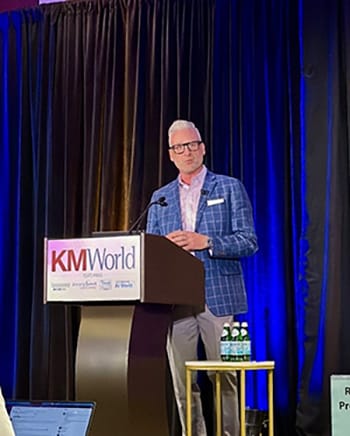
A major shift from previous KMWorld events is how conversations are no longer as basic as, “What is generative search?”
Experts are talking about faithfulness (ensuring AI responses reflect verified source content), and relevance (delivering the right information in the right context), along with hallucination prevention, grounding, citations, and evidence-based answers.
Experts also focused on:
- Semantic architecture - Content organized by meaning
- Context-aware retrieval - Answers matched to intent
- Vector search vs. keyword search - Meaning vs. exact matches
- Enterprise AI guardrails - Controls for secure AI use
- Retrieval-augmented generation (RAG) reliability - AI grounded in verified sources
This evolution benefits everyone. It means organizations can pursue AI-augmented knowledge strategies with mature, grounded expectations, not buzzwords.
2. Change management, not GenAI, is still the hardest part to scale
One consistent theme emerged: most generative AI initiatives aren’t failing because of technology. They’re stalling because organizations are still operating with manual, outdated content processes that don’t scale.
Content managers repeatedly described the same internal challenges, such as hand-tagging metadata, manually reviewing all content updates, one-off SME reviews, unclear ownership and accountability, and siloed systems and uncontrolled version sprawl.
Generative AI can accelerate knowledge work, but it can’t compensate for broken processes. KM leaders that are aligned in governance, ownership, and change management will be the biggest determinants of success. If organizations don’t fix how content is created, maintained, reviewed, and retired, even the most advanced GenAI will struggle to deliver value.
3. Document processing is back: AI is only as good as your input
Document processing had a renaissance at KMWorld. And by document processing, we’re talking about the very unglamorous work of taking boxes of paper, scanned PDFs, and old files and turning them into clean, usable digital knowledge.
Why? Because enterprises have decades of scanned PDFs, paper archives, inconsistent formats, legacy documentation, and unstructured knowledge.
AI systems can’t extract meaning from what they can’t parse.
The future of knowledge management is in intelligent document classification, processing, and universal question-answering.
The lesson: clean, structured inputs create reliable generative outputs. And organizations are finally taking that seriously.

4. Every keynote repeated the same message: AI needs the human element
AI alone does not deliver trustworthy knowledge. What does? People. Oversight. Governance. Judgment. Nuance.
AI systems require:
- Human validation
- Human-in-the-loop workflows
- Human-owned governance
- Human context
Technology accelerates KM, but it doesn’t replace critical thinking. This blended model: human + AI is emerging as a sustainable future.
5. AI fails when knowledge fails
In one of the more thought-provoking sessions, a speaker raised the question: “Are we in an AI bubble?”
This hits differently when paired with new research. According to MIT’s GenAI Divide study, 95% of enterprise pilots showed no measurable ROI - not because of model quality, but because of workflow, context, and knowledge gaps. Even more striking: MIT found the issue was not model quality, but:
- Lack of workflow integration
- Lack of context
- Poor change management
- Unclear business outcomes
- Fragmented knowledge
Organizations cannot skip the foundational KM work and expect AI to succeed.
6. In the agentic revolution, context is everything
A standout concept is the agentic revolution, where AI agents autonomously complete tasks, update knowledge, generate new content, trigger workflows, and act on behalf of users. In practical terms, agentic AI means software that doesn’t just answer questions - it takes action inside enterprise systems.
Agentic AI represents the next evolution of artificial intelligence, moving beyond prediction and automation to autonomous decision-making and action. Unlike traditional AI, it can reason, plan, and act dynamically based on real-time data and context.
The key KMWorld takeaway: Without a strong AI platform, agentic systems become unpredictable - and potentially risky.
Agentic systems require the following to be effective:
- Metadata - Content descriptors
- Taxonomies - Structured content categories
- Semantic layers - Context added to content
- Strong governance - Clear rules and ownership
- Vector-indexed content - Content indexed by meaning
- Enterprise rules - Built-in policy controls
Or else they become unpredictable.
Agentic AI is powerful, but only when grounded in clean, contextualized knowledge ecosystems.
7. Trust is becoming the core metric
Multiple KMWorld sessions cited the MIT GenAI Divide report on generative AI adoption in business. The biggest takeaways show trust gaps are widening.
- Users don’t trust generic AI output
- Executives don’t trust AI ROI claims
- Customers don’t trust low-quality content
This is why faithfulness and relevancy were such dominant themes. If you can’t prove that answers are grounded in authoritative knowledge, you can’t scale AI in the enterprise.

8. ‘Turn ROT into ART’ - The best metaphor of the entire conference
One speaker delivered what might be the most memorable line of KMWorld 2025: “Turn ROT into ART.”
ROT = Redundant, Obsolete, Trivial
ART = Accurate, Relevant, Timely
This simple idea perfectly captures the mission of modern knowledge management: don’t create more content, transform what you have into something useful. In CX, this means transforming outdated or redundant content into accurate, relevant, and timely knowledge that empowers agents, improves customer experiences, and drives measurable outcomes.
For organizations overwhelmed by years of forgotten documentation, it’s a powerful rallying cry.
9. Content readiness is the new competitive advantage
A recurring theme in product demos and customer case studies: the organizations succeeding with AI are those that prepare their knowledge.
Successful teams are:
- Rationalizing content - Reducing overlap and sprawl
- Standardizing formats - Consistent content structure
- Cleaning up metadata - Accurate, usable labels
- Using AI to identify duplicate content - Automated duplicate detection
- Building stronger taxonomies - Better content organization
- Establishing true content ownership - Defined accountability
- Implementing relevance scoring - Ranking the best answers
- Automating version control - Always-current content
In other words: AI amplifies whatever state your content is in. If your content is chaotic, AI will amplify chaos. If your content is structured, clean, and contextual, AI will amplify value.
10. The future of KM belongs to those who combine people, process, and AI
The biggest takeaway from KMWorld 2025: the next era of KM isn’t about replacing people, it’s about empowering them.
The organizations getting the most value are those that combine:
- Context-aware generative search
- Human-in-the-loop oversight
- Strong governance & change management
- Structured content & metadata
- Automated document processing
- Agentic workflows
- Continuous feedback loops
A true knowledge management strategy means building an ecosystem.

Effortless knowledge discovery. Faster decisions. Greater trust. Better outcomes.
These trends explain why traditional knowledge bases, standalone search tools, and disconnected AI pilots are failing.
Enterprises need a unified knowledge foundation that connects content, context, governance, and AI - with intelligent search and instant answers that resolve issues before they become problems.
If your organization wants to unlock the power of AI, whether generative search, knowledge agents, or intelligent automation, the path is clear:
- Clean your content
- Strengthen your governance
- Adopt human-AI hybrid models
- Prioritize context
- Turn ROT into ART
KMWorld’s insights reaffirm what we at NiCE have long understood: successful AI initiatives are built on trusted knowledge, strong governance, and human-centered design.
Discover how our unified AI platform empowers smarter, more efficient knowledge management