

Customer experience is no longer just a support function, it has become a critical differentiator in today’s competitive business landscape. But that message isn’t reaching every business leader.
New research suggests only one-third of organizations are equipped with the unified data foundation needed for AI-led CX. That means too many companies risk falling behind as customer expectations accelerate.
MIT Technology Review Insights’ latest report: The Connected Customer exposes more about that widening “experience divide” with next steps for organizations looking to lead in the next wave of service transformation, combining personal connection, AI capabilities, and orchestrated workflows to deliver seamless, personalized customer experiences.
The report offers action items for closing that gap with an AI-first foundation. Below, we highlight four top insights that reveal where CX is heading, and why the next era of customer service differentiation will belong to companies that connect people, data, and intelligence into a single experience ecosystem.
AI is the multiplier - but only for connected organizations
Consumers today are more informed and have higher standards than ever before. They expect personalized, immediate, and consistent interactions at every touchpoint.
In fact, seven in 10 consumers expected personalized interactions from companies as early as 2021, and that number is only growing as more and more people interact with AI engines.
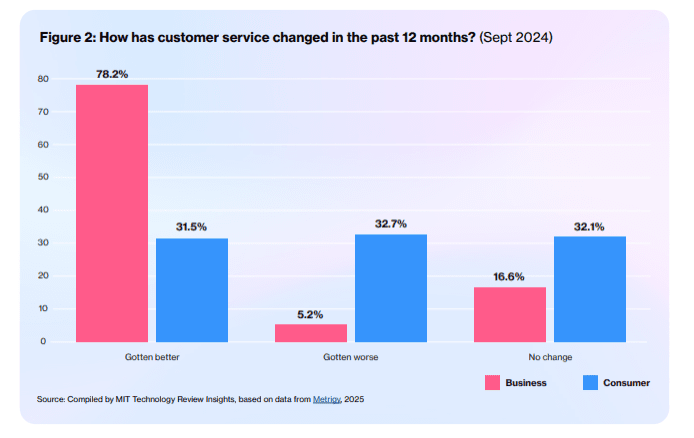
Yet, legacy systems and fragmented data remain major barriers. Research from Metrigy shows:
- 78% of businesses believe their customer service improved over the past year
- Yet only 31% of consumers agree
This gap underscores a fundamental challenge: many organizations dramatically overestimate the quality of their CX. And that miscalculation puts their business at a disadvantage.
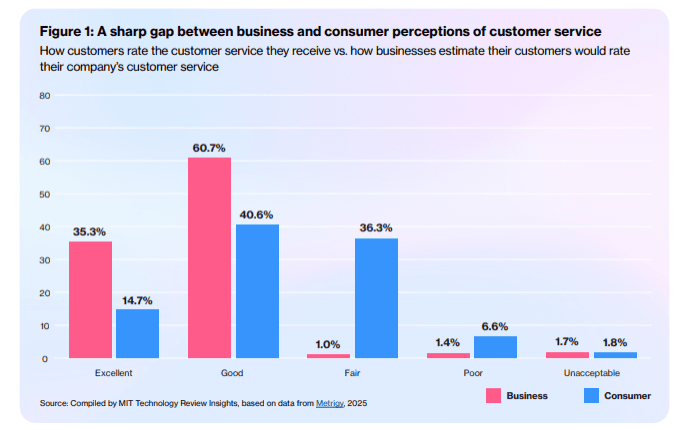
“There are a lot of gaps between how well businesses think they’re doing, and how well consumers think [businesses are] doing.”
- Robin Gareiss, CEO and Principal Analyst, Metrigy
AI presents a transformative opportunity, but only if it’s part of a unified platform. According to Gareiss, only about one-third of companies have a unified data core, and the rest struggle with splintered data sources. For the rest, fragmented systems create blind spots that limit AI’s ability to deliver true personalization or proactive service.
Fragmented data makes it impossible for AI to reach its potential. Without a unified foundation, it can’t deliver the personalization, speed, or proactive service customers have come to expect - and demand.
To understand what’s truly holding customer experience back, and what will define its future, consider these forces modernizing how AI learns, connects, and delivers.

Four key insights on the future of CX
1. A new loyalty curve powered by intelligence
AI is reshaping both customer interactions and employee experience, but adoption and impact vary widely. Organizations using AI effectively can reduce agent burnout by handling repetitive tasks, enable proactive service by predicting customer needs, and personalize interactions at scale.
“In the context of intense commodification, there’s not much difference in the products or services that brands are producing. Customer service is important as a way of differentiation and providing brand equity to counter that.”
- Andy Traba, VP of Product Marketing, NiCE
AI enables organizations to anticipate customer needs, surface hidden friction points, and streamline processes that slow service down.
2. Legacy systems are the real barrier
AI is a big part of the solution – if used in a coordinated end-to-end way. The real challenge lies in integrating multiple, disparate systems into a unified experience. When data lives in silos, AI hits a ceiling - and customers feel it.
Case in point: Lowe’s saved over $1 million in operational costs in just eight months by orchestrating multiple systems to work together seamlessly. Beyond cost savings, agent satisfaction improved significantly, demonstrating that integration does more than just improve operations. It improves the employee experience, which directly impacts CX.
3. Balancing human connection with AI
AI excels at automating repetitive tasks, freeing employees to focus on meaningful interactions and complex problem solving, but human connection remains irreplaceable. According to MIT, consumer reactions to AI-generated empathy are mixed:
- 42% appreciate it
- 20% find it frustrating
This confirms that certain moments still require a human touch - especially in emotionally sensitive or high-stakes situations.
AI tools can enhance agent effectiveness by:
- Synthesizing customer data across touchpoints
- Providing actionable insights in real time
- Supporting predictive decision-making for proactive service
“Automating mundane tasks can improve employee experience. AI can support the employee by synthesizing data and then making the data a searchable object in a database to support future predictions in CX,” Traba said.
Scaling personalization without losing the human touch requires solid frameworks for when to let AI handle interactions and when to escalate to humans.
4. Orchestration as a strategic advantage
Connected workflows and unified data cores aren’t just operational efficiencies, they are emerging as strategic differentiators. Organizations that orchestrate the customer journey end to end create experiences that feel seamless, even when complexity exists behind the scenes.
Case in point: Maps Credit Union reduced after-call work by up to 94% through automation and workflow integration, allowing employees to focus on value-added tasks.
Leading companies build connected workflows to increase efficiency, improve customer satisfaction, and gain a competitive edge.

What’s at stake: Trust, loyalty, cost, and competitiveness
Organizations that fail to modernize their customer experience risk falling behind competitors who are already leveraging AI, orchestration, and unified data to their advantage.
The gap between digitally mature and legacy-bound organizations is widening, and the implications go far beyond customer satisfaction—directly affecting loyalty, costs, brand reputation, and workforce effectiveness.
Disconnected systems erode trust. Customers expect seamless, consistent experiences across every interaction. When systems are fragmented or data is siloed, customers encounter delays, repeated questions, and inconsistent messaging. These gaps not only frustrate users, they erode trust in the brand. As AI matures, organizations with connected, intelligent platforms can deliver proactive, personalized experiences, while those bound by legacy systems will struggle to keep pace, risking lost revenue and customer churn.
Customer loyalty is earned - or lost - through experience. Personalized, frictionless service is no longer a nice-to-have, it’s a key differentiator. Companies that orchestrate AI and human insight across the journey can anticipate customer needs, resolve issues faster, and create memorable interactions. Organizations that fail to do so risk losing loyal customers to competitors who consistently exceed expectations.
Operational inefficiency undermines competitiveness. Fragmented workflows and redundant processes increase costs and slow response times. By integrating systems and automating routine tasks, companies not only reduce overhead but also free employees to focus on high-value interactions that drive revenue and engagement. Conversely, organizations that cling to legacy processes risk being outpaced by competitors that operate smarter, faster, and more efficiently.
Brand differentiation depends on exceptional CX. In markets where products and services are commoditized, customer experience is often the only way to stand out. For example, airlines with similar routes and prices often differentiate through superior customer service. Companies that leverage AI to enhance human interactions can create experiences that feel personalized, responsive, and genuinely human. Without this focus, brands risk being perceived as generic, transactional, or unresponsive.
Workforce transformation drives business resilience. Employees empowered with AI tools, clear workflows, and actionable insights spend more time solving complex problems and delivering meaningful customer interactions. Companies that fail to equip their teams with these tools risk low engagement, high turnover, and lost institutional knowledge, which ultimately undermines the customer experience itself.
In short, the business impact of connected, AI-driven CX is profound: organizations that unify systems, orchestrate workflows, and balance AI with human connection gain measurable advantages in customer loyalty, operational efficiency, brand perception, and workforce effectiveness.
Those that do not will face an increasingly steep competitive disadvantage, as the market rewards agility, intelligence, and connection at scale.
A vision for the future of CX
The future of CX will belong to organizations that connect people, data, and technology into a single, intelligent fabric. It’s not about replacing human empathy with AI, it’s about building connection through intelligence, enabling teams to deliver experiences that are both efficient and deeply human.
The MIT report offers a blueprint for that future. But leadership requires more than insight, it requires action. Now is the time for organizations to reimagine their architecture, empower their teams, and design customer experiences that delight, inspire, and endure.