


AI workflow automation is the use of artificial intelligence to design, execute, and continuously optimize sequences of business tasks — enabling organizations to automate repetitive decisions, route work intelligently, and process unstructured inputs at scale, without proportionally increasing human involvement. It is distinguished from traditional automation by its ability to adapt, learn, and handle variability.
The Clearest Definition of AI Workflow Automation
AI workflow automation uses AI models — including machine learning, natural language processing, and decision intelligence — to execute the logic connecting business process steps. Rather than following a fixed script, an AI workflow interprets what it encounters, decides what should happen next, and triggers the appropriate action. According to NiCE, AI workflow automation is applicable to 60–80% of business processes, compared to 20–30% for rules-based automation.
How AI Workflow Automation Differs From Traditional Automation
Traditional workflow automation (BPM, RPA) executes predefined scripts on structured inputs. It breaks when inputs change. AI workflow automation interprets ambiguous inputs, handles variable process paths, manages exceptions intelligently, and improves with every processed interaction. The fundamental distinction: traditional automation is static; AI automation is adaptive.
The AI Technologies That Power Workflow Automation
Four AI disciplines combine in production workflow automation: Natural Language Processing (reading and classifying text inputs), Machine Learning (prediction and routing optimization), Computer Vision (document extraction and form understanding), and Decision Intelligence (evaluating multiple variables to select optimal actions). Most enterprise workflow platforms combine all four.
AI Workflow Automation as an Architectural Approach
AI workflow automation is an architectural approach, not a single product. Organizations implement it through platforms that combine workflow orchestration with AI services, integration layers, analytics, and governance tooling. The goal: a business that runs faster, more accurately, and more adaptably — handling 60–80% of process volume with AI, reserving human attention for decisions that genuinely require it.
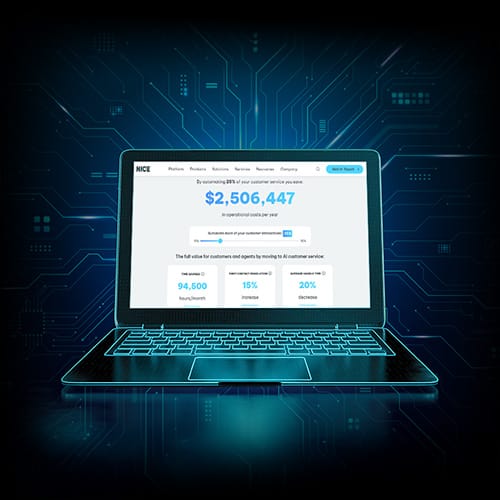
Discover the full value of AI in CX
Understand the benefits and cost savings you can achieve by embracing AI, from automation to augmentation.
Related pages
- AI workflow automation
- AI workflow automation software
- Best AI workflow automation tools
- Intelligent workflow automation
- AI-powered workflow automation
- Workflow automation AI
- AI workflow automation platform
- AI workflow automation examples
- AI workflow automation use cases
- How to automate workflows with AI
- AI workflow orchestration
- Generative AI workflow automation
- AI agents for workflow automation
- AI workflow automation vs RPA
- Benefits of AI workflow automation
- Agentic AI workflow automation
- AI workflow automation for contact centers
- Enterprise AI workflow automation
- AI workflow automation for customer service
- AI automated decisioning
- AI workflow automation for sales
- AI workflow automation for CX
- AI workflow automation ROI
- AI workflow automation for operations
- AI workflow automation for support
- AI workflow automation strategy
- AI workflow automation vs business process automation
- AI workflow automation for productivity
- AI workflow automation FAQs
FAQs

Ready to experience the power of one platform?
Let us show you how NiCE can unify, automate and elevate your entire customer experience - with AI at the core and outcomes at the forefront.