

AI agents are autonomous software systems that perceive their environment, plan sequences of actions, execute across tools and systems, and adapt when circumstances change — pursuing a defined goal without requiring a human to specify each step. In workflow automation, they represent the shift from 'execute this script' to 'achieve this outcome.'
How AI Agents Work in Workflow Contexts
AI agents for workflow automation operate through four components: a Reasoning Layer (an LLM that determines what actions to take given the current state and goal), a Tool Use Layer (APIs and integrations that execute those actions across real systems), a Memory Component (maintaining context across multi-step and multi-session workflows), and a Guardrails Layer (enforcing scope boundaries, escalation triggers, and compliance rules).
Where AI Agents Add the Most Value in Workflows
AI agents deliver the highest value in tasks requiring multi-system navigation, synthesis of information from multiple sources, and adaptive sequencing based on intermediate results. Customer service agents — handling account lookup, policy explanation, billing adjustment, and case resolution in a single automated session — are the most deployed enterprise use case.
Performance Benchmarks: What AI Agents Achieve in Production
According to NiCE, AI agents deployed for bounded customer service tasks achieve 85–90% autonomous resolution rates on supported transaction types within 6 months of deployment. This means 85–90% of interactions on those task types are fully resolved without human involvement — a step-change in automation coverage compared to scripted bots.
Deploying AI Agents Safely in Enterprise Environments
Safe enterprise AI agent deployment requires: clear scope definition (which tasks and systems the agent can access), explicit permission boundaries (what actions it can execute without human approval), comprehensive logging of all agent actions, and human escalation paths for low-confidence decisions or out-of-scope requests. Start bounded, validate outcomes, then expand scope.
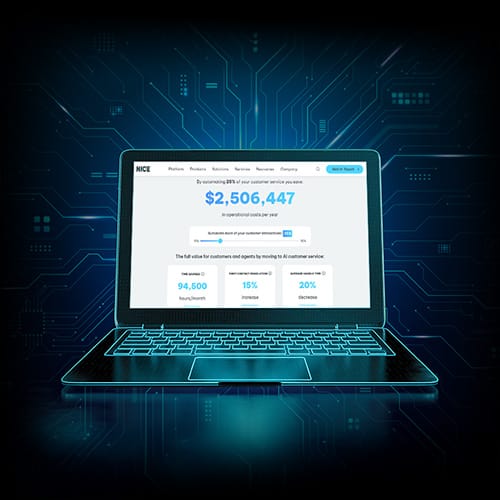
Discover the full value of AI in CX
Understand the benefits and cost savings you can achieve by embracing AI, from automation to augmentation.
Related pages
- AI workflow automation
- AI workflow automation software
- Best AI workflow automation tools
- Intelligent workflow automation
- AI-powered workflow automation
- Workflow automation AI
- AI workflow automation platform
- AI workflow automation examples
- AI workflow automation use cases
- How to automate workflows with AI
- AI workflow orchestration
- Generative AI workflow automation
- AI workflow automation vs RPA
- What is AI workflow automation
- Benefits of AI workflow automation
- Agentic AI workflow automation
- AI workflow automation for contact centers
- Enterprise AI workflow automation
- AI workflow automation for customer service
- AI automated decisioning
- AI workflow automation for sales
- AI workflow automation for CX
- AI workflow automation ROI
- AI workflow automation for operations
- AI workflow automation for support
- AI workflow automation strategy
- AI workflow automation vs business process automation
- AI workflow automation for productivity
- AI workflow automation FAQs
FAQs

Ready to experience the power of one platform?
Let us show you how NiCE can unify, automate and elevate your entire customer experience - with AI at the core and outcomes at the forefront.