

AI Workflow Automation vs Business Process Automation
What's the Difference?

Business Process Automation (BPA) and AI workflow automation both reduce manual effort in business processes — but they differ fundamentally in what they can automate and how. BPA executes defined, rules-based process sequences on structured inputs. AI workflow automation handles variable, judgment-intensive processes using machine learning and NLP. Understanding this distinction prevents organizations from deploying the wrong tool for the problem.
What Business Process Automation Does Well
BPA excels at stable, well-defined workflows with predictable inputs: employee record updates, compliance checklist execution, report generation, scheduled data transfers. For these processes, BPA delivers reliable execution with lower implementation complexity than AI — making it the right tool when the workflow is genuinely rule-complete and stable.
How AI Extends What BPA Can Do
AI workflow automation extends BPA into the 40–60% of process volume that involves variable inputs, unstructured data, or judgment-intensive decisions. Where BPA models processes as they should be, AI handles them as they actually are — with all the ambiguity, variability, and exception cases that rules cannot pre-specify.
A Direct Comparison: 5 Key Dimensions
Input Type: BPA requires structured, predictable inputs. AI handles unstructured and variable inputs. | Process Stability: BPA excels in stable processes. AI adapts to changing processes. | Exceptions: BPA fails on exceptions. AI classifies and routes them. | Learning: BPA is static. AI improves with use. | Coverage: BPA addresses 20–30% of processes. AI extends coverage to 60–80%. According to NiCE, layering AI on BPA delivers 2–3x total coverage.
How to Choose: BPA, AI Workflow Automation, or Both
For each process, ask: Is the input always structured? Is the process path fixed? Are exceptions rare and pre-definable? If yes to all three, BPA is sufficient and more cost-effective. If any answer is no, AI workflow automation is required. For most organizations, the answer is both — BPA as the execution framework for defined processes, AI as the decision-making layer for everything variable above it.
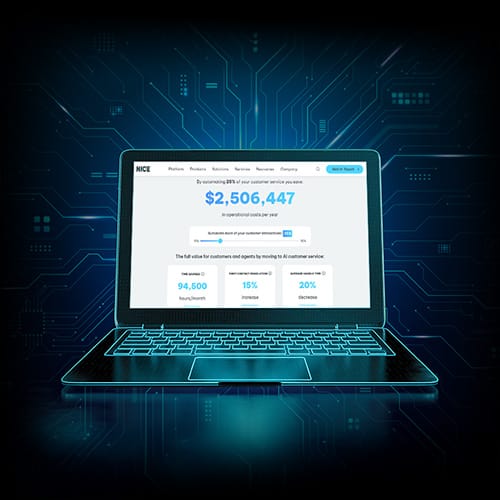
Discover the full value of AI in CX
Understand the benefits and cost savings you can achieve by embracing AI, from automation to augmentation.
Related pages
- AI workflow automation
- AI workflow automation software
- Best AI workflow automation tools
- Intelligent workflow automation
- AI-powered workflow automation
- Workflow automation AI
- AI workflow automation platform
- AI workflow automation examples
- AI workflow automation use cases
- How to automate workflows with AI
- AI workflow orchestration
- Generative AI workflow automation
- AI agents for workflow automation
- AI workflow automation vs RPA
- What is AI workflow automation
- Benefits of AI workflow automation
- Agentic AI workflow automation
- AI workflow automation for contact centers
- Enterprise AI workflow automation
- AI workflow automation for customer service
- AI automated decisioning
- AI workflow automation for sales
- AI workflow automation for CX
- AI workflow automation ROI
- AI workflow automation for operations
- AI workflow automation for support
- AI workflow automation strategy
- AI workflow automation for productivity
- AI workflow automation FAQs
FAQs

Ready to experience the power of one platform?
Let us show you how NiCE can unify, automate and elevate your entire customer experience - with AI at the core and outcomes at the forefront.