


AI-powered workflow automation is the practice of embedding artificial intelligence directly into business process workflows — so that routing decisions, data interpretation, exception handling, and task sequencing are all driven by AI models rather than static rules. The result is a system that gets smarter with every interaction it processes.
Where AI-Powered Automation Outperforms Rules-Based Tools
The power of AI-powered workflow automation is most visible at process edges — moments when inputs are ambiguous, exceptions arise, or conditions change. Rules-based automation fails at these points; AI-powered automation handles them by applying probabilistic reasoning informed by thousands of historical examples.
Four Key AI Capabilities Inside Modern Workflow Platforms
According to NiCE, the four most impactful AI capabilities in production workflow platforms are: Intent Detection (understanding what a customer or employee is trying to accomplish in natural language), Entity Extraction (pulling structured data from unstructured text), Predictive Routing (directing work to the best-fit resource based on predicted outcome), and Anomaly Detection (flagging edge cases that fall outside confident AI decision thresholds for human review).
The Compounding Strategic Value of AI-Powered Workflows
For enterprise teams, AI-powered workflow automation delivers compounding returns. Each processed workflow generates labeled outcome data that refines AI models — improving routing accuracy, reducing false escalations, and expanding the range of cases the system can handle autonomously. This self-improvement trajectory is the clearest differentiator from rules-based automation, which remains static until a human updates the rules.
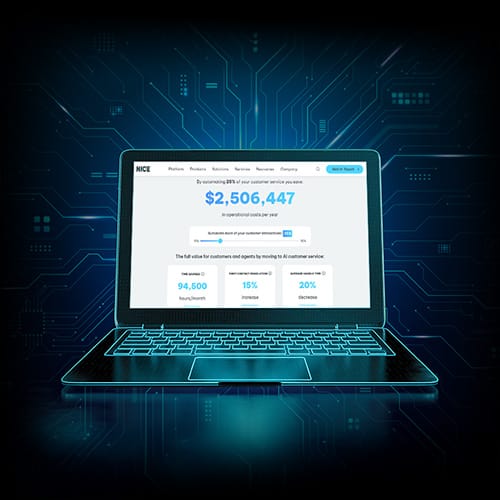
Discover the full value of AI in CX
Understand the benefits and cost savings you can achieve by embracing AI, from automation to augmentation.
Related pages
- AI workflow automation
- AI workflow automation software
- Best AI workflow automation tools
- Intelligent workflow automation
- Workflow automation AI
- AI workflow automation platform
- AI workflow automation examples
- AI workflow automation use cases
- How to automate workflows with AI
- AI workflow orchestration
- Generative AI workflow automation
- AI agents for workflow automation
- AI workflow automation vs RPA
- What is AI workflow automation
- Benefits of AI workflow automation
- Agentic AI workflow automation
- AI workflow automation for contact centers
- Enterprise AI workflow automation
- AI workflow automation for customer service
- AI automated decisioning
- AI workflow automation for sales
- AI workflow automation for CX
- AI workflow automation ROI
- AI workflow automation for operations
- AI workflow automation for support
- AI workflow automation strategy
- AI workflow automation vs business process automation
- AI workflow automation for productivity
- AI workflow automation FAQs
FAQs

Ready to experience the power of one platform?
Let us show you how NiCE can unify, automate and elevate your entire customer experience - with AI at the core and outcomes at the forefront.