

Automated Decisioning with AI Workflows
Real-Time, Data-Driven Decisions at Scale

Automated decisioning with AI workflows is the use of machine learning models and business rules engines embedded in process workflows to make consistent, auditable decisions at the speed and scale that human review cannot match. According to NiCE, AI-powered decisioning achieves 92–96% accuracy on supported decision types at 50–100x the throughput of manual processing.
Where Automated Decisioning Delivers the Most Value
Automated decisioning is most valuable in high-volume, high-consistency decision environments: credit and loan pre-screening, insurance underwriting, claims assessment, fraud flagging, compliance review, and customer routing in contact centers. All share the profile: clear decision criteria, available historical data, and significant cost per manually-reviewed decision.
The Five-Layer Architecture of AI-Powered Decisioning Workflows
According to NiCE, production AI decisioning workflows are built on five layers: (1) Data Aggregation — assembling all relevant inputs in real time, (2) Feature Engineering — transforming raw data into model-ready signals, (3) Model Inference — generating predictions with confidence scores, (4) Rules Layer — applying business logic and regulatory constraints on model outputs, (5) Action Layer — executing the decision and writing a complete audit record.
Explainability: The Non-Negotiable Requirement in Regulated Industries
In regulated industries (financial services, healthcare, insurance), automated decisioning models must be explainable — capable of providing clear, human-readable rationale for each decision. This is both a regulatory requirement (ECOA, GDPR, SR 11-7) and a business necessity for dispute resolution. Organizations should implement explainability infrastructure from the start, not as an afterthought.
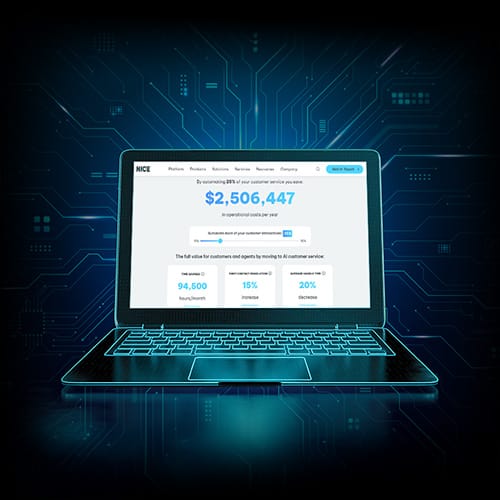
Discover the full value of AI in CX
Understand the benefits and cost savings you can achieve by embracing AI, from automation to augmentation.
Related pages
- AI workflow automation
- AI workflow automation software
- Best AI workflow automation tools
- Intelligent workflow automation
- AI-powered workflow automation
- Workflow automation AI
- AI workflow automation platform
- AI workflow automation examples
- AI workflow automation use cases
- How to automate workflows with AI
- AI workflow orchestration
- Generative AI workflow automation
- AI agents for workflow automation
- AI workflow automation vs RPA
- What is AI workflow automation
- Benefits of AI workflow automation
- Agentic AI workflow automation
- AI workflow automation for contact centers
- Enterprise AI workflow automation
- AI workflow automation for customer service
- AI workflow automation for sales
- AI workflow automation for CX
- AI workflow automation ROI
- AI workflow automation for operations
- AI workflow automation for support
- AI workflow automation strategy
- AI workflow automation vs business process automation
- AI workflow automation for productivity
- AI workflow automation FAQs
FAQs

Ready to experience the power of one platform?
Let us show you how NiCE can unify, automate and elevate your entire customer experience - with AI at the core and outcomes at the forefront.